Rising US Treasury yields and oil prices supported the dollar, pushing the dollar index close to 99.50. Non-farm payroll data will be a key directional variable.
2026-09-01 14:52:03
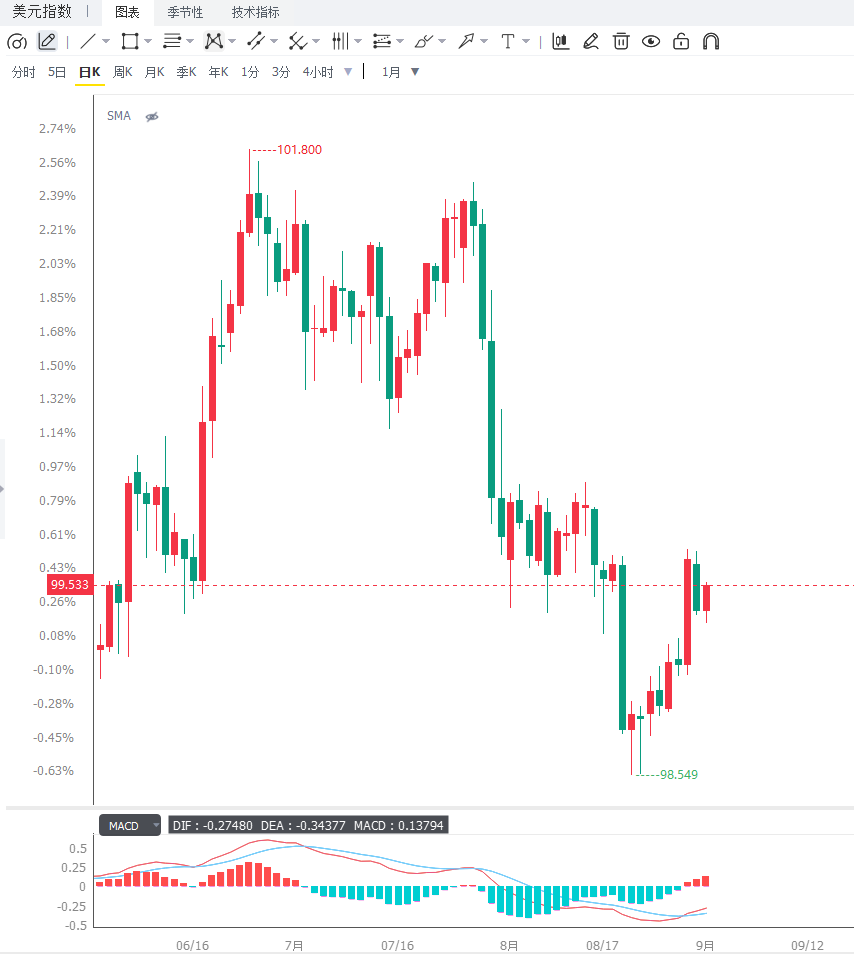
The US dollar remained relatively strong on Tuesday, with the dollar index rising to around 99.50 in early trading. Recent escalation of tensions in the Middle East, continued rises in oil prices, heightened market concerns about energy supply disruptions, and renewed focus on inflation expectations have all contributed to this. Against this backdrop, yields on long-term US Treasury bonds have risen significantly, providing the dollar with a new interest rate advantage.  The yield on the 10-year US Treasury note rose to 4.78%, a new high in about 19 months, just shy of the previous multi-year high of 4.81%; the yield on the 30-year US Treasury note rose to about 5.27%. The rapid rise in long-term yields reflects the market's reassessment of the impact of rising energy prices on future inflation and monetary policy. Oil prices are a key driver of this change. WTI crude oil prices rose to about $86 per barrel on Tuesday, with escalating tensions in the Middle East and increased risks to energy transport through the Strait of Hormuz causing the market to re-induce supply disruption premiums. If high oil prices persist for an extended period, energy costs could be further passed on to transportation, manufacturing, and consumer spending, thus increasing inflationary pressures in the US. The correlation between rising oil prices and rising US Treasury yields is the core logic supporting the current dollar. If the market believes that an energy shock could prolong the inflation decline cycle, it will reduce expectations for rapid easing by the Federal Reserve, thereby increasing the attractiveness of dollar-denominated assets. At the same time, the recent policy signals from the Federal Reserve have also leaned towards caution. Federal Reserve Chairman Kevin Warsh previously emphasized that if underlying inflation does not sufficiently decline, the Fed will still need to continue to take action. The renewed rise in energy prices has further increased the importance of this policy stance, as a renewed divergence in inflation expectations could force the Federal Reserve to adopt a more cautious approach to interest rate cuts. However, the dollar has not yet formed a very strong one-sided upward trend. Although the dollar index has rebounded to around 99.50, the market still needs more economic data to confirm whether the US economy can support higher interest rates. Especially after the significant shift in Fed policy expectations, any weaker-than-expected economic data could quickly erode the dollar's interest rate advantage. This week's US economic data will be a key catalyst for the dollar's short-term movement. Investors will first focus on the August ISM Manufacturing PMI and the July JOLTS job openings data, followed by Friday's non-farm payroll report for August. If manufacturing activity and the job market perform strongly, the case for the Fed to maintain a tight policy will be further strengthened, and the dollar is expected to receive more support. Conversely, if the US job market shows a significant cooling, especially with non-farm payroll growth falling sharply below expectations and the unemployment rate rising, the market may re-increase expectations for future easing policies, US Treasury yields may fall, and the dollar index may come under pressure. From a global market perspective, the US dollar is currently driven by two main factors: rising energy prices leading to renewed inflation expectations, and increased geopolitical risks resulting in safe-haven inflows. Both factors support the dollar, but their duration depends on the situation in the Middle East and whether there are substantial disruptions to energy supplies. For gold, foreign exchange, and global bond markets, changes in US Treasury yields are particularly noteworthy. If the 10-year yield continues to approach or even break through previous highs, the dollar may continue to enjoy an interest rate advantage, while the high real interest rate environment may put pressure on non-yielding assets such as gold. Conversely, if weak US economic data leads to a decline in yields, the dollar's current upward momentum may quickly weaken. The US dollar index maintains a mildly weak structure on the daily chart, currently trading around 99.48, and still slightly below the 20-day EMA of 99.53. This level is a key resistance that bulls need to break through in the short term. If it effectively holds above 99.53, further upside targets could be the 100.00 level and the area around 100.50; if it continues to be pressured, the areas around 99.00 and 98.50 may become important support levels. The RSI is around 46.6, below the 50 level, indicating that market momentum remains weak, but it has not yet entered oversold territory. Looking at the 4-hour chart, the US dollar index is in a crucial confirmation phase after a rebound, with the 99.50 area currently a battleground between bulls and bears. If the price breaks through and stabilizes above 99.53, the short-term rebound is expected to extend further; if it is rejected again and falls below 99.00, the previous weak structure may regain dominance. Currently, the technical picture has not yet formed a strong one-sided signal; economic data will be a crucial catalyst for a breakout direction.
  Editor's Summary: The US dollar is currently supported by multiple factors, including rising US Treasury yields, higher oil prices, and safe-haven demand. However, whether this short-term rebound can translate into a sustained upward trend depends on whether US economic data can validate the sustainability of the high-interest-rate environment. 99.53 is a crucial level for the short-term strength or weakness of the US dollar index. A break and hold above this level could see the dollar further challenge the 100 mark; conversely, continued pressure suggests a potential pullback. In the coming days, the ISM Manufacturing PMI, JOLTS, and August non-farm payroll data will be key variables determining the dollar's direction, while oil prices and US Treasury yields are important market indicators for observing changes in inflation expectations.
The yield on the 10-year US Treasury note rose to 4.78%, a new high in about 19 months, just shy of the previous multi-year high of 4.81%; the yield on the 30-year US Treasury note rose to about 5.27%. The rapid rise in long-term yields reflects the market's reassessment of the impact of rising energy prices on future inflation and monetary policy. Oil prices are a key driver of this change. WTI crude oil prices rose to about $86 per barrel on Tuesday, with escalating tensions in the Middle East and increased risks to energy transport through the Strait of Hormuz causing the market to re-induce supply disruption premiums. If high oil prices persist for an extended period, energy costs could be further passed on to transportation, manufacturing, and consumer spending, thus increasing inflationary pressures in the US. The correlation between rising oil prices and rising US Treasury yields is the core logic supporting the current dollar. If the market believes that an energy shock could prolong the inflation decline cycle, it will reduce expectations for rapid easing by the Federal Reserve, thereby increasing the attractiveness of dollar-denominated assets. At the same time, the recent policy signals from the Federal Reserve have also leaned towards caution. Federal Reserve Chairman Kevin Warsh previously emphasized that if underlying inflation does not sufficiently decline, the Fed will still need to continue to take action. The renewed rise in energy prices has further increased the importance of this policy stance, as a renewed divergence in inflation expectations could force the Federal Reserve to adopt a more cautious approach to interest rate cuts. However, the dollar has not yet formed a very strong one-sided upward trend. Although the dollar index has rebounded to around 99.50, the market still needs more economic data to confirm whether the US economy can support higher interest rates. Especially after the significant shift in Fed policy expectations, any weaker-than-expected economic data could quickly erode the dollar's interest rate advantage. This week's US economic data will be a key catalyst for the dollar's short-term movement. Investors will first focus on the August ISM Manufacturing PMI and the July JOLTS job openings data, followed by Friday's non-farm payroll report for August. If manufacturing activity and the job market perform strongly, the case for the Fed to maintain a tight policy will be further strengthened, and the dollar is expected to receive more support. Conversely, if the US job market shows a significant cooling, especially with non-farm payroll growth falling sharply below expectations and the unemployment rate rising, the market may re-increase expectations for future easing policies, US Treasury yields may fall, and the dollar index may come under pressure. From a global market perspective, the US dollar is currently driven by two main factors: rising energy prices leading to renewed inflation expectations, and increased geopolitical risks resulting in safe-haven inflows. Both factors support the dollar, but their duration depends on the situation in the Middle East and whether there are substantial disruptions to energy supplies. For gold, foreign exchange, and global bond markets, changes in US Treasury yields are particularly noteworthy. If the 10-year yield continues to approach or even break through previous highs, the dollar may continue to enjoy an interest rate advantage, while the high real interest rate environment may put pressure on non-yielding assets such as gold. Conversely, if weak US economic data leads to a decline in yields, the dollar's current upward momentum may quickly weaken. The US dollar index maintains a mildly weak structure on the daily chart, currently trading around 99.48, and still slightly below the 20-day EMA of 99.53. This level is a key resistance that bulls need to break through in the short term. If it effectively holds above 99.53, further upside targets could be the 100.00 level and the area around 100.50; if it continues to be pressured, the areas around 99.00 and 98.50 may become important support levels. The RSI is around 46.6, below the 50 level, indicating that market momentum remains weak, but it has not yet entered oversold territory. Looking at the 4-hour chart, the US dollar index is in a crucial confirmation phase after a rebound, with the 99.50 area currently a battleground between bulls and bears. If the price breaks through and stabilizes above 99.53, the short-term rebound is expected to extend further; if it is rejected again and falls below 99.00, the previous weak structure may regain dominance. Currently, the technical picture has not yet formed a strong one-sided signal; economic data will be a crucial catalyst for a breakout direction. Editor's Summary: The US dollar is currently supported by multiple factors, including rising US Treasury yields, higher oil prices, and safe-haven demand. However, whether this short-term rebound can translate into a sustained upward trend depends on whether US economic data can validate the sustainability of the high-interest-rate environment. 99.53 is a crucial level for the short-term strength or weakness of the US dollar index. A break and hold above this level could see the dollar further challenge the 100 mark; conversely, continued pressure suggests a potential pullback. In the coming days, the ISM Manufacturing PMI, JOLTS, and August non-farm payroll data will be key variables determining the dollar's direction, while oil prices and US Treasury yields are important market indicators for observing changes in inflation expectations.
- Risk Warning and Disclaimer
- The market involves risk, and trading may not be suitable for all investors. This article is for reference only and does not constitute personal investment advice, nor does it take into account certain users’ specific investment objectives, financial situation, or other needs. Any investment decisions made based on this information are at your own risk.