Bank of America: The gold market is experiencing its strongest wave of institutional buying in nearly a year.
2026-09-01 18:00:02
According to data tracked by Bank of America, the gold market is experiencing its strongest wave of institutional investment in nearly a year, with investor inflows reaching their highest level since October 2025. This influx reflects a significant increase in the holdings of defensive assets like gold by institutional investors. Investors are reassessing the direction of Federal Reserve interest rates, the strength of the US dollar, and various potential risks at the global macroeconomic level, moving away from simply chasing high-risk equity assets and instead using gold as a physical tool to hedge against uncertainty. This shift is likely to provide further upward momentum for spot gold prices and gold-linked ETFs.  The latest fund flow statistics show a significant jump in weekly gold buying demand in 2026, with the four-week moving average of fund inflows also rising. The four-week moving average filters out data disturbances caused by sudden large-scale transactions in a single week, eliminating short-term fluctuations and revealing the true medium- to long-term fund trends. It is a core indicator frequently referenced by institutional traders in practice. This is crucial, indicating that the recent strength in the gold market is not solely due to a single large-scale entry in a particular week, but rather a comprehensive market recovery driven by an expanded range of market participants and a continuous influx of funds from multiple sources. ETFs with gold as their underlying asset have seen particularly rapid fund inflows. In August, these products saw a single-week increase of $6.4 billion in holdings, marking the largest weekly increase in approximately 10 months. Gold ETF holdings data is readily observable hard data; every increase or decrease corresponds to real market buying and selling, not just changes in paper valuations, directly reflecting the genuine bullish intentions of large funds. Compared to the market conditions in 2023 and 2024, the magnitude of this round of capital flows is particularly striking. In those two periods, the overall capital game in the gold market was relatively subdued, with neither bulls nor bears making large-scale bets. Starting in the second half of 2025, weekly capital inflows into gold repeatedly exceeded $6 billion; however, this was accompanied by an equivalent amount of capital outflow. This clearly indicates that the current market participants' positions are highly volatile, with capital flowing in and out rapidly, and no one-sided, long-term consensus of bullishness has formed. The backdrop to this new round of buying is investors repeatedly weighing the future evolution of interest rates and the US dollar. Gold itself does not generate interest income. When bond yields decline, the opportunity cost of holding gold decreases, increasing its relative attractiveness. Furthermore, a weaker US dollar reduces the exchange cost for buyers in other countries to purchase gold, further boosting demand for both physical and financial gold. Simply put: the higher the US Treasury yield, the more unprofitable it is to hold gold; the more expensive the US dollar, the more expensive it is to buy gold overseas. These two variables directly constrain the upward ceiling for gold. Bank of America strategist Michael Hartnett remains bullish on gold's investment value, viewing it as a hedge against two major risks: the risk of asset devaluation due to a weakening dollar and the widespread market concern about currency purchasing power dilution. This provides practical guidance for gold investors.
 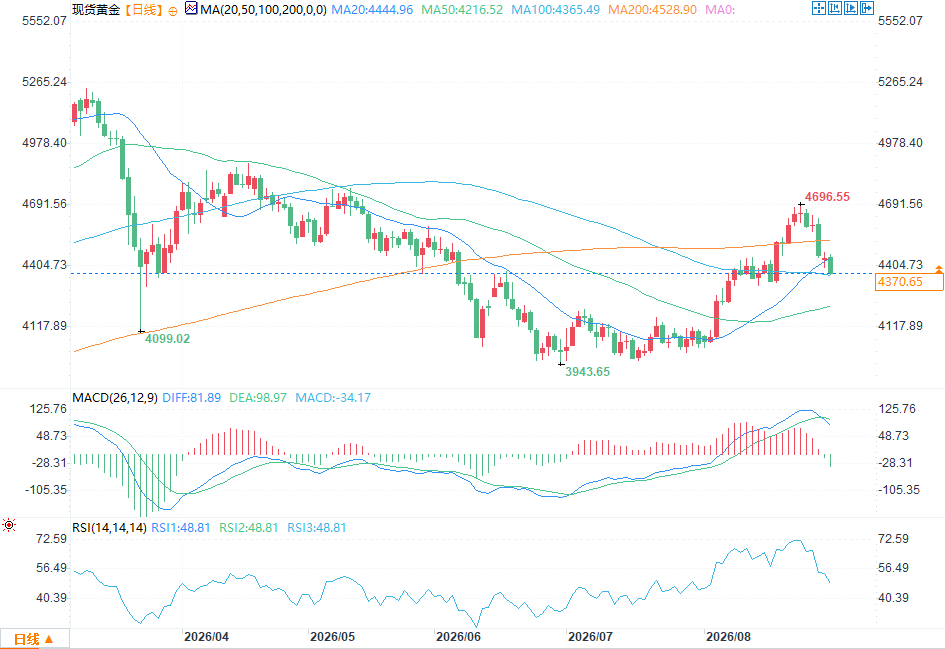 (Spot gold daily chart source: FX678) For investors positioning themselves in gold, the most crucial signal to watch is whether this surge in capital inflows can be sustained in the long term, rather than being a short-lived, fleeting phenomenon. Ordinary investors can focus on four readily trackable indicators: weekly fund flows in gold ETFs, four-week fund flow trends, US Treasury yields, and the US dollar index. If funds continue to flow into gold, while US Treasury yields decline or the dollar weakens, the convergence of these multiple conditions will further solidify the bullish foundation for gold and gold ETFs like SPDR Gold Shares (GLD). However, the potential risks cannot be ignored: the current market's volatility is already very pronounced. If US Treasury yields rebound and strengthen again, the dollar rises again, or gold ETFs suddenly experience large-scale redemptions, the short-term upward momentum will be quickly dissipated, and a rapid correction is likely. However, based on the current four-week average fund flow data, institutional interest in gold has indeed increased, a point that cannot be easily overlooked.
The latest fund flow statistics show a significant jump in weekly gold buying demand in 2026, with the four-week moving average of fund inflows also rising. The four-week moving average filters out data disturbances caused by sudden large-scale transactions in a single week, eliminating short-term fluctuations and revealing the true medium- to long-term fund trends. It is a core indicator frequently referenced by institutional traders in practice. This is crucial, indicating that the recent strength in the gold market is not solely due to a single large-scale entry in a particular week, but rather a comprehensive market recovery driven by an expanded range of market participants and a continuous influx of funds from multiple sources. ETFs with gold as their underlying asset have seen particularly rapid fund inflows. In August, these products saw a single-week increase of $6.4 billion in holdings, marking the largest weekly increase in approximately 10 months. Gold ETF holdings data is readily observable hard data; every increase or decrease corresponds to real market buying and selling, not just changes in paper valuations, directly reflecting the genuine bullish intentions of large funds. Compared to the market conditions in 2023 and 2024, the magnitude of this round of capital flows is particularly striking. In those two periods, the overall capital game in the gold market was relatively subdued, with neither bulls nor bears making large-scale bets. Starting in the second half of 2025, weekly capital inflows into gold repeatedly exceeded $6 billion; however, this was accompanied by an equivalent amount of capital outflow. This clearly indicates that the current market participants' positions are highly volatile, with capital flowing in and out rapidly, and no one-sided, long-term consensus of bullishness has formed. The backdrop to this new round of buying is investors repeatedly weighing the future evolution of interest rates and the US dollar. Gold itself does not generate interest income. When bond yields decline, the opportunity cost of holding gold decreases, increasing its relative attractiveness. Furthermore, a weaker US dollar reduces the exchange cost for buyers in other countries to purchase gold, further boosting demand for both physical and financial gold. Simply put: the higher the US Treasury yield, the more unprofitable it is to hold gold; the more expensive the US dollar, the more expensive it is to buy gold overseas. These two variables directly constrain the upward ceiling for gold. Bank of America strategist Michael Hartnett remains bullish on gold's investment value, viewing it as a hedge against two major risks: the risk of asset devaluation due to a weakening dollar and the widespread market concern about currency purchasing power dilution. This provides practical guidance for gold investors. (Spot gold daily chart source: FX678) For investors positioning themselves in gold, the most crucial signal to watch is whether this surge in capital inflows can be sustained in the long term, rather than being a short-lived, fleeting phenomenon. Ordinary investors can focus on four readily trackable indicators: weekly fund flows in gold ETFs, four-week fund flow trends, US Treasury yields, and the US dollar index. If funds continue to flow into gold, while US Treasury yields decline or the dollar weakens, the convergence of these multiple conditions will further solidify the bullish foundation for gold and gold ETFs like SPDR Gold Shares (GLD). However, the potential risks cannot be ignored: the current market's volatility is already very pronounced. If US Treasury yields rebound and strengthen again, the dollar rises again, or gold ETFs suddenly experience large-scale redemptions, the short-term upward momentum will be quickly dissipated, and a rapid correction is likely. However, based on the current four-week average fund flow data, institutional interest in gold has indeed increased, a point that cannot be easily overlooked.
- Risk Warning and Disclaimer
- The market involves risk, and trading may not be suitable for all investors. This article is for reference only and does not constitute personal investment advice, nor does it take into account certain users’ specific investment objectives, financial situation, or other needs. Any investment decisions made based on this information are at your own risk.