The probability of an interest rate hike has risen to 66.4%, gold prices have overcorrected, and the market is experiencing a cash shortage.
2026-09-01 17:54:03
Gold prices continued to decline during the Asian and European sessions on Tuesday (September 1), currently down more than 1.7% and trading around 4373. The Federal Reserve's hawkish signals have raised expectations of tighter liquidity. Gold is a non-interest-bearing asset, and the reduction of US Treasury holdings by overseas investors has pushed up the central interest rate. These two forces combined have increased the opportunity cost of holding gold, raising the risk of a price correction, and putting pressure on gold ETFs as well. 
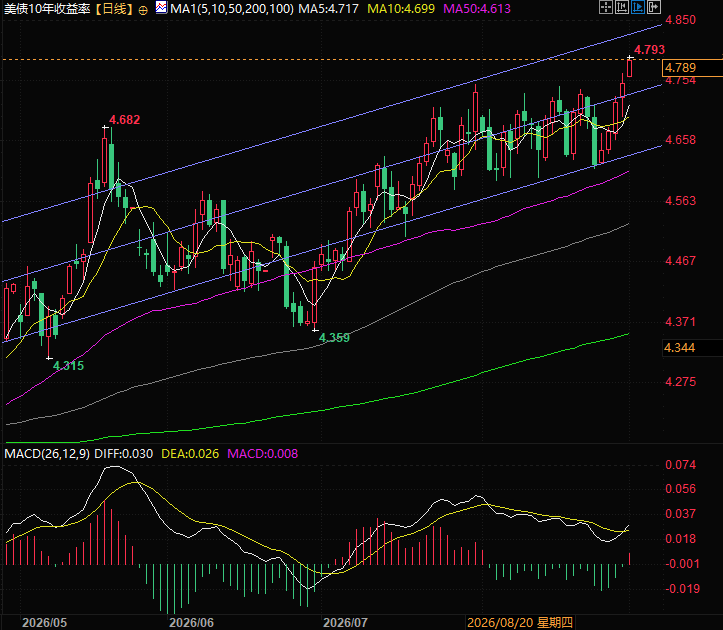 (Daily chart of the US 10-year Treasury yield, source: EasyTrade)
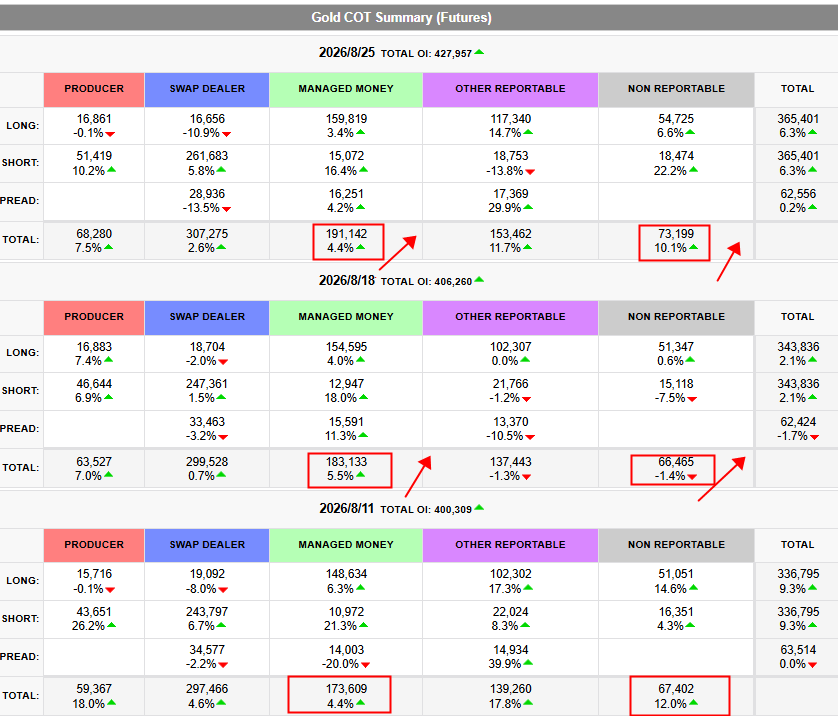 (CFTC Gold Positions Table, Source: CME Group)
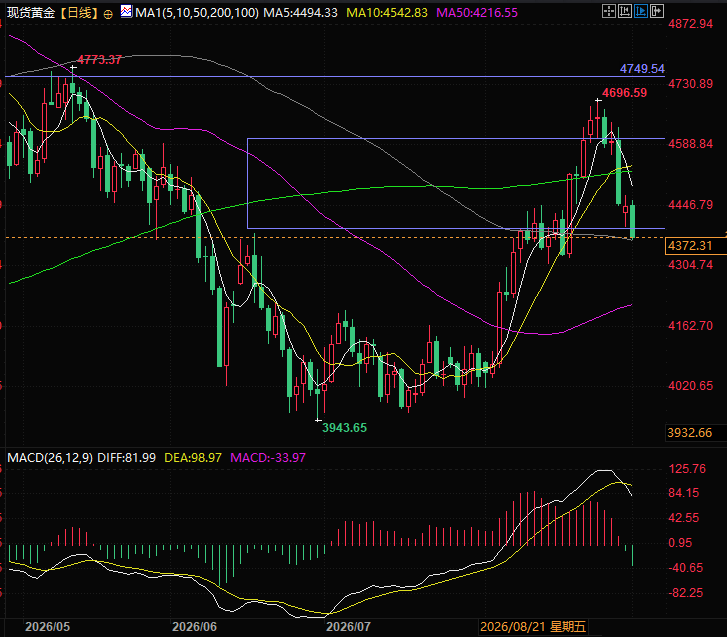 (Spot gold daily chart, source: EasyTrade) At 17:51 Beijing time, spot gold is currently trading at $4369 per ounce.
Jackson Hole signals hawkish sentiment: expectations of monetary policy tightening weigh on gold prices.
Federal Reserve Chairman Kevin Warsh's hawkish speech at the Jackson Hole symposium became the direct trigger for recent downward pressure on gold prices. Warsh stated that US inflation has not shown a credible decline, with PCE and CPI inflation levels still above the 2% policy target. He argued that current financial conditions are insufficient to combat high inflation, and the Fed does not rule out further interest rate hikes. He emphasized that policy will prioritize price stability over economic growth. This statement significantly boosted market expectations for further rate hikes in September and December. Stronger rate hike expectations benefit the US dollar. Since gold itself does not generate interest income, as yields on US Treasury bonds rise, gold's relative attractiveness decreases. The expectation of tighter monetary policy liquidity directly exerts downward pressure on gold prices. Following the meeting and subsequent weekend discussions, the expectation of a rate hike this month reached 60%, and has now jumped to 66.4%. Yesterday's article discussed whether the rate hike will continue, mainly depending on CPI and non-farm payroll data. However, with the interest rate decision approaching, interest rate futures are becoming increasingly accurate. Currently, the probability of a rate hike is as high as 66%. At the same time, the 2-year Treasury yield, as a leading indicator of short-term interest rate changes, also rose by 17 basis points today, implying a 25bp rate hike.Dramatic Changes in US Treasury Investor Structure: Outflow of Overseas Funds Pushes Up Interest Rates
Besides the Federal Reserve's policies, structural changes in the US Treasury market are resonating with expectations of interest rate hikes, further raising overall market interest rates. The proportion of US tradable Treasury bonds held by overseas investors has fallen to 40%, lower than the peak of 50% before the 2008 crisis. Previously, the main buyers of US Treasury bonds were central banks such as China and Japan; now, the holdings of overseas private investors are nearly twice that of official creditors. Private capital is more sensitive to macroeconomic shocks and risk sentiment, amplifying fluctuations in US Treasury bond prices and yields. Over the past 12 months, China has continued to reduce its US Treasury bond reserves by 13%, while Japan's holdings have remained largely unchanged; European financial centers such as the UK, Belgium, Luxembourg, and Ireland have seen net increases in holdings, primarily from global private investors. With the US fiscal deficit reaching 6% of GDP, coupled with foreign policy factors, many institutions believe their dollar asset allocation is already too high and have begun to proactively reduce their US Treasury bond exposure. Overseas funds are not experiencing a panic sell-off, but rather a slow outflow of positions. However, the weakening of overseas buying will push up the term premium of US Treasury bonds, raising the overall interest rate level. Even if the Federal Reserve doesn't raise interest rates, rising US Treasury yields will still increase the opportunity cost of non-interest-bearing gold, putting downward pressure on gold prices. There are also hedging factors in the market: the liquidity of bonds from other developed economies is difficult to replace US Treasuries, and global long-term debt-laden institutions still heavily rely on US Treasuries as a duration allocation tool; the US Treasury's bond repurchase operations are also expected to alleviate upward pressure on long-term yields, but in the short term, it will be difficult to completely offset the upward pressure on interest rates caused by private investors reducing their holdings. (Daily chart of the US 10-year Treasury yield, source: EasyTrade)Trading volume increased significantly, and gold prices entered a wide range of fluctuations.
Bart Melek, head of commodities research at TD Securities, predicts that gold may fall back to the $4,200-$4,700 range by the end of this year. A research institution analyzed the ETF holdings of 13 investment institutions, finding that 5 increased their holdings and 8 decreased them over the past three months, indicating a cautious and divergent attitude among professional investors towards the future of gold. Meanwhile, the COT's gold holdings report shows a continuous increase in both institutional and retail gold holdings recently, with both long and short positions at recent highs. This suggests that after a significant price increase, divergence has widened, making it prone to amplifying both upward and downward movements. (CFTC Gold Positions Table, Source: CME Group)Logical summary: Short-term interest rate suppression prevails; the dollar's credit narrative gives way to real opportunity costs.
The Federal Reserve's hawkish stance has fueled expectations of tighter monetary policy liquidity; shrinking overseas purchases of US Treasuries have pushed up the central interest rate, resulting in a significant increase in real interest rates. Both factors have raised the opportunity cost of holding non-interest-bearing gold. However, excessively high interest rates will hinder global government operations and normal economic activity, so interest rates will not rise indefinitely. A short-term surge in interest rates may actually help gold quickly reach a temporary bottom. In the long term, the continued reduction of overseas holdings of US Treasuries has a positive logic for gold due to the weakening of the dollar's credibility. However, the continued shortage of funds in the market due to AI capital expenditures will also lead to a tight liquidity environment, which is bearish for gold prices. Technically, spot gold has recently undergone a significant correction, breaking the bottom of its trading range. This correction is likely an overreaction in the short term, and the latest price center should be around 4428. Currently, attention should be paid to the area around 4428, which is a key level for bulls and bears in the near term. (Spot gold daily chart, source: EasyTrade) At 17:51 Beijing time, spot gold is currently trading at $4369 per ounce.
- Risk Warning and Disclaimer
- The market involves risk, and trading may not be suitable for all investors. This article is for reference only and does not constitute personal investment advice, nor does it take into account certain users’ specific investment objectives, financial situation, or other needs. Any investment decisions made based on this information are at your own risk.