A series of hawkish comments from the Federal Reserve have reopened the window for a September rate hike.
2026-09-01 21:57:04
In September 2026, the Federal Reserve's monetary policy stance underwent a significant shift, with Chairman Warsh and Governor Barr successively signaling a hawkish stance against inflation, completely reversing previous market expectations of easing. Against the backdrop of persistently high inflation in the US for five years and a resilient economic fundamentals, the probability of a rate hike at the Fed's September meeting increased dramatically, ushering in a new round of interest rate repricing in global financial markets and further raising the uncertainty surrounding the future path of monetary policy and interest rate trends. 
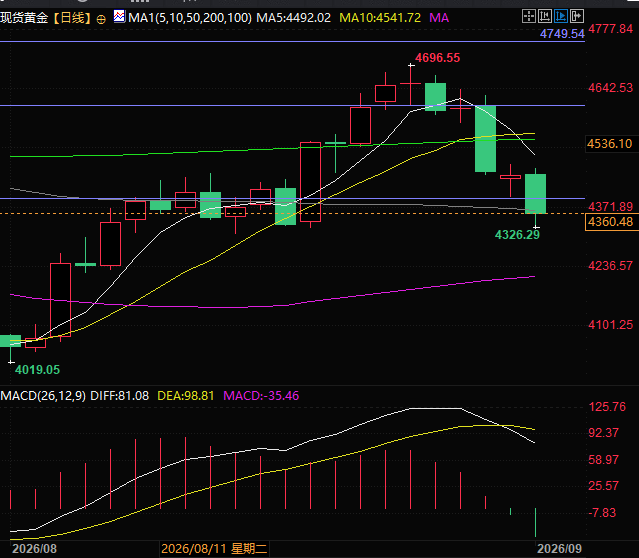 (Spot gold daily chart, source: EasyTrade) At 21:53 Beijing time, spot gold is currently trading at $4362 per ounce.
Jackson Hole sets the tone: Warsh releases a tough stance against inflation.
The core trigger for this reversal in policy expectations was Federal Reserve Chairman Warsh's keynote speech at the Jackson Hole Economic Symposium. Unlike his relatively dovish remarks in July, Warsh adopted a clearly hawkish stance, emphasizing that underlying inflation in the US had not shown substantial or sustained improvement. He explicitly stated that the Fed must be 100% certain that inflation is falling towards its 2% policy target at a clear and sufficient pace; unless this condition is met, the Fed will need to continue tightening monetary policy to complete its anti-inflation task. This statement directly shattered market uncertainty and completely reshaped short-term interest rate expectations.The decision-making body is united in its stance: Barr clarifies the triggering conditions for interest rate hikes.
Following the Chairman's statement, the core decision-making body of the Federal Reserve reached a unified stance. Fed Governor Barr reiterated the tightening tone, stating bluntly that US inflation has been persistently high for five years, continuously eroding economic stability and monetary credibility. He outlined a clear policy implementation logic: if subsequent inflation data fails to sufficiently cool down and the decline is less pronounced than expected, the Fed will decisively raise interest rates; conversely, if data confirms that inflation is steadily converging towards the 2% target, the central bank can postpone operations and prudently assess the policy's effectiveness. At the same time, Barr affirmed the resilience of the current US economy, noting that continued investment in the artificial intelligence industry is supporting economic growth, the job market remains stable, and the unemployment rate is low. He concluded that the economic fundamentals are fully capable of withstanding monetary tightening policies, providing ample confidence for the Fed to raise interest rates.Significant Market Repricing: Probability of a September Rate Hike Soars
Hawkish comments from two key officials have rapidly fueled market expectations for an interest rate hike. According to data from the CME FedWatch Tool, the probability of a 25 basis point rate hike at the Fed's September 15-16 meeting has surged to 66.1%, nearly doubling since before the Jackson Hole meeting. The current benchmark interest rate range of 3.50%-3.75% is highly likely to be adjusted upwards. Several major investment banks have followed suit with their predictions. Bank of America explicitly stated that Warsh's remarks significantly raised the bar for the Fed to maintain current interest rates, focusing on inflation trends rather than short-term data. This means that unless inflation declines more than expected, a September rate hike is a foregone conclusion. A delay in the rate hike would actually weaken the Fed's policy credibility.The battle between bulls and bears continues: disagreements exist between the market and policymakers.
It is worth noting that the current market and institutional disagreements regarding interest rate hikes have not been completely resolved, and policy maneuvering continues. Opposition to a hasty rate hike mainly comes from two sides: First, US Treasury Secretary Bessant publicly stated that this round of inflation is largely due to supply shocks, and without the transmission effects of secondary and tertiary inflation, blindly raising interest rates is unnecessary. Furthermore, core inflation is already showing signs of convergence, and excessive tightening is unnecessary. Second, analysts from institutions such as Citigroup and JPMorgan Chase pointed out that recent economic data have released cooling signals, with non-farm payroll data continuously weakening, inflation slowing marginally, and economic growth momentum declining. There is no fundamental support for an emergency rate hike, and the July FOMC meeting did not reach a consensus on raising interest rates. The wait-and-see approach is likely to continue in September, and the possibility of continued rate hikes this year is low.Key Data Window: Multiple Core Indicators Determine Policy Direction
The Federal Reserve has entered a quiet preview period leading up to its September policy meeting, and a series of key economic data will directly determine the final policy outcome. This week will see the release of non-farm payroll data, and before the meeting, key indicators such as core CPI, PCE inflation, retail sales, and the housing market will also be released. Among these, the core PCE data is particularly crucial. Currently, the overall US PCE inflation rate remains at 3.7%, and the core PCE is at 3.3%. Although this has declined slightly from the previous period, it is still significantly higher than the 2% policy target, indicating that inflation remains stubbornly sticky. The strength of the job market and marginal changes in inflation will be the core factors influencing the Fed officials' final vote.Summary: With Federal Reserve officials making consecutive hawkish statements, the worst of the gold price downturn has passed.
Overall, the Federal Reserve's core policy focus has now completely shifted back to combating inflation, with official statements, market pricing, and policy direction all leaning towards tightening. The risk of short-term interest rates rising is significant, and the normalization of high interest rates will become a core characteristic of US monetary policy for some time to come. The recent sharp correction in gold prices reflects this ongoing shift in pricing. (Spot gold daily chart, source: EasyTrade) At 21:53 Beijing time, spot gold is currently trading at $4362 per ounce.
- Risk Warning and Disclaimer
- The market involves risk, and trading may not be suitable for all investors. This article is for reference only and does not constitute personal investment advice, nor does it take into account certain users’ specific investment objectives, financial situation, or other needs. Any investment decisions made based on this information are at your own risk.