A technical glitch and a 40% staff loss at the U.S. Energy Information Administration have left Brent crude futures facing an "information vacuum" around $95.
2026-09-02 08:46:03
On Wednesday (September 2nd) during Asian trading hours, Brent crude futures continued their overnight gains, rising nearly 5% after yesterday's surge and reaching a five-week high of $96.25 per barrel, currently trading around $96.00 per barrel. While oil prices are hovering above $95, US crude oil production data unexpectedly went silent. The US Energy Information Administration (EIA) delayed the release of its June "Monthly Petroleum Supply Report" due to a technical glitch. This report, a key monthly data source for measuring US crude oil production, was originally scheduled for release on August 31st, but is now expected to be released in September, with the specific date undetermined. This delay comes at a time when US strategic petroleum reserves are at a 44-year low and the ongoing US-Iran conflict continues to disrupt shipping in the Strait of Hormuz, increasing market uncertainty regarding supply-side assessments. The EIA has lost approximately 30%-40% of its staff since Trump's second term. While a direct link between the staff reduction and system problems has not been confirmed, the decline in the agency's capabilities warrants attention. Weekly petroleum condition reports continue to be released on time, but the absence of a monthly report increases uncertainty in production estimates. 
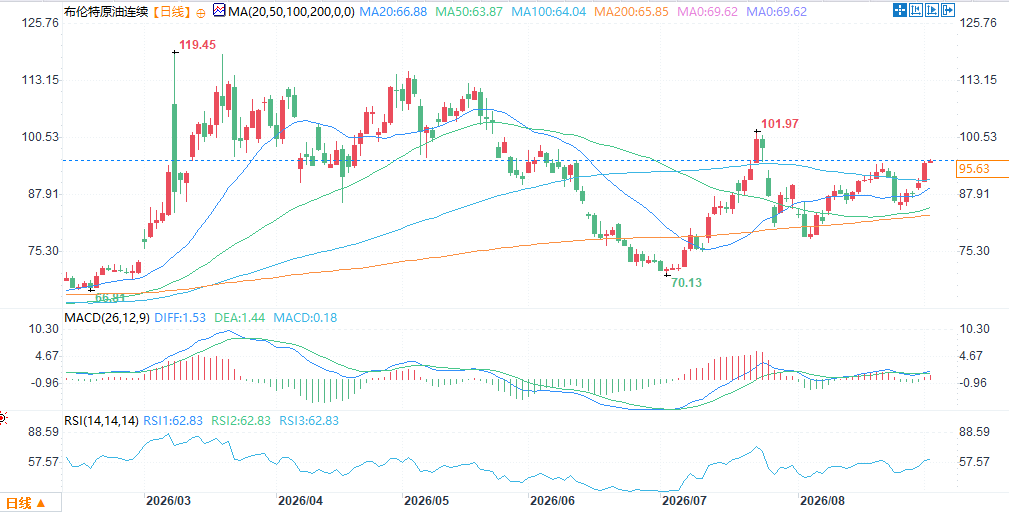 (Brent crude oil futures daily chart, source: EasyTrade) At 8:44 Beijing time, Brent crude oil futures were trading at $96.03 per barrel.
EIA technical glitch delays key oil data release, market faces supply uncertainty.
The EIA has postponed the release of its June Petroleum Supply Monthly report due to a technical glitch. This report is the most authoritative and detailed monthly source of data on U.S. crude oil production, imports, exports, and inventories, and can be broken down by state and region. Originally scheduled for release on August 31, the report has been postponed to September, with the specific date yet to be determined. This delay coincides with the U.S. Strategic Petroleum Reserve (SPR) being at its lowest level in 44 years, and the ongoing U.S.-Iran conflict disrupting shipping in the Strait of Hormuz, already putting the global oil supply chain under considerable strain. The absence of the monthly report directly increases the difficulty for the market to assess the actual U.S. supply side, making it difficult for traders and analysts to accurately determine whether domestic production has been indirectly affected by the conflict, the true changes in inventories, and changes in import and export flows. Although the weekly Situation in Petroleum Report is still released on time, providing a rough signal of short-term inventories and production, the lack of depth and precision of the monthly report leads to wider errors in production estimates and increased price volatility risk. In the short term, the market will rely more heavily on futures curves, freight data, and geopolitical developments to assess supply and demand balance, significantly increasing supply uncertainty.EIA staff turnover exacerbates concerns about data delays.
Since Trump's second term, the EIA has lost approximately 30%-40% of its staff, primarily through voluntary buyouts, layoffs of probationary employees, mandatory return-to-work requirements, and a government-wide hiring freeze. While the official response has not confirmed a direct causal link between the staff reduction and the recent system malfunction, the decline in the agency's overall operational capabilities has drawn widespread market attention. Analysts point out that staff shortages in key positions could affect the stability of data collection, verification, and release processes, increasing the risk of future report delays or quality fluctuations. During the absence of official monthly reports, the market will rely more heavily on private sector inventory surveys, satellite tracking data, and weekly reports as alternative references. Current private sector surveys have shown a larger-than-expected decline in crude oil inventories, providing some directional clues for trading, but they cannot completely replace the authority and comprehensiveness of official EIA data. Overall, the combination of staff losses and technical glitches further amplifies the information vacuum on the supply side, exacerbating short-term uncertainty and price sensitivity in the oil market.Oil prices: Data delays increase supply uncertainty, geopolitical premiums remain high
The EIA's delayed release of its June monthly oil supply report comes at a time when the market is highly sensitive to supply-side information, and its impact on Brent crude futures prices is primarily reflected in the "uncertainty premium." Currently, Brent crude is trading at a high of $95 per barrel, with geopolitical risks already providing significant price support—the ongoing US-Iran conflict continues to disrupt shipping in the Strait of Hormuz, and the US Strategic Petroleum Reserve is at a 44-year low. Against this backdrop, the lack of monthly production data prevents the market from accurately assessing the true state of US crude oil supply, increasing uncertainty surrounding the supply-demand balance sheet. Private sector inventory surveys showed a larger-than-expected decline in crude oil inventories, providing some upward support for prices. However, the delay in the monthly report means that traders and policymakers will lack the most detailed US crude oil production, import, and export data for several weeks, especially detailed information broken down by state and region. Given the already tight supply situation, any additional uncertainty could be amplified by the market. More importantly, the EIA has lost approximately 30%-40% of its staff since Trump's second term, and this decline in the agency's capabilities could affect the timeliness and reliability of future data. If data delays become the norm, the market will rely more heavily on private surveys and real-time data, potentially exacerbating volatility in Brent crude oil prices. In the short term, the combined effects of geopolitical risk and data uncertainty premiums suggest that Brent crude futures are likely to remain high around $95. Traders should pay close attention to Friday's non-farm payroll data and when the EIA will release its delayed report to assess the actual supply situation.Summarize
The EIA delayed the release of its key monthly oil data due to a technical glitch, at a time when the SPR (Spray Price Index) is at a 44-year low and the US-Iran conflict is disrupting shipping around the Strait of Hormuz. A 30-40% staff loss at the EIA exacerbates concerns about the agency's capabilities. Weekly data releases continue, but the absence of a monthly report increases supply-side uncertainty. Brent crude futures are likely to remain high in the short term, with the market relying more on private data until the official report is released. (Brent crude oil futures daily chart, source: EasyTrade) At 8:44 Beijing time, Brent crude oil futures were trading at $96.03 per barrel.
- Risk Warning and Disclaimer
- The market involves risk, and trading may not be suitable for all investors. This article is for reference only and does not constitute personal investment advice, nor does it take into account certain users’ specific investment objectives, financial situation, or other needs. Any investment decisions made based on this information are at your own risk.