













The US military escorted 18 million barrels of crude oil across the Strait of Hormuz in a single day! How long can Brent crude oil hold at $95?
2026-09-03 12:30:03
On Thursday (September 3), Brent crude oil futures fluctuated near a more than one-month high in Asian trading, currently trading around $95.20 per barrel. Overnight, oil prices touched $96.97 per barrel, a new high since July 27. While oil prices remain high, data from the Strait of Hormuz points to an improvement on the supply side – the daily escort volume by the US military is approaching pre-war levels. According to media reports citing US officials, the US military conducted a large-scale escort mission in the Strait of Hormuz on Tuesday (September 1), safely escorting approximately 40 merchant ships and about 18 million barrels of crude oil through, setting a new wartime record for daily escort volume. In comparison, the daily average crude oil transport volume through the strait before the war was about 20 million barrels, and Tuesday's escort volume has essentially returned to pre-conflict levels. However, despite the effectiveness of this military escort, the shipping industry generally remains skeptical about the US's ability to sustain such large-scale escort operations in the long term, and energy companies remain cautious about passing through the strait under military protection. The divergence between improved official traffic data and risk aversion in the private sector means that geopolitical risk premiums will not disappear with a single action, but the scale of Tuesday's escort does indicate that the U.S. military is helping to restore near-normal traffic capacity, which puts some downward pressure on the geopolitical risk premiums implied in current oil prices. 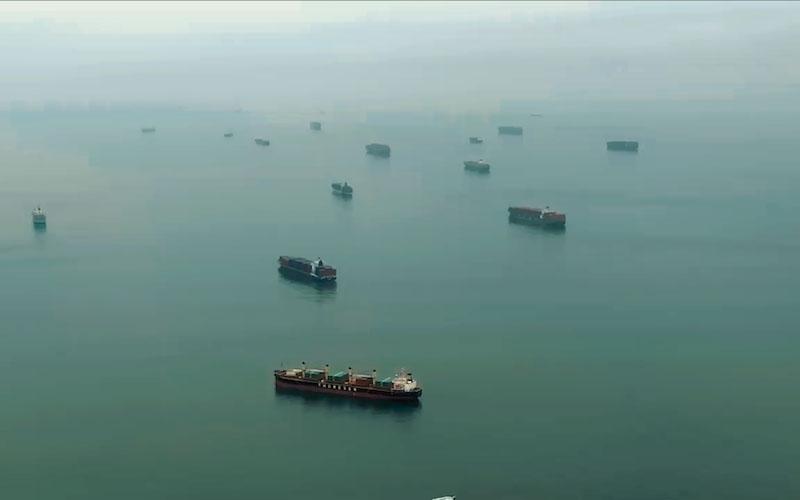
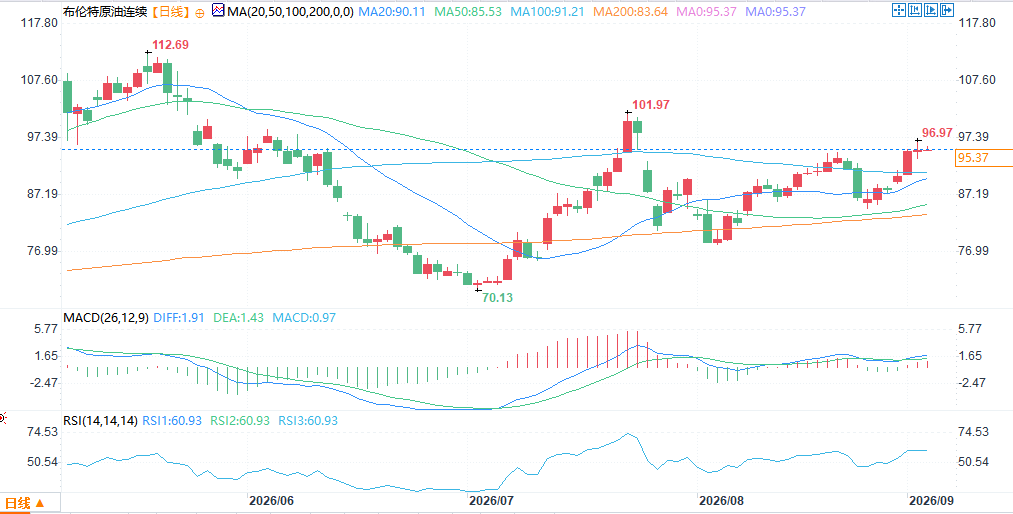 (Brent crude oil futures daily chart, source: EasyTrade) At 12:28 Beijing time, Brent crude oil futures were trading at $95.21 per barrel.
The U.S. military escorted 18 million barrels of crude oil across the Taiwan Strait, approaching pre-war levels.
According to media reports, the U.S. military successfully escorted approximately 40 merchant ships, carrying a total of about 18 million barrels of crude oil, through the Strait of Hormuz on Tuesday, setting a new wartime record. Before the war, the strait's daily crude oil flow averaged about 20 million barrels; Tuesday's escort volume approached that level, indicating a significant recovery in passage capacity. The U.S. military utilized multiple land, sea, and air assets in the operation, intercepting an anti-ship cruise missile and repelling multiple waves of Iranian drone attacks to ensure the safe passage of the convoy. U.S. Treasury Secretary Bessant previously revealed that Monday's flow exceeded 17 million barrels per day, also breaking wartime records. Officials pointed out that the strait is gradually becoming a "devalued asset" for Iran—as flow continues to recover, the strategic threat of Iran blocking the waterway is being substantially weakened. This large-scale escort operation demonstrates that the U.S. military is actively promoting a return to normal levels of strait traffic, directly suppressing geopolitical risk premiums in the oil market.The gap between official data and private sector risk appetite
Despite the significant success of the US escort operation, shipping companies and energy companies generally remain skeptical about the long-term sustainability of the escort system, and most businesses are still unwilling to risk transiting the Strait under military protection. The significant gap between officially released traffic data and the actual risk appetite of the private sector means that the geopolitical premium is unlikely to completely subside in the short term. US officials anticipate that the conflict will not be resolved quickly, so the pattern of partially restored passage under direct military escort may continue for some time. Tuesday's escort volume was close to pre-war levels, indicating that the US military is helping to restore near-normal traffic volumes, which is bearish for the geopolitical risk premium in current oil prices.Brent crude: Escort volumes near pre-war levels, geopolitical premiums face test
Before the conflict, the daily traffic volume in the Strait of Hormuz was approximately 20 million barrels. Tuesday's escort volume approached this level, indicating that the US military is helping to restore near-normal traffic flow through direct military escorts. This fact contrasts sharply with the market's previous narrative of "Hormuz near closure," forcing traders to reassess the reasonable level of geopolitical risk premiums. Brent crude is currently trading around $95 per barrel, a significant portion of which can be attributed to the risk of Hormuz disruption. If the escort model remains effective, oil prices may fall back towards $90-92 per barrel. However, the downside for oil prices is constrained by several factors. First, shipping companies generally doubt the US military's ability to sustain the escort system, and the hesitation of the private sector means that actual traffic volume may still be lower than official figures. Second, Iran still retains the ability to create uncertainty by further attacking merchant ships, even if it cannot completely close the strait. Third, the US military escort itself implies that the conflict is ongoing, not a peaceful resolution. Therefore, the geopolitical premium for Brent crude will not disappear entirely due to a single day's escort data, but rather will be repriced from a "complete disruption" scenario to a "high-risk passage" scenario. Brent crude oil is facing accumulating geopolitical premium correction pressure in the short term, with prices more likely to gradually return to the $93-95 range. However, this process faces significant uncertainties—the sustainability of the escort measures, potential Iranian retaliatory actions, and the impact of Friday's US non-farm payroll data on the dollar and risk sentiment could all disrupt the price path in different directions. Overall, the market is shifting from pricing in a "complete disruption" scenario to pricing in a "high-risk passage" scenario, with a downward bias, but the pace and magnitude remain highly dependent on the evolution of the aforementioned variables. (Brent crude oil futures daily chart, source: EasyTrade) At 12:28 Beijing time, Brent crude oil futures were trading at $95.21 per barrel.
- Risk Warning and Disclaimer
- The market involves risk, and trading may not be suitable for all investors. This article is for reference only and does not constitute personal investment advice, nor does it take into account certain users’ specific investment objectives, financial situation, or other needs. Any investment decisions made based on this information are at your own risk.

