Schroders left in May and returned in August; even high interest rates couldn't stop this round of structural price movements in gold.
2026-09-03 11:28:05
After taking profits and adopting a wait-and-see approach in May, analysts at Schroders announced an upward revision of their view on gold at the end of August, rebuilding their positions in the precious metal. The London-based asset management firm stated that despite high real yields and recent gold price increases, medium-term opportunities are becoming increasingly attractive.
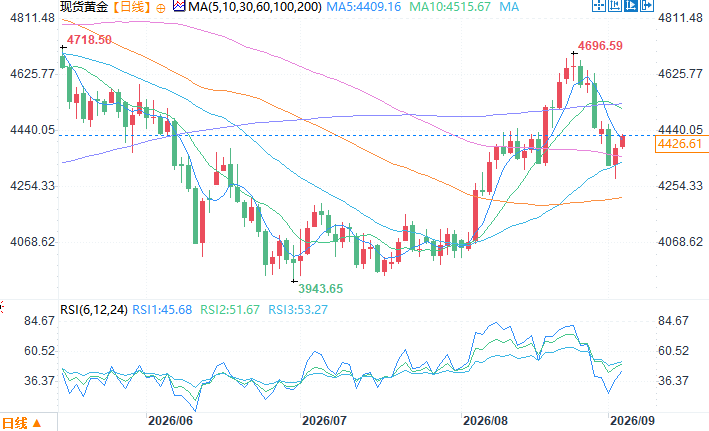 Spot gold daily chart source: FX678. At 11:27 AM Beijing time on September 3, spot gold was trading at $4427.21 per ounce.
From Exit to Return: Three Factors Driving the Turnaround
In its latest multi-asset outlook, Schroders upgraded gold to positive, highlighting a combination of factors: strong structural demand, improved speculative positioning, and ongoing concerns surrounding inflation, sovereign debt, and currency stability. The asset management firm stated, "High real yields, recovering institutional demand, and cleaner positioning by fast-money investors are prompting us to re-engage in gold trading. Despite recent price gains, we believe this position could offer an attractive medium-term risk-reward opportunity." Schroders' bullish stance on gold comes as prices regain momentum due to heightened market concerns about unsustainable US debt growth and a renewed push for a weaker dollar. Gold prices have retreated significantly from recent highs after Federal Reserve Chairman Kevin Warsh reiterated his focus on price stability and commitment to bringing inflation down to the central bank's 2% target. Nevertheless, gold prices remain well above their July lows.Why enter the market against the trend when there are headwinds?
Schroders' bullish stance on gold is noteworthy because its analysts maintain a constructive view on the global economy and risk assets overall. The firm continues to favor equities and maintains a pro-cyclical investment posture. Meanwhile, Schroders states that higher real yields have improved the valuation of US Treasuries. Traditionally, rising real yields increase the opportunity cost of gold, as the precious metal offers no returns. However, Schroders' decision to re-enter the market suggests that other fundamental factors are strong enough to offset this traditional headwind. The firm specifically cites the recovery in institutional demand and cleaner positions held by speculators as catalysts for its renewed interest in precious metals. Analysts also note that precious metals are "supported by strong structural demand from central banks and major Asian powers, while concerns about inflation, sovereign debt, and currency stability persist." Schroders states that it remains wary of the risks to monetary policy independence in an environment of large fiscal deficits but continues to believe that central banks will maintain an appropriate policy path. The asset management firm also expects the resilience of the US economy to allow the Federal Reserve to maintain a tightening stance. Schroders points out that the market has only priced in a small amount of additional tightening, and if its constructive economic scenario unfolds, it will leave room for further rate hikes. At the same time, the company has also re-established long positions in the US dollar against low-yielding currencies such as the Japanese yen and the Swiss franc.Why is Schroder still bullish?
This combination traditionally presents a challenging environment for gold: high real yields, a prospect of rising US interest rates, and a strong dollar. However, Schroders has increased its exposure to precious metals. This divergence suggests the firm believes gold's structural investment logic is increasingly independent of traditional short-term macroeconomic relationships. Central bank demand has been one of the most important pillars supporting gold in recent years, as reserve managers have diversified their holdings. Schroders also emphasizes that demand from major Asian countries is another source of structural support. Meanwhile, concerns surrounding sovereign debt and currency stability continue to reinforce gold's role as a monetary asset and a portfolio diversification tool. These risks could become increasingly significant if large fiscal deficits ultimately undermine investor confidence in government debt or the independence of monetary policy. Schroders' bullish outlook on gold aligns with its broader positive outlook on commodities. In addition to gold, the asset management firm maintains a constructive view on energy and industrial metals and carries exposure to natural resources through global mining companies and energy producers. While Schroders remains optimistic about global growth, it also identifies accelerating inflation and a significant deterioration in economic activity as two major risks to its outlook, both of which could ultimately enhance gold's diversification appeal.Conclusion
Schroder's choice is quite significant: while increasing its holdings of the US dollar, favoring US Treasuries and stocks, it has simultaneously become enthusiastic about gold again. This apparent contradiction points to a deeper judgment: the structural investment logic for gold no longer relies on declining interest rates or lower real yields. Amidst the triple headwinds of high real yields, a strong dollar, and high interest rate expectations, concerns about central bank demand and debt and currency stability from major Asian countries are creating a new track for gold independent of short-term macroeconomic fluctuations. For investors, Schroder's message may be: the reasons for holding gold have changed. Spot gold daily chart source: FX678. At 11:27 AM Beijing time on September 3, spot gold was trading at $4427.21 per ounce.
- Risk Warning and Disclaimer
- The market involves risk, and trading may not be suitable for all investors. This article is for reference only and does not constitute personal investment advice, nor does it take into account certain users’ specific investment objectives, financial situation, or other needs. Any investment decisions made based on this information are at your own risk.