The Reserve Bank of New Zealand raised interest rates by 25 basis points, but its dovish tone caused the New Zealand dollar to plunge by more than 0.5% at one point.
2026-09-02 11:26:05
On Wednesday (September 2nd) during Asian trading hours, the New Zealand dollar fell more than 0.5% against the US dollar to 0.5843. The Reserve Bank of New Zealand (RBNZ) raised interest rates by 25 basis points to 2.75% as expected, but the statement was dovish – stating that "gradual removal of monetary stimulus is appropriate" and "reducing the risk of needing larger rate hikes in the future" – which the market interpreted as a possible slowdown in the pace of subsequent rate hikes. The market had already priced in the rate hike before the decision was announced, but the dovish wording disappointed New Zealand dollar bulls, triggering a large-scale sell-off. The RBNZ Monetary Policy Committee unanimously agreed to raise interest rates by 25 basis points to 2.75%. Inflation rose to 4.1% in the second quarter (driven by fuel prices pushed up by the Middle East conflict) and is expected to fall back to the 1%-3% target range by mid-2027, reaching the midpoint of the 2% target by the end of 2027. The economic recovery has resumed but is uneven across industries and regions, with a strong external sector and weak domestic consumption. The Committee believes that a gradual removal of monetary stimulus is appropriate to bring inflation back to the target while supporting growth and employment. Future policy decisions will depend on the medium-term inflation risk assessment. Four members believe the risks to inflation are skewed to the upside, while two believe the risks are balanced. Following the interest rate decision, the market will focus on the press conference held by Reserve Bank of New Zealand Governor Brehman. 
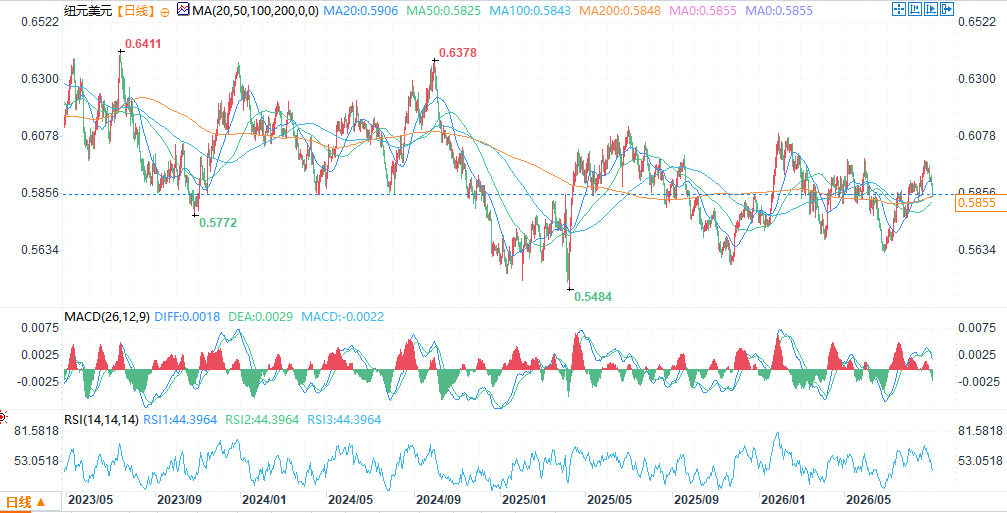 (NZD/USD daily chart, source: EasyForex) At 11:24 Beijing time, the NZD/USD exchange rate was 0.5844/45.
Inflation and Growth Outlook: Inflation is projected to return to 2% by the end of 2027.
The Reserve Bank of New Zealand unanimously agreed to raise the official cash rate by 25 basis points to 2.75%. Inflation rose to 4.1% in the second quarter, mainly driven by fuel prices pushed up by the Middle East conflict, but core inflation, expected wage growth, and overall inflation expectations remained consistent with the central bank's forecast path: returning to the 1%-3% target range by mid-2027 and reaching the midpoint of the 2% target by the end of 2027. The economic recovery has resumed, but it is uneven across sectors and regions: the export sector has remained strong, benefiting from external demand and commodity price support, while domestic consumption continues to be dragged down by weak income growth, uncertainty about the employment outlook, and stagnant house prices. The committee believes that as the effects of monetary policy gradually emerge and external conditions improve, the recovery momentum will gradually strengthen and expand to a wider range of areas. Overall, although upward pressure on inflation has intensified in the short term due to energy prices, the path back to the target in the medium to long term remains fundamental, and the economic fundamentals are moving from divergence to a more balanced improvement.Policy stance: Gradually remove monetary stimulus; future path depends on data.
The Committee believes that, given the current inflation and economic activity context, a gradual withdrawal of monetary stimulus is an appropriate policy option. Four members (Gourley, Silk, Gai, and Breman) noted that inflation risks are skewed to the upside, with the persistence of energy and petrochemical prices potentially altering corporate pricing behavior, leading to more sticky inflation in the medium term. Two other members (Conway and Hansen) considered inflation risks broadly balanced, with a greater focus on downside risks to economic activity. All members agreed that downside risks to activity remain significant, and the economic recovery is likely to continue to be uneven. The future path of the official cash rate is not predetermined and will depend entirely on the Committee's ongoing assessment of various factors influencing inflation, including energy price transmission, wage and expectation evolution, and the strength of demand recovery. Policy will remain data-dependent and flexible, aiming to prevent inflation from becoming entrenched while avoiding excessive suppression of the fragile recovery.Economic Forecast: Inflation Turning Point Appears, Recovery Foundation Remains Weak
The Reserve Bank of New Zealand's latest forecast shows that inflation will peak at 4.1% in the June quarter of 2026, lower than the previously projected 4.3% for the September quarter, reflecting a shift in the peak effect of energy price shocks. Regarding economic growth, the forecast for the last two quarters of 2026 is 0.5%, slightly higher than previously predicted, indicating a stronger recovery. The Reserve Bank of New Zealand noted that the economic recovery has resumed after a weak second quarter but remains uneven – the accelerated recovery in the second half of 2025 was interrupted by the Middle East conflict and soaring fuel prices, but recent high-frequency data shows a rebound in economic activity in the third quarter. This rate hike reflects the general shift towards a hawkish stance among major central banks due to high energy costs. From the Federal Reserve to the European Central Bank and the Reserve Bank of Australia, policymakers have emphasized the need to maintain higher borrowing costs for a longer period. The Reserve Bank of New Zealand's next decision will be made in October, less than 10 days before the close election. Economists say the central bank will act cautiously to avoid becoming a campaign focus during a politically sensitive period.Summarize
The Reserve Bank of New Zealand (RBNZ) unanimously raised interest rates by 25 basis points to 2.75%, with inflation projected to return to 2% by the end of 2027. The economic recovery is uneven, with strong external factors but weak domestic ones. Four members believe inflation risks are skewed to the upside, while two believe the risks are balanced. Future policy will depend on data. A hawkish tone could boost the New Zealand dollar, while a dovish tone would put downward pressure on it. If Brehman's press conference releases dovish signals or US data is strong, the New Zealand dollar may fall further towards 0.5800; if the press conference is unexpectedly hawkish, it could push the New Zealand dollar back to the 0.5920-0.5950 area. (NZD/USD daily chart, source: EasyForex) At 11:24 Beijing time, the NZD/USD exchange rate was 0.5844/45.
- Risk Warning and Disclaimer
- The market involves risk, and trading may not be suitable for all investors. This article is for reference only and does not constitute personal investment advice, nor does it take into account certain users’ specific investment objectives, financial situation, or other needs. Any investment decisions made based on this information are at your own risk.