Gold prices fell below $4,300, but institutions say the long-term upward trend remains intact.
2026-09-02 11:39:03
After recording its biggest monthly gain since February, the gold market got off to a bad start in September, with spot gold closing below $4,400 on September 1 and briefly falling below $4,300 on September 2. Ole Hansen, head of commodity strategy at Saxo Bank, said gold is currently in a difficult position as investors remain focused on short-term inflation concerns, which are partly driven by rising commodity prices.
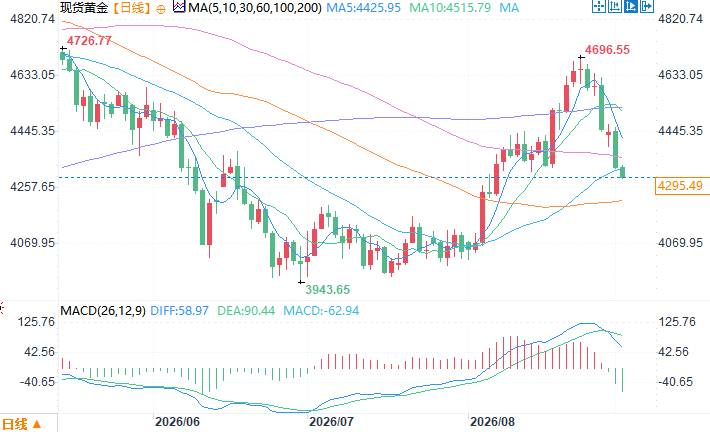 Spot gold daily chart source: FX678. At 11:36 AM Beijing time on September 2nd, spot gold was trading at $4284.70 per ounce.
The culprits driving up inflation are all surging.
Overnight, as hostilities between the US and Iran escalated, West Texas Intermediate (WTI) crude oil prices rebounded to $90 per barrel. Meanwhile, Hansen added that the ongoing Russia-Ukraine conflict and severe weather in many parts of the world are driving up grain and soft commodity prices, led by sugar, wheat, and corn. He added that the Bloomberg Commodity Agricultural Total Return Index surged 12.4% in August, reaching a 14-year high. He said, "In short, commodities that create inflation problems continue to rise, while commodities traditionally used to hedge against the consequences of inflation are falling." This statement accurately summarizes the current predicament of gold: as a traditional inflation hedge, gold has become a laggard in this round of commodity price increases.The aftermath of Walsh's hawkish speech: Three headwinds strike simultaneously.
The gold sell-off began last Friday (August 28) when Federal Reserve Chairman Kevin Warsh reiterated his commitment to bringing inflation down to the central bank's 2% target during his speech at the Jackson Hole Federal Reserve Symposium in Wyoming. "Gold and silver have both fallen since last Friday because Warsh's speech generated three direct headwinds: higher short-term interest rate expectations, rising real and nominal yields, and a stronger dollar," Hansen said. Last Friday, Hansen warned investors that the renewed focus on inflation could put pressure on gold. However, he added that he did not believe this renewed focus on inflation would undermine the long-term upward trend driven by concerns about government debt growth and currency devaluation.Two forces pulling at each other: the immediate cost of money vs. long-term reputation.
Hansen stated, "Rising real interest rates driven by credible, inflation-resistant central banks are generally bearish for gold. However, rising long-term yields, increasingly driven by concerns about debt sustainability, massive sovereign issuance, and fiscal credibility, are another matter. Persistently rising debt servicing costs could eventually increase pressure on policymakers to prevent long-term borrowing costs from rising indefinitely. Therefore, gold remains caught between two opposing forces: the immediate cost of money and long-term concerns about the quantity and credibility of the currency. Persistent central bank demand and reserve diversification provide another source of structural support, making it less sensitive to short-term changes in US interest rates."The central bank's paradox: raising interest rates can suppress demand, but it can't generate new goods.
Hansen added that supply-driven inflationary pressures also present a unique challenge for the Federal Reserve. He stated, "Central banks can suppress demand, but they cannot produce additional crude oil, refining capacity, or natural gas. The paradox is that if rising commodity prices force interest rates to remain high for a longer period, the pressure on highly indebted governments could ultimately reignite concerns about fiscal and currency devaluation, which has been one of the strongest structural drivers of investment demand for precious metals."Conclusion
Gold is caught in a tug-of-war: on one side, there's the immediate headwind of interest rates from Warsh's hawkish stance; on the other, there's the long-term tailwind of debt inflation and currency devaluation. In the short term, the more aggressively commodities drive up inflation, the stronger the expectation of interest rate hikes, and the more suppressed gold prices become. But from a longer-term perspective, it is precisely the pressure of high commodity prices and rising debt servicing costs that could ultimately push the market back down the old path of devaluation and fiscal concerns. For gold, whether the current pullback is a shift in gears or a reversal may only become clear after the aftershocks of this round of commodity inflation subside. Spot gold daily chart source: FX678. At 11:36 AM Beijing time on September 2nd, spot gold was trading at $4284.70 per ounce.
- Risk Warning and Disclaimer
- The market involves risk, and trading may not be suitable for all investors. This article is for reference only and does not constitute personal investment advice, nor does it take into account certain users’ specific investment objectives, financial situation, or other needs. Any investment decisions made based on this information are at your own risk.