Expectations of a Federal Reserve rate hike in September have intensified, sending the US dollar to a two-week high against the Canadian dollar.
2026-09-02 14:08:03
The Canadian dollar continued to be under pressure on Wednesday, with the USD/CAD pair rising for the second consecutive trading day, climbing above 1.3920 to a two-week high. A rapid rise in global bond yields, declining risk appetite, and market expectations of a renewed tightening of monetary policy by the Federal Reserve have collectively helped the US dollar regain its safe-haven asset status, further widening its advantage over the Canadian dollar.  The pricing logic of global financial markets has recently undergone a significant shift. As long-term bond yields in major economies continue to rise, investors are reassessing global inflation and monetary policy risks. Rising yields not only increase the relative attractiveness of dollar assets but also raise the financing costs of global risk assets, thus suppressing market risk appetite. In this environment, funds tend to flow more towards highly liquid safe-haven assets such as the US dollar, significantly dragging down the Canadian dollar. The renewed escalation of tensions in the Middle East has further reinforced this trend. After a period of relative calm, regional tensions have escalated again, and markets are reassessing potential risks to energy supply and global economic growth. Given the strong cyclical nature of the Canadian dollar, its performance is typically closely correlated with global risk appetite and commodity prices. When markets enter a clear risk-averse mode, the Canadian dollar is susceptible to capital outflows. Meanwhile, the Bank of Canada's interest rate decision has become the direct focus of the Canadian dollar market. The market widely expects the Bank of Canada to maintain its benchmark interest rate at 2.25%, and there is a high probability that it will keep the rate unchanged for the remainder of the year. Against the backdrop of hawkish expectations for US monetary policy, the Bank of Canada lacks the incentive to further tighten policy, further tilting the interest rate expectation spread between the US dollar and the Canadian dollar towards the US dollar. The Canadian economy also faces significant external uncertainties. The ongoing tariff dispute with the United States continues to impact business and market confidence, while escalating tensions in the Middle East further increase uncertainty about the global economic outlook. Against this backdrop, even if the Bank of Canada wishes to maintain monetary policy stability, it needs to pay closer attention to the pressures on economic growth. Therefore, simply maintaining the 2.25% policy rate is unlikely to be a catalyst for a stronger Canadian dollar. In the US, while the latest data does not entirely support further appreciation of the US dollar, it has not changed market expectations regarding the Federal Reserve's policy path. The August ISM Manufacturing PMI fell more than expected, and the July JOLTS job openings increase was also lower than anticipated, reflecting signs of cooling in some sectors of the US economy. However, the US economy still possesses a certain degree of resilience, and rising oil prices have renewed inflationary risks, making investors reluctant to bet on a rapid shift to easing by the Federal Reserve. Market expectations for the Federal Reserve's policy in September are particularly crucial. The Brown Brothers Harriman strategy team points out that federal funds futures already reflect a probability of approximately 67% for a 25 basis point rate hike by the Federal Reserve on September 16, with a cumulative tightening of approximately 60 basis points over the next 12 months. If this expectation persists or even intensifies, the interest rate differential between the US and Canada may continue to tilt towards the US dollar, thus providing support for USD/CAD. It's worth noting that the market's pricing in the Fed's September policy is already significantly higher than previous levels, so further dollar appreciation will require confirmation from more economic data. The US August CPI will be a key indicator. If inflation data rebounds, especially if core inflation exceeds expectations, the market may further strengthen its bets on interest rate hikes, and USD/CAD could continue to test higher levels; conversely, if inflation cools significantly, the recent policy premium accumulated by the dollar may be reversed. Regarding employment data, the market is currently awaiting the US ADP employment report. Data shows that US private sector employment is expected to increase by approximately 47,000 in August, higher than the 44,000 in July. While this increase remains relatively moderate, if the actual data significantly exceeds expectations, it will strengthen the market's assessment of the resilience of the US labor market and further support the Fed maintaining a tight policy. For USD/CAD, future movements will depend not only on the interest rate differential between the Fed and the Bank of Canada but also on changes in oil prices. Rising oil prices typically improve Canada's energy export revenue and, to some extent, support the Canadian dollar. However, the current rise in oil prices is also driven by geopolitical risks and inflationary factors. If the market focuses more on risk aversion and the dollar's interest rate advantage, the support for the Canadian dollar from rising oil prices may be partially offset. Therefore, the USD/CAD market is currently experiencing a clear tug-of-war between bulls and bears. On the one hand, US interest rate expectations, global yields, and safe-haven flows all support the US dollar; on the other hand, higher oil prices theoretically provide a buffer for the Canadian dollar. The key factor determining the short-term exchange rate direction lies in whether US inflation and employment data can further confirm expectations of a Fed rate hike. From a daily chart perspective, USD/CAD has risen for two consecutive trading days, breaking through the 1.3900 level and reaching a two-week high above 1.3920, indicating a significantly strengthened short-term bullish structure. If the price can effectively hold above 1.3920, the first resistance level to watch is around 1.3970, and a further break above this level could test the 1.4000 level. If the bulls continue to dominate, the next target area will be around 1.4050. On the downside, key support levels to watch are around 1.3870, 1.3820, and 1.3770. As long as the price remains above 1.3820, the short-term rebound structure remains relatively intact. Looking at the 4-hour chart, USD/CAD has formed a clear stepped upward structure, with both short-term highs and lows rising simultaneously, indicating that buying momentum remains dominant. However, after the price quickly approached 1.4000, short-term profit-taking may increase. If the price fails to extend its gains after breaking through 1.3920 and falls back below 1.3870, a pullback should be anticipated, with the price potentially seeking support at 1.3820. If 1.3920 successfully becomes a new support area, USD/CAD still has a chance to continue its advance towards 1.3970 and 1.4000. Overall, the 4-hour trend is bullish, but the area around 1.4000 will be a crucial technical level for the bulls to further expand their position.
 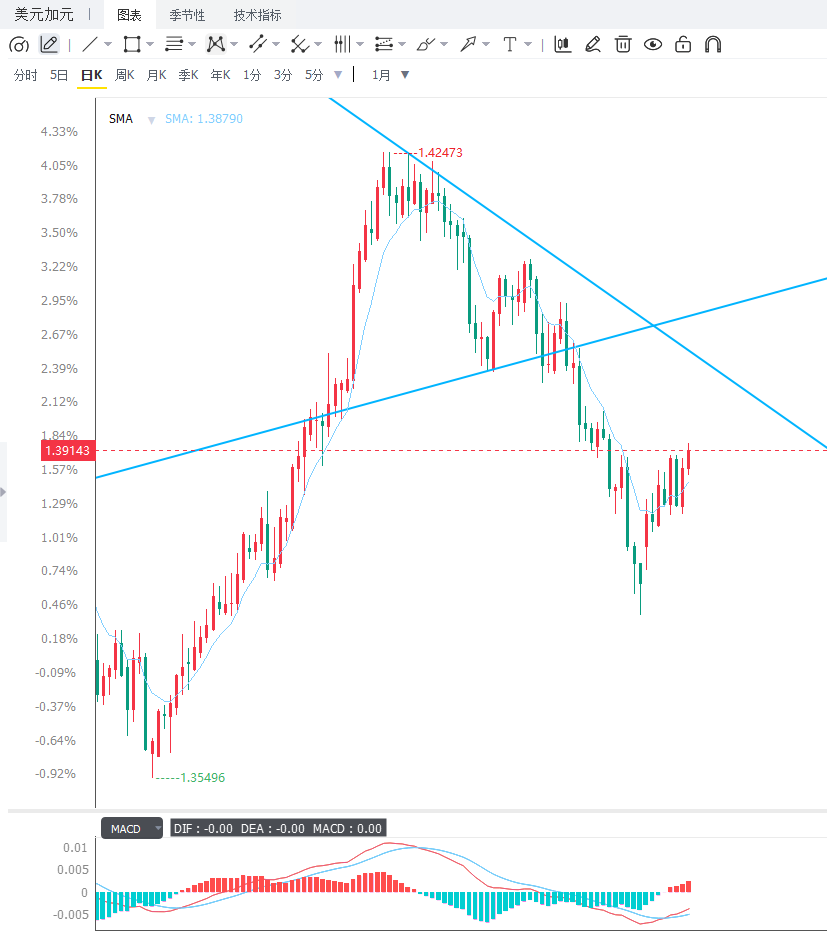 Editor's Summary: The core drivers for USD/CAD remain rising expectations of a Fed rate hike, higher global bond yields, and increased risk aversion. The Bank of Canada is expected to maintain its interest rate at 2.25%, further favoring the US dollar over the Canadian dollar. In the short term, after breaking through 1.3920, the bulls remain in control, with 1.4000 becoming the next important psychological level. However, the US dollar has already accumulated some gains recently, and whether it can continue to rise depends on confirmation from US employment and inflation data. If both ADP and CPI are strong, expectations of a Fed rate hike in September may continue to rise, potentially allowing USD/CAD to test higher levels. If US economic data cools significantly while oil prices remain high, the Canadian dollar may have some room for recovery. In the coming week, US inflation data will be a crucial variable determining the direction of USD/CAD.
The pricing logic of global financial markets has recently undergone a significant shift. As long-term bond yields in major economies continue to rise, investors are reassessing global inflation and monetary policy risks. Rising yields not only increase the relative attractiveness of dollar assets but also raise the financing costs of global risk assets, thus suppressing market risk appetite. In this environment, funds tend to flow more towards highly liquid safe-haven assets such as the US dollar, significantly dragging down the Canadian dollar. The renewed escalation of tensions in the Middle East has further reinforced this trend. After a period of relative calm, regional tensions have escalated again, and markets are reassessing potential risks to energy supply and global economic growth. Given the strong cyclical nature of the Canadian dollar, its performance is typically closely correlated with global risk appetite and commodity prices. When markets enter a clear risk-averse mode, the Canadian dollar is susceptible to capital outflows. Meanwhile, the Bank of Canada's interest rate decision has become the direct focus of the Canadian dollar market. The market widely expects the Bank of Canada to maintain its benchmark interest rate at 2.25%, and there is a high probability that it will keep the rate unchanged for the remainder of the year. Against the backdrop of hawkish expectations for US monetary policy, the Bank of Canada lacks the incentive to further tighten policy, further tilting the interest rate expectation spread between the US dollar and the Canadian dollar towards the US dollar. The Canadian economy also faces significant external uncertainties. The ongoing tariff dispute with the United States continues to impact business and market confidence, while escalating tensions in the Middle East further increase uncertainty about the global economic outlook. Against this backdrop, even if the Bank of Canada wishes to maintain monetary policy stability, it needs to pay closer attention to the pressures on economic growth. Therefore, simply maintaining the 2.25% policy rate is unlikely to be a catalyst for a stronger Canadian dollar. In the US, while the latest data does not entirely support further appreciation of the US dollar, it has not changed market expectations regarding the Federal Reserve's policy path. The August ISM Manufacturing PMI fell more than expected, and the July JOLTS job openings increase was also lower than anticipated, reflecting signs of cooling in some sectors of the US economy. However, the US economy still possesses a certain degree of resilience, and rising oil prices have renewed inflationary risks, making investors reluctant to bet on a rapid shift to easing by the Federal Reserve. Market expectations for the Federal Reserve's policy in September are particularly crucial. The Brown Brothers Harriman strategy team points out that federal funds futures already reflect a probability of approximately 67% for a 25 basis point rate hike by the Federal Reserve on September 16, with a cumulative tightening of approximately 60 basis points over the next 12 months. If this expectation persists or even intensifies, the interest rate differential between the US and Canada may continue to tilt towards the US dollar, thus providing support for USD/CAD. It's worth noting that the market's pricing in the Fed's September policy is already significantly higher than previous levels, so further dollar appreciation will require confirmation from more economic data. The US August CPI will be a key indicator. If inflation data rebounds, especially if core inflation exceeds expectations, the market may further strengthen its bets on interest rate hikes, and USD/CAD could continue to test higher levels; conversely, if inflation cools significantly, the recent policy premium accumulated by the dollar may be reversed. Regarding employment data, the market is currently awaiting the US ADP employment report. Data shows that US private sector employment is expected to increase by approximately 47,000 in August, higher than the 44,000 in July. While this increase remains relatively moderate, if the actual data significantly exceeds expectations, it will strengthen the market's assessment of the resilience of the US labor market and further support the Fed maintaining a tight policy. For USD/CAD, future movements will depend not only on the interest rate differential between the Fed and the Bank of Canada but also on changes in oil prices. Rising oil prices typically improve Canada's energy export revenue and, to some extent, support the Canadian dollar. However, the current rise in oil prices is also driven by geopolitical risks and inflationary factors. If the market focuses more on risk aversion and the dollar's interest rate advantage, the support for the Canadian dollar from rising oil prices may be partially offset. Therefore, the USD/CAD market is currently experiencing a clear tug-of-war between bulls and bears. On the one hand, US interest rate expectations, global yields, and safe-haven flows all support the US dollar; on the other hand, higher oil prices theoretically provide a buffer for the Canadian dollar. The key factor determining the short-term exchange rate direction lies in whether US inflation and employment data can further confirm expectations of a Fed rate hike. From a daily chart perspective, USD/CAD has risen for two consecutive trading days, breaking through the 1.3900 level and reaching a two-week high above 1.3920, indicating a significantly strengthened short-term bullish structure. If the price can effectively hold above 1.3920, the first resistance level to watch is around 1.3970, and a further break above this level could test the 1.4000 level. If the bulls continue to dominate, the next target area will be around 1.4050. On the downside, key support levels to watch are around 1.3870, 1.3820, and 1.3770. As long as the price remains above 1.3820, the short-term rebound structure remains relatively intact. Looking at the 4-hour chart, USD/CAD has formed a clear stepped upward structure, with both short-term highs and lows rising simultaneously, indicating that buying momentum remains dominant. However, after the price quickly approached 1.4000, short-term profit-taking may increase. If the price fails to extend its gains after breaking through 1.3920 and falls back below 1.3870, a pullback should be anticipated, with the price potentially seeking support at 1.3820. If 1.3920 successfully becomes a new support area, USD/CAD still has a chance to continue its advance towards 1.3970 and 1.4000. Overall, the 4-hour trend is bullish, but the area around 1.4000 will be a crucial technical level for the bulls to further expand their position. Editor's Summary: The core drivers for USD/CAD remain rising expectations of a Fed rate hike, higher global bond yields, and increased risk aversion. The Bank of Canada is expected to maintain its interest rate at 2.25%, further favoring the US dollar over the Canadian dollar. In the short term, after breaking through 1.3920, the bulls remain in control, with 1.4000 becoming the next important psychological level. However, the US dollar has already accumulated some gains recently, and whether it can continue to rise depends on confirmation from US employment and inflation data. If both ADP and CPI are strong, expectations of a Fed rate hike in September may continue to rise, potentially allowing USD/CAD to test higher levels. If US economic data cools significantly while oil prices remain high, the Canadian dollar may have some room for recovery. In the coming week, US inflation data will be a crucial variable determining the direction of USD/CAD.
- Risk Warning and Disclaimer
- The market involves risk, and trading may not be suitable for all investors. This article is for reference only and does not constitute personal investment advice, nor does it take into account certain users’ specific investment objectives, financial situation, or other needs. Any investment decisions made based on this information are at your own risk.