The yield on 10-year US Treasury bonds hit a three-year high, and Japan's yield returned to 3% after 30 years, triggering a global bond market sell-off.
2026-09-02 15:22:03
The global bond market has recently experienced its most severe sell-off in recent years. From Tokyo to London to New York, sovereign bond yields have surged across the board, with several key instruments hitting multi-decade highs. The trigger for this sell-off was the escalating conflict in the Middle East driving up energy prices, but the deeper driving force is collective investor anxiety about sticky inflation, expanding fiscal deficits, and the repricing of global monetary policy. As the anchor for pricing various assets in the financial market, the surge in sovereign bond yields signifies a comprehensive increase in financing costs—consumers will face higher mortgage rates, businesses will face tighter financing conditions, and governments will face more difficult choices regarding fiscal spending. 
 Naka Matsuzawa, chief macro strategist at Nomura Securities in Tokyo, points out that hyperscale cloud service providers are willing to pay relatively high financing costs, which is driving up yields across the board. Zhengyan Luo, senior fixed-income strategist at State Street Investment Management, believes that the 3% yield on Japanese 10-year government bonds is a process of monetary policy normalization, not a crisis—the market is repricing to accommodate a higher inflationary environment and a higher neutral interest rate. The deterioration of Japan's fiscal situation is also a significant factor pushing up yields. The Japanese government has hinted at ambitious spending plans in the coming years, and the debt-to-GDP ratio has surged from about 100% when the 10-year yield last reached 3% in 1996 to 250% today. In its preliminary budget request for the next fiscal year, the Ministry of Finance has already listed a record 36.6 trillion yen (approximately US$230 billion) for debt servicing. Overnight index swap data shows that the market implies a 92% probability of the Bank of Japan raising interest rates before September.
I. United States: 10-year yield approaches 5%, and expectations for interest rate hikes are rising sharply.
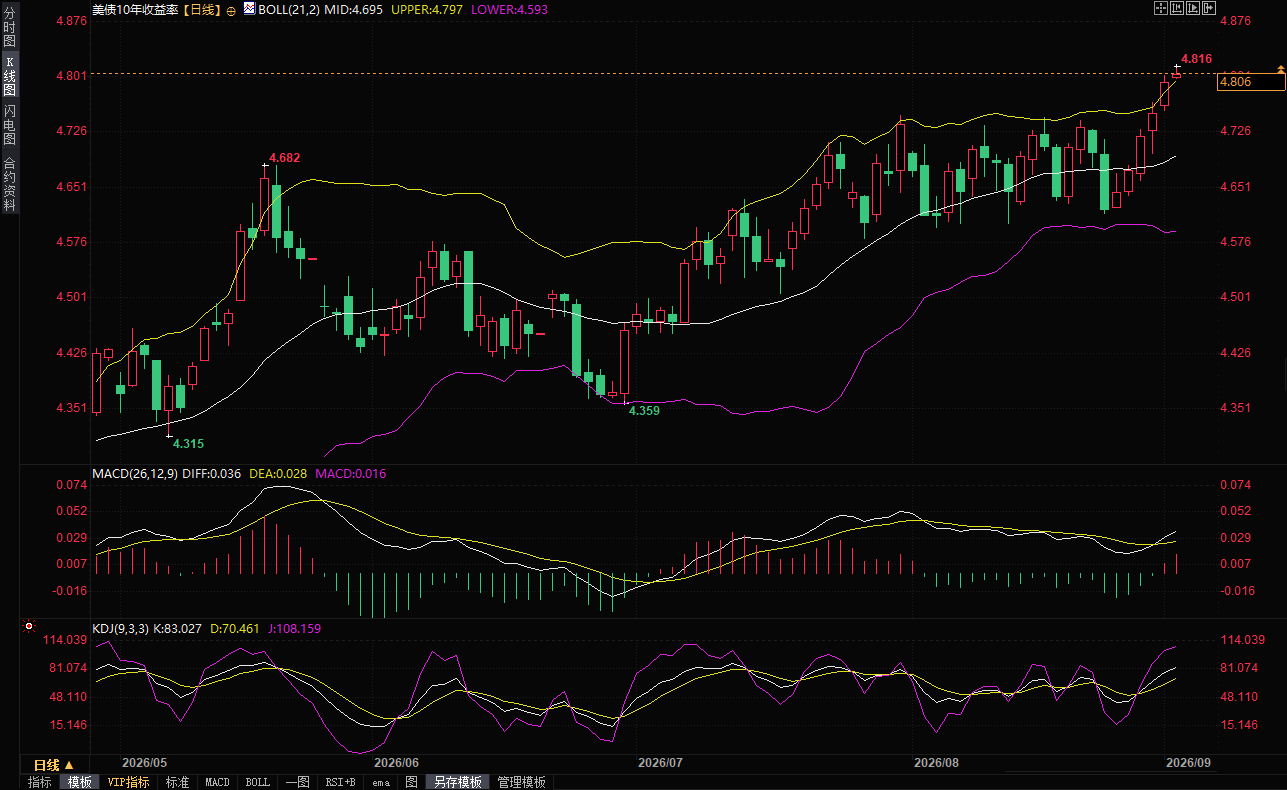
The US Treasury market is one of the core areas of this round of sell-off. On Wednesday (September 2), the yield on the 10-year US Treasury note climbed to 4.816%, the highest level since the end of 2023. This level is close to a three-year high, and market participants warned that if the yield climbs further to around 5%, it could further volatile the already tense stock market. The yield on the two-year US Treasury note, which is most sensitive to interest rate expectations, also rose to 4.41%, the highest since January 2025. The rapid rise in short-term yields reflects the market's rapidly increasing expectations for a near-term interest rate hike by the Federal Reserve. According to CME's "FedWatch" data on September 2, the probability of the Fed keeping interest rates unchanged at its September meeting is only 33.1%, while the probability of a cumulative rate hike of 25 basis points is as high as 66.9%. The probability of the Fed keeping interest rates unchanged by October has further decreased to 22.5%, and the probability of a cumulative rate hike of 50 basis points is 21.5%. The probability of at least a 25 basis point rate hike this year has reached 91%. This abrupt shift in interest rate hike expectations began with Federal Reserve Chairman Kevin Warsh's hawkish remarks at last week's Jackson Hole Economic Symposium. In his keynote address, Warsh repeatedly emphasized that current U.S. monetary policy has done little to curb lending or credit growth, and financial conditions remain accommodative. He insisted that unless inflation falls sharply to the 2% target level—unlikely before the Fed meeting on September 16—the Fed "has a lot of work to do." Warsh's comments challenged the long-held assumption among many Fed officials that interest rates remained slightly "tight," prompting a rapid repricing in the market.II. Japan: First time breaking 3% in 30 years, the "last pillar of global low interest rates" collapses.
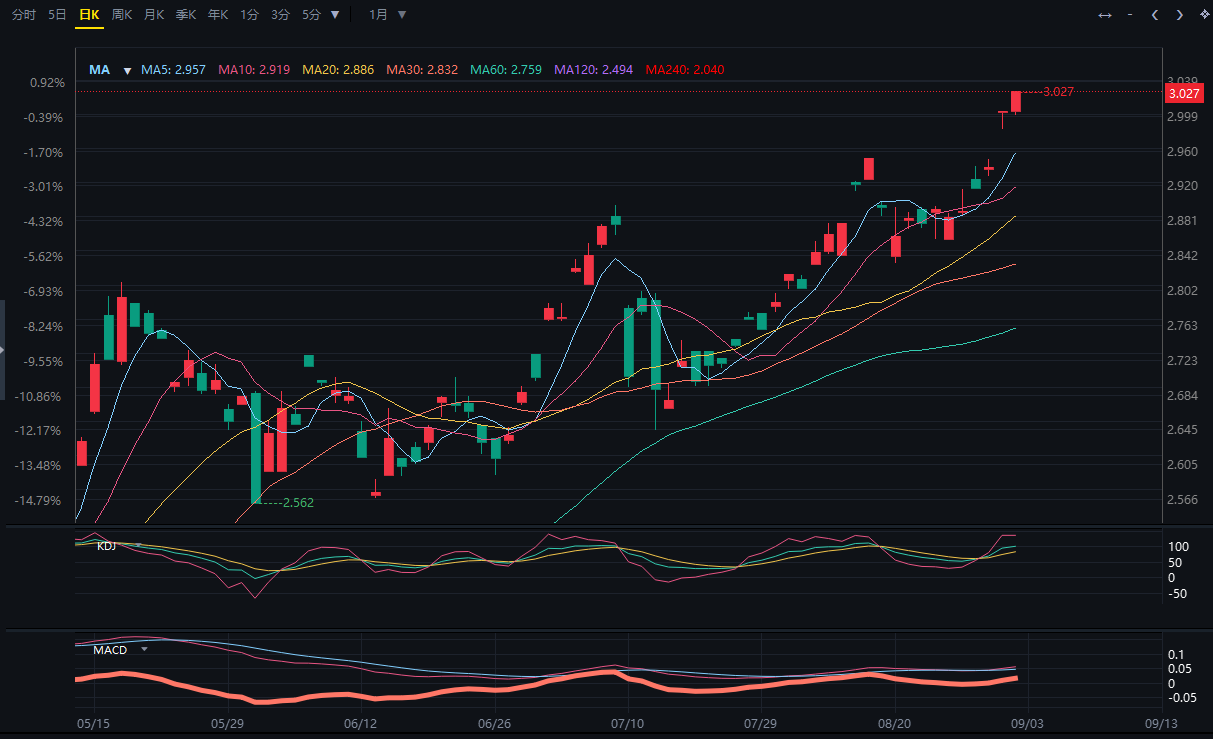
The changes in Japan's bond market are particularly significant. On September 1, the yield on Japan's 10-year government bonds touched the 3% mark for the first time since 1996. On Wednesday, the yield reached 3.027%, the highest level since 1996. The yield on 5-year government bonds hit a new high of 2.26%, and the yield on 2-year bonds rose to a 31-year high of 1.795%. This breakthrough is considered a milestone event for the global bond market. The yield on Japan's 10-year government bonds had long been among the lowest in the world, hovering near zero for many years. Since the Bank of Japan ends the world's last negative interest rate policy in 2024, the operating logic of the country's bond market has undergone a fundamental shift—bond pricing is now driven more by the independent decisions of domestic and foreign investors, rather than by central bank policy. Naka Matsuzawa, chief macro strategist at Nomura Securities in Tokyo, points out that hyperscale cloud service providers are willing to pay relatively high financing costs, which is driving up yields across the board. Zhengyan Luo, senior fixed-income strategist at State Street Investment Management, believes that the 3% yield on Japanese 10-year government bonds is a process of monetary policy normalization, not a crisis—the market is repricing to accommodate a higher inflationary environment and a higher neutral interest rate. The deterioration of Japan's fiscal situation is also a significant factor pushing up yields. The Japanese government has hinted at ambitious spending plans in the coming years, and the debt-to-GDP ratio has surged from about 100% when the 10-year yield last reached 3% in 1996 to 250% today. In its preliminary budget request for the next fiscal year, the Ministry of Finance has already listed a record 36.6 trillion yen (approximately US$230 billion) for debt servicing. Overnight index swap data shows that the market implies a 92% probability of the Bank of Japan raising interest rates before September.III. Europe: German, French, and British bond markets all hit record highs.
The European bond market was also not spared. The yield on German 10-year government bonds, the eurozone benchmark, rose to 3.369% on Tuesday, its highest level since 2011. On Wednesday, the yield rose a further 3.9 basis points to 3.377%, its highest level since April 2011. The yield on German 30-year government bonds also rose to 3.845%, its highest level since 2011. The situation for French government bonds was even more dire. The yield on French 10-year government bonds rose to 4.244% on Wednesday, its highest level since 2008. France is considered by investors to be the riskiest country in the eurozone, and its 10-year borrowing cost has exceeded that of Greece (4.04%). The yield on Italian 10-year government bonds touched 4.22%, its highest level since 2023. The UK market was also severely impacted. The yield on UK 30-year government bonds reached a high of 5.9% on September 1, its highest level since 1998. The yield on 10-year government bonds rose to approximately 5.25% at one point during the session. Saxo Bank's chief investment strategist, Charu Chanana, said bond investors are increasingly demanding higher premiums to compensate for inflation risks, fiscal risks, and the impact of a large supply of new debt in the market. She warned that the bond market sell-off could be more severe than expected, and the possibility of the US 10-year Treasury yield rising to 5% is growing. Traders have already fully priced in the expectation of a European Central Bank rate hike next week.IV. Australia and Other Markets: Global Repercussions
The yield on Australian 10-year government bonds rose to 5.18% on September 1, its highest level since July 2011. The yield on 3-year government bonds rose 7 basis points to 4.73%. This trend reflects both overall pressure on global bond markets and market expectations of further interest rate hikes by the Reserve Bank of Australia. Prashant Newnaha, senior interest rate strategist at TD Securities in Singapore, pointed out that this is indeed a real shift in the landscape—Japanese government bonds have long been the anchor of the global fixed income market, but the situation has now reversed. If the selling pressure on Japanese government bonds continues, it could trigger a repricing in the global fixed income market. Neumann, chief Asia economist at HSBC, analyzed that the rise in Japanese government bond yields not only reflects investors' concerns about Japan's fiscal prospects but also reflects upward pressure on global long-term financing costs.V. Underlying Logic: Reassessment of the Neutral Interest Rate and the AI Investment Boom
The underlying drivers of this round of bond market sell-off go far beyond geopolitics and rising oil prices. Analysts point out that a closer look at yield changes reveals that the latest trend is at least partly driven by inflation-adjusted "real" yields. The US 10-year real yield has risen by about 40 basis points in just three months. Japan's 10-year real yield has almost doubled to 0.9%. A reassessment of the so-called "neutral interest rate" (the level of interest rates that neither stimulates nor drags down the economy) is accelerating. The median quarterly forecast for the long-term nominal policy rate by Federal Reserve policymakers has risen from 2.4% in 2022, and the real neutral interest rate shown by the Fed's models is between 1.0% and 1.65%. If the 2% inflation target is added, the nominal interest rate will be close to the upper limit of the current federal funds rate range. Large technology companies are actively raising funds for the artificial intelligence boom, triggering a new wave of bond issuance and putting additional pressure on the sovereign debt market. Chip giant Nvidia has indicated that the AI capital expenditure boom will continue at least into next year, with its sales expected to grow by 70% by 2028. The AI-related investment boom is changing the nature of the global economy, forcing a re-examination of neutral interest rate models. Data released by the OECD shows that G20 merchandise trade accelerated in the second quarter, with quarterly import growth rising from 5.2% in the first quarter to 6.7%, with AI-related chips and computing equipment accounting for a significant portion of this growth.Editor's Summary
The global bond market sell-off in early September 2026 was the result of a confluence of factors. Escalating conflicts in the Middle East, pushing up energy prices, was the most direct catalyst, with Brent crude oil breaking through $95 per barrel further exacerbating inflation anxieties. However, the deeper driving force lay in a fundamental shift in global monetary policy—Federal Reserve Chairman Warsh's hawkish remarks completely reversed market expectations for interest rate cuts, and Japan's 10-year government bond yield breaking 3% for the first time in 30 years marked the collapse of the "last pillar of global low interest rates." The surge in corporate financing demand driven by the AI investment boom, the continued expansion of fiscal deficits in various countries, and the market's reassessment of the neutral interest rate collectively constituted the macroeconomic backdrop for this round of bond market sell-off. For investors, a 5% yield on the US 10-year Treasury bond may not be the end, but rather the beginning of a new normal. For governments, soaring yields mean a sharp increase in debt servicing costs, and the room for maneuver in fiscal policy is rapidly narrowing. At 15:19 Beijing time, the yield on the US 10-year Treasury bond was 4.805%.- Risk Warning and Disclaimer
- The market involves risk, and trading may not be suitable for all investors. This article is for reference only and does not constitute personal investment advice, nor does it take into account certain users’ specific investment objectives, financial situation, or other needs. Any investment decisions made based on this information are at your own risk.