US Treasury yields rose to 4.80%, coupled with rising oil prices, pushing the dollar index close to the 100 mark.
2026-09-02 14:12:03
The US dollar index continued its rebound in Asian trading on Wednesday, rising for the second consecutive session and currently trading around 99.70. The recent renewed support for the dollar is mainly driven by a rapid rise in US Treasury yields and a significant increase in international oil prices. Rising bond yields have increased the relative attractiveness of dollar-denominated assets, while rising energy prices have reignited concerns about the sustainability of inflation, both factors contributing to investors readjusting their expectations for US monetary policy.  The global bond market has recently seen a significant sell-off, with US Treasuries also under considerable pressure. The yield on the 10-year US Treasury note rose to 4.80%, its highest level since early 2025. For the foreign exchange market, a rapid rise in long-term US Treasury yields typically strengthens the dollar's interest rate advantage, especially as the market lowers expectations for short-term rate cuts, further enhancing the attractiveness of dollar funds. Rising oil prices have been another important catalyst for the recent strengthening of the dollar. Continued tensions in the Middle East have pushed oil prices to their highest level since July 24, prompting the market to reassess the potential impact of energy supply disruptions on global inflation. Continued increases in energy costs will increase cost pressures on US businesses and consumers and may slow the pace of inflation's decline towards its target level. This means the Federal Reserve faces new complexities in its future policy. If economic growth remains resilient while energy prices further push up inflation, the Fed may need to maintain high interest rates for a longer period or even reconsider tightening policies. For the dollar, such changes in policy expectations usually provide strong support, as high interest rates mean that dollar assets can continue to offer relatively high returns. However, recent US economic data has not presented a completely consistent and strong signal. July's JOLTS job openings totaled 7.27 million, lower than market expectations, indicating that labor market demand is not universally strong. Meanwhile, the August ISM Manufacturing PMI fell to 54.6 from 55.6 in July, lower than the previous reading but still within expansion territory, showing that the US manufacturing sector as a whole remains resilient. This combination of data—"partial cooling, but overall support"—has made the market cautious about the Fed's policy path. On the one hand, signs of a marginal slowdown in the job market theoretically favor a future shift in monetary policy; on the other hand, the manufacturing sector remains in expansion, and the potential for secondary inflationary pressures from rising energy prices limits market bets on rapid easing. Therefore, the ADP employment report and the upcoming US non-farm payroll data will be important catalysts for the dollar's next phase of movement. If the employment data is significantly stronger than expected, the market may further reduce its bets on easing policies, and US Treasury yields and the dollar index are expected to continue rising; if the job market cools rapidly, the dollar's recent interest rate advantage may be weakened, and the dollar index may fall back to 99 or even lower. At the same time, US fiscal risk is beginning to become a potential variable in the dollar's medium-term trend. Rising US long-term bond yields do not necessarily indicate market optimism about the economic outlook; they may also reflect investors' demand for higher term premiums. With increasing US government interest payments, long-term fiscal sustainability remains an unavoidable issue for the bond market. The Brown Brothers Harriman strategy team points out that the recent performance of 10-year US Treasury bonds compared to other major bond markets has been relatively strong, so the yield increase cannot be entirely attributed to fiscal concerns. However, this does not mean that fiscal risks have disappeared. As interest payments increase, the US Treasury term premium may rise further, making the dollar more vulnerable during periods of heightened fiscal pressure. This factor suggests that the current dollar appreciation has a certain "pro-cyclical" characteristic. As long as the rise in US Treasury yields primarily stems from the resilience of the US economy and expectations of monetary policy, the dollar typically benefits; however, if the continued rise in yields ultimately translates into market concerns about fiscal stability, the support for the dollar may gradually weaken. Therefore, investors need to distinguish the reasons for the yield increase and cannot simply equate higher US Treasury yields with a long-term positive for the dollar. From a global market perspective, the dollar is currently also supported by safe-haven demand. Escalating tensions in the Middle East have increased uncertainty regarding energy supply and global economic growth, leading funds to favor more liquid dollar assets. In this environment, the US dollar index may remain relatively strong even with some weak US economic data. However, as the dollar index approaches the 100 mark, upward pressure will increase significantly. The market needs new fundamental catalysts to drive a breakthrough in the dollar; otherwise, profit-taking may occur after continuous gains. If US employment data fails to continue providing interest rate support, and US Treasury yields fall from their highs, the short-term rebound in the dollar index may gradually lose momentum. Therefore, the core contradiction in the dollar market has now shifted to the interplay between "high yield support" and "fiscal risk constraints." Short-term direction remains dominated by expectations of Fed policy, while medium-term direction requires further observation of changes in the US fiscal situation, economic growth, and global capital flows. From a daily chart perspective, the dollar index has recently seen a continuous rebound, with the price approaching the 100 mark again, indicating a significant improvement in short-term bullish momentum. The area around 99.70 is currently a key trading zone. If it can effectively break through and hold above 100.00, the dollar index may further test the resistance around 100.50, with the 101.00 area as a further resistance level to watch. The first support level to watch is around 99.20. If the price breaks below this level again, it may retrace to around 98.80; if it breaks further, the 98.30 area will become an important support. From an overall trend perspective, the US dollar index is currently still in a rebound and correction phase. Whether it can break through the 100 mark will determine whether this rally can transform from a short-term rebound into a more significant trend. Looking at the 4-hour chart, the US dollar index shows a fluctuating upward structure, with short-term lows gradually rising, indicating that buying pressure still holds a certain advantage. However, the 99.70 to 100.00 area has entered a previous important trading zone, and technical profit-taking is likely after continuous gains. If the price breaks through 100.00 and forms a valid confirmation, the short-term target could be further towards 100.50; if it encounters resistance near 100 and breaks below 99.20, we need to be wary of the rebound structure being broken, and the price may seek support again at 98.80 or even 98.30. The current short-term trend is bullish, but the quality of a breakout near the 100 level is more noteworthy than a simple intraday spike.
 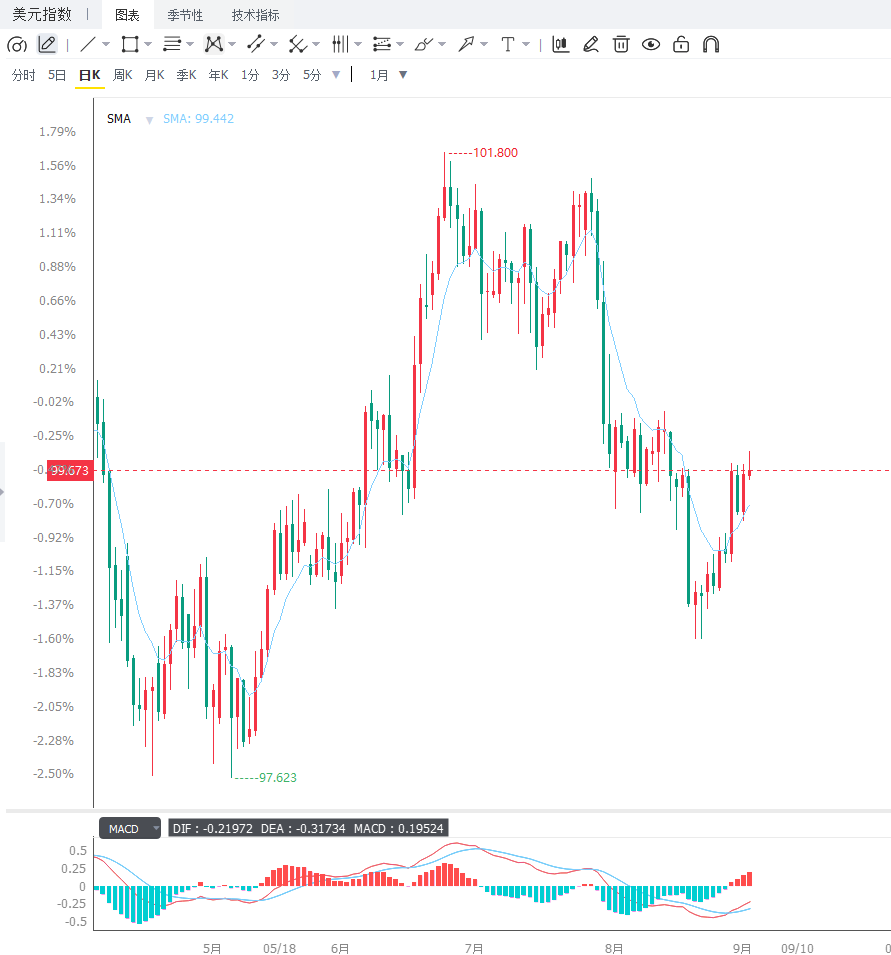 Editor's Summary: The recent strength of the US dollar index has been driven by the rise in the US 10-year Treasury yield to 4.80%, inflation concerns stemming from rising oil prices, and safe-haven inflows. At the same time, signs of a cooling in the US job market and the US fiscal risk premium also pose potential medium-term pressure on the dollar. In the short term, 100.00 is the most crucial psychological and technical level for the dollar index. A successful break above this level could open up further upside potential; however, if it repeatedly fails to break through and falls below 99.20, it warrants caution as this rebound may enter a correction phase. Going forward, ADP and non-farm payroll data will be key triggers for the dollar's repricing, and investors should closely observe whether employment data and US Treasury yields move in the same direction.
The global bond market has recently seen a significant sell-off, with US Treasuries also under considerable pressure. The yield on the 10-year US Treasury note rose to 4.80%, its highest level since early 2025. For the foreign exchange market, a rapid rise in long-term US Treasury yields typically strengthens the dollar's interest rate advantage, especially as the market lowers expectations for short-term rate cuts, further enhancing the attractiveness of dollar funds. Rising oil prices have been another important catalyst for the recent strengthening of the dollar. Continued tensions in the Middle East have pushed oil prices to their highest level since July 24, prompting the market to reassess the potential impact of energy supply disruptions on global inflation. Continued increases in energy costs will increase cost pressures on US businesses and consumers and may slow the pace of inflation's decline towards its target level. This means the Federal Reserve faces new complexities in its future policy. If economic growth remains resilient while energy prices further push up inflation, the Fed may need to maintain high interest rates for a longer period or even reconsider tightening policies. For the dollar, such changes in policy expectations usually provide strong support, as high interest rates mean that dollar assets can continue to offer relatively high returns. However, recent US economic data has not presented a completely consistent and strong signal. July's JOLTS job openings totaled 7.27 million, lower than market expectations, indicating that labor market demand is not universally strong. Meanwhile, the August ISM Manufacturing PMI fell to 54.6 from 55.6 in July, lower than the previous reading but still within expansion territory, showing that the US manufacturing sector as a whole remains resilient. This combination of data—"partial cooling, but overall support"—has made the market cautious about the Fed's policy path. On the one hand, signs of a marginal slowdown in the job market theoretically favor a future shift in monetary policy; on the other hand, the manufacturing sector remains in expansion, and the potential for secondary inflationary pressures from rising energy prices limits market bets on rapid easing. Therefore, the ADP employment report and the upcoming US non-farm payroll data will be important catalysts for the dollar's next phase of movement. If the employment data is significantly stronger than expected, the market may further reduce its bets on easing policies, and US Treasury yields and the dollar index are expected to continue rising; if the job market cools rapidly, the dollar's recent interest rate advantage may be weakened, and the dollar index may fall back to 99 or even lower. At the same time, US fiscal risk is beginning to become a potential variable in the dollar's medium-term trend. Rising US long-term bond yields do not necessarily indicate market optimism about the economic outlook; they may also reflect investors' demand for higher term premiums. With increasing US government interest payments, long-term fiscal sustainability remains an unavoidable issue for the bond market. The Brown Brothers Harriman strategy team points out that the recent performance of 10-year US Treasury bonds compared to other major bond markets has been relatively strong, so the yield increase cannot be entirely attributed to fiscal concerns. However, this does not mean that fiscal risks have disappeared. As interest payments increase, the US Treasury term premium may rise further, making the dollar more vulnerable during periods of heightened fiscal pressure. This factor suggests that the current dollar appreciation has a certain "pro-cyclical" characteristic. As long as the rise in US Treasury yields primarily stems from the resilience of the US economy and expectations of monetary policy, the dollar typically benefits; however, if the continued rise in yields ultimately translates into market concerns about fiscal stability, the support for the dollar may gradually weaken. Therefore, investors need to distinguish the reasons for the yield increase and cannot simply equate higher US Treasury yields with a long-term positive for the dollar. From a global market perspective, the dollar is currently also supported by safe-haven demand. Escalating tensions in the Middle East have increased uncertainty regarding energy supply and global economic growth, leading funds to favor more liquid dollar assets. In this environment, the US dollar index may remain relatively strong even with some weak US economic data. However, as the dollar index approaches the 100 mark, upward pressure will increase significantly. The market needs new fundamental catalysts to drive a breakthrough in the dollar; otherwise, profit-taking may occur after continuous gains. If US employment data fails to continue providing interest rate support, and US Treasury yields fall from their highs, the short-term rebound in the dollar index may gradually lose momentum. Therefore, the core contradiction in the dollar market has now shifted to the interplay between "high yield support" and "fiscal risk constraints." Short-term direction remains dominated by expectations of Fed policy, while medium-term direction requires further observation of changes in the US fiscal situation, economic growth, and global capital flows. From a daily chart perspective, the dollar index has recently seen a continuous rebound, with the price approaching the 100 mark again, indicating a significant improvement in short-term bullish momentum. The area around 99.70 is currently a key trading zone. If it can effectively break through and hold above 100.00, the dollar index may further test the resistance around 100.50, with the 101.00 area as a further resistance level to watch. The first support level to watch is around 99.20. If the price breaks below this level again, it may retrace to around 98.80; if it breaks further, the 98.30 area will become an important support. From an overall trend perspective, the US dollar index is currently still in a rebound and correction phase. Whether it can break through the 100 mark will determine whether this rally can transform from a short-term rebound into a more significant trend. Looking at the 4-hour chart, the US dollar index shows a fluctuating upward structure, with short-term lows gradually rising, indicating that buying pressure still holds a certain advantage. However, the 99.70 to 100.00 area has entered a previous important trading zone, and technical profit-taking is likely after continuous gains. If the price breaks through 100.00 and forms a valid confirmation, the short-term target could be further towards 100.50; if it encounters resistance near 100 and breaks below 99.20, we need to be wary of the rebound structure being broken, and the price may seek support again at 98.80 or even 98.30. The current short-term trend is bullish, but the quality of a breakout near the 100 level is more noteworthy than a simple intraday spike. Editor's Summary: The recent strength of the US dollar index has been driven by the rise in the US 10-year Treasury yield to 4.80%, inflation concerns stemming from rising oil prices, and safe-haven inflows. At the same time, signs of a cooling in the US job market and the US fiscal risk premium also pose potential medium-term pressure on the dollar. In the short term, 100.00 is the most crucial psychological and technical level for the dollar index. A successful break above this level could open up further upside potential; however, if it repeatedly fails to break through and falls below 99.20, it warrants caution as this rebound may enter a correction phase. Going forward, ADP and non-farm payroll data will be key triggers for the dollar's repricing, and investors should closely observe whether employment data and US Treasury yields move in the same direction.
- Risk Warning and Disclaimer
- The market involves risk, and trading may not be suitable for all investors. This article is for reference only and does not constitute personal investment advice, nor does it take into account certain users’ specific investment objectives, financial situation, or other needs. Any investment decisions made based on this information are at your own risk.