US Treasury yields continued to rise, putting pressure on gold prices, which then corrected and returned to range-bound trading.
2026-09-02 14:18:03
Spot gold continued its weakness in Asian trading on Wednesday, hitting a near four-week low before rebounding slightly. It is currently hovering above $4,300, with a daily decline still exceeding 0.5%. Under multiple pressures from a stronger dollar, rising US Treasury yields, and a renewed hawkish outlook for the Federal Reserve, gold's recent upward momentum has clearly weakened, and market risk appetite has begun to shift from previous safe-haven buying to a repricing of interest rates and real yields.  The current gold price correction is primarily driven by rising energy prices. Continued tensions in the Middle East have pushed crude oil prices to their highest level since July 24th, reintroducing energy supply risks into market pricing. Rising oil prices suggest renewed upward pressure on inflation, and if energy costs are passed on to broader commodity prices through transportation, production, and consumption, major central banks' room for interest rate cuts will be further limited. For gold, this change has a significant dual impact. On one hand, escalating geopolitical risks typically stimulate safe-haven flows into gold; on the other hand, if geopolitical risks ultimately manifest primarily as rising oil prices and fueled inflation expectations, higher interest rate expectations and real yields could offset gold's safe-haven advantage. The market has clearly focused more on the latter recently, a key reason why gold prices have continued to fall despite ongoing risk events. A stronger US dollar further amplifies the downward pressure on gold. Since gold is priced in US dollars, a stronger dollar typically increases holding costs for non-dollar investors, reflecting market expectations of persistently high US interest rates. Recent hawkish comments from Federal Reserve Chairman Kevin Warsh at the Jackson Hole conference continue to resonate, significantly strengthening market expectations for further policy tightening in September. Changes in market interest rate pricing are particularly noteworthy. Current market estimates suggest that the Fed's September rate hike expectations are significantly higher than previously anticipated. If subsequent US employment data remains resilient, and energy prices drive inflation expectations higher, the probability of a further hawkish shift in Fed policy could increase, providing new support for the dollar and US Treasury yields, while gold may continue to face downward pressure. Meanwhile, the US long-term Treasury market has also become a significant factor suppressing gold. Affected by fiscal risk concerns and a global bond sell-off, the yield on the 10-year US Treasury note has risen to its highest level since January 2025. Rising yields mean an increased opportunity cost of holding gold, a non-interest-bearing asset, leading some funds to be reallocated to dollar-denominated fixed-income assets. The Societe Generale strategy team believes that the recent sell-off in the US bond market may continue to push long-term yields higher, warning of a risk that the 10-year US Treasury yield could approach 5%. If this scenario becomes the market consensus, the short-term pressure on gold will further increase. Especially with rising real interest rates, gold needs stronger safe-haven inflows to offset the adverse effects of interest rate factors. However, gold prices have not completely lost fundamental support. The situation in the Middle East remains highly uncertain, and risks to energy transportation security and global supply chains could stimulate a return of safe-haven funds to the precious metals market. If the situation escalates unexpectedly, gold may regain safe-haven buying and experience a technical rebound after a rapid decline. Furthermore, US fiscal risks have a two-way impact. While fiscal concerns are driving up US Treasury yields, which is unfavorable for gold in the short term, if the market begins to worry about the sustainability of long-term US debt and further weakens confidence in dollar assets, then gold's long-term allocation value may regain attention. Therefore, gold is currently in a tug-of-war between "high interest rate pressure" and "fiscal and geopolitical safe-haven demand." The most important catalyst going forward remains the US non-farm payroll data. Employment data not only affects the market's assessment of the resilience of the US economy but will also directly influence the Fed's future policy path. If non-farm payrolls are stronger than expected, the market may further increase expectations of interest rate hikes, and rising dollar and US Treasury yields will put new pressure on gold; if employment cools significantly, the market may bet again on a policy shift, and gold may have room for a rebound. From a market sentiment perspective, gold is currently clearly in a cautious mode. The safe-haven sentiment that previously drove up gold prices remains, but funds are now paying closer attention to changes in interest rates and yields. Therefore, every short-term rebound in gold is likely to be met with profit-taking and selling pressure. Only when the US dollar and US Treasury yields decline simultaneously, or when geopolitical risks escalate further to the point of affecting global financial market stability, will gold be able to regain strong upward momentum. From a daily chart perspective, spot gold has weakened significantly recently, with prices falling back to around $4300 and gradually approaching a key medium- to long-term support zone. Technical indicators show that the MACD is below the zero line and remains significantly negative, while the RSI is around 44, indicating that bullish momentum continues to weaken, but it has not yet entered extreme oversold territory. Therefore, gold still has room for further correction. The most crucial technical level currently is the 200-day exponential moving average at $4280. If gold prices can hold this area, the previous medium-term upward structure may still be repaired. However, a decisive break below $4280 would see the next support level at the 61.8% Fibonacci retracement around $4230, followed by the 78.6% retracement around $4120, and then the previous low area around $3952. On the upside, the first resistance level to watch is $4350, with further resistance at $4400 and stronger resistance around $4520. From a 4-hour chart perspective, gold remains in a short-term downward trend. Although there has been some technical rebound after the continuous decline, a clear trend reversal signal has not yet formed. $4300 is a significant psychological level. If prices can regain a foothold above $4350, a further test of $4400 is possible in the short term; however, if the rebound continues to be suppressed and prices fall below $4300 again, the market may retest $4280. If the $4280 level is broken, bearish momentum could strengthen further, pushing gold prices towards the $4230 or even $4111 area. Currently, short-term indicators are generally weak; therefore, before key support levels are confirmed, shorting should be avoided due to the risk of a rapid rebound.
 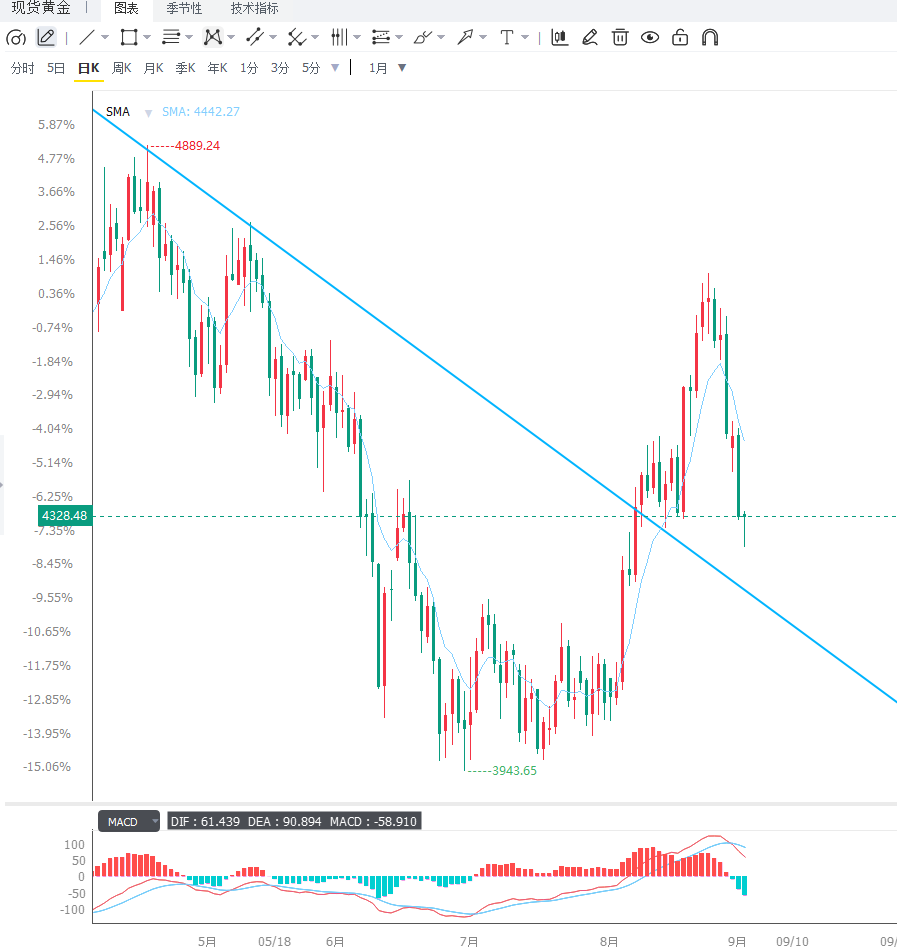 Editor's Summary: The main contradiction in the spot gold market has shifted from simple geopolitical safe-haven demand to a tug-of-war between safe-haven demand and interest rate pressures. Escalating tensions in the Middle East and rising oil prices provide safe-haven support for gold, but rising inflation concerns, increased expectations of a Fed rate hike, and higher US Treasury yields are creating stronger downward pressure. In the short term, $4280 is a key level to determine whether gold will open up further downside potential; if this area is broken, $4230 and $4111 will become important targets. Conversely, if US employment data weakens and pushes down the dollar and US Treasury yields, gold may quickly recover its losses. In the near term, close attention should be paid to non-farm payrolls, US inflation data, US Treasury yields, and changes in the Middle East situation, and caution should be exercised against sharp price fluctuations caused by rapid shifts in macroeconomic expectations.
The current gold price correction is primarily driven by rising energy prices. Continued tensions in the Middle East have pushed crude oil prices to their highest level since July 24th, reintroducing energy supply risks into market pricing. Rising oil prices suggest renewed upward pressure on inflation, and if energy costs are passed on to broader commodity prices through transportation, production, and consumption, major central banks' room for interest rate cuts will be further limited. For gold, this change has a significant dual impact. On one hand, escalating geopolitical risks typically stimulate safe-haven flows into gold; on the other hand, if geopolitical risks ultimately manifest primarily as rising oil prices and fueled inflation expectations, higher interest rate expectations and real yields could offset gold's safe-haven advantage. The market has clearly focused more on the latter recently, a key reason why gold prices have continued to fall despite ongoing risk events. A stronger US dollar further amplifies the downward pressure on gold. Since gold is priced in US dollars, a stronger dollar typically increases holding costs for non-dollar investors, reflecting market expectations of persistently high US interest rates. Recent hawkish comments from Federal Reserve Chairman Kevin Warsh at the Jackson Hole conference continue to resonate, significantly strengthening market expectations for further policy tightening in September. Changes in market interest rate pricing are particularly noteworthy. Current market estimates suggest that the Fed's September rate hike expectations are significantly higher than previously anticipated. If subsequent US employment data remains resilient, and energy prices drive inflation expectations higher, the probability of a further hawkish shift in Fed policy could increase, providing new support for the dollar and US Treasury yields, while gold may continue to face downward pressure. Meanwhile, the US long-term Treasury market has also become a significant factor suppressing gold. Affected by fiscal risk concerns and a global bond sell-off, the yield on the 10-year US Treasury note has risen to its highest level since January 2025. Rising yields mean an increased opportunity cost of holding gold, a non-interest-bearing asset, leading some funds to be reallocated to dollar-denominated fixed-income assets. The Societe Generale strategy team believes that the recent sell-off in the US bond market may continue to push long-term yields higher, warning of a risk that the 10-year US Treasury yield could approach 5%. If this scenario becomes the market consensus, the short-term pressure on gold will further increase. Especially with rising real interest rates, gold needs stronger safe-haven inflows to offset the adverse effects of interest rate factors. However, gold prices have not completely lost fundamental support. The situation in the Middle East remains highly uncertain, and risks to energy transportation security and global supply chains could stimulate a return of safe-haven funds to the precious metals market. If the situation escalates unexpectedly, gold may regain safe-haven buying and experience a technical rebound after a rapid decline. Furthermore, US fiscal risks have a two-way impact. While fiscal concerns are driving up US Treasury yields, which is unfavorable for gold in the short term, if the market begins to worry about the sustainability of long-term US debt and further weakens confidence in dollar assets, then gold's long-term allocation value may regain attention. Therefore, gold is currently in a tug-of-war between "high interest rate pressure" and "fiscal and geopolitical safe-haven demand." The most important catalyst going forward remains the US non-farm payroll data. Employment data not only affects the market's assessment of the resilience of the US economy but will also directly influence the Fed's future policy path. If non-farm payrolls are stronger than expected, the market may further increase expectations of interest rate hikes, and rising dollar and US Treasury yields will put new pressure on gold; if employment cools significantly, the market may bet again on a policy shift, and gold may have room for a rebound. From a market sentiment perspective, gold is currently clearly in a cautious mode. The safe-haven sentiment that previously drove up gold prices remains, but funds are now paying closer attention to changes in interest rates and yields. Therefore, every short-term rebound in gold is likely to be met with profit-taking and selling pressure. Only when the US dollar and US Treasury yields decline simultaneously, or when geopolitical risks escalate further to the point of affecting global financial market stability, will gold be able to regain strong upward momentum. From a daily chart perspective, spot gold has weakened significantly recently, with prices falling back to around $4300 and gradually approaching a key medium- to long-term support zone. Technical indicators show that the MACD is below the zero line and remains significantly negative, while the RSI is around 44, indicating that bullish momentum continues to weaken, but it has not yet entered extreme oversold territory. Therefore, gold still has room for further correction. The most crucial technical level currently is the 200-day exponential moving average at $4280. If gold prices can hold this area, the previous medium-term upward structure may still be repaired. However, a decisive break below $4280 would see the next support level at the 61.8% Fibonacci retracement around $4230, followed by the 78.6% retracement around $4120, and then the previous low area around $3952. On the upside, the first resistance level to watch is $4350, with further resistance at $4400 and stronger resistance around $4520. From a 4-hour chart perspective, gold remains in a short-term downward trend. Although there has been some technical rebound after the continuous decline, a clear trend reversal signal has not yet formed. $4300 is a significant psychological level. If prices can regain a foothold above $4350, a further test of $4400 is possible in the short term; however, if the rebound continues to be suppressed and prices fall below $4300 again, the market may retest $4280. If the $4280 level is broken, bearish momentum could strengthen further, pushing gold prices towards the $4230 or even $4111 area. Currently, short-term indicators are generally weak; therefore, before key support levels are confirmed, shorting should be avoided due to the risk of a rapid rebound. Editor's Summary: The main contradiction in the spot gold market has shifted from simple geopolitical safe-haven demand to a tug-of-war between safe-haven demand and interest rate pressures. Escalating tensions in the Middle East and rising oil prices provide safe-haven support for gold, but rising inflation concerns, increased expectations of a Fed rate hike, and higher US Treasury yields are creating stronger downward pressure. In the short term, $4280 is a key level to determine whether gold will open up further downside potential; if this area is broken, $4230 and $4111 will become important targets. Conversely, if US employment data weakens and pushes down the dollar and US Treasury yields, gold may quickly recover its losses. In the near term, close attention should be paid to non-farm payrolls, US inflation data, US Treasury yields, and changes in the Middle East situation, and caution should be exercised against sharp price fluctuations caused by rapid shifts in macroeconomic expectations.
- Risk Warning and Disclaimer
- The market involves risk, and trading may not be suitable for all investors. This article is for reference only and does not constitute personal investment advice, nor does it take into account certain users’ specific investment objectives, financial situation, or other needs. Any investment decisions made based on this information are at your own risk.