GBP/USD fell to around 1.3510, with the market focusing on the divergence in interest rate policies between the UK and the US.
2026-09-02 14:24:04
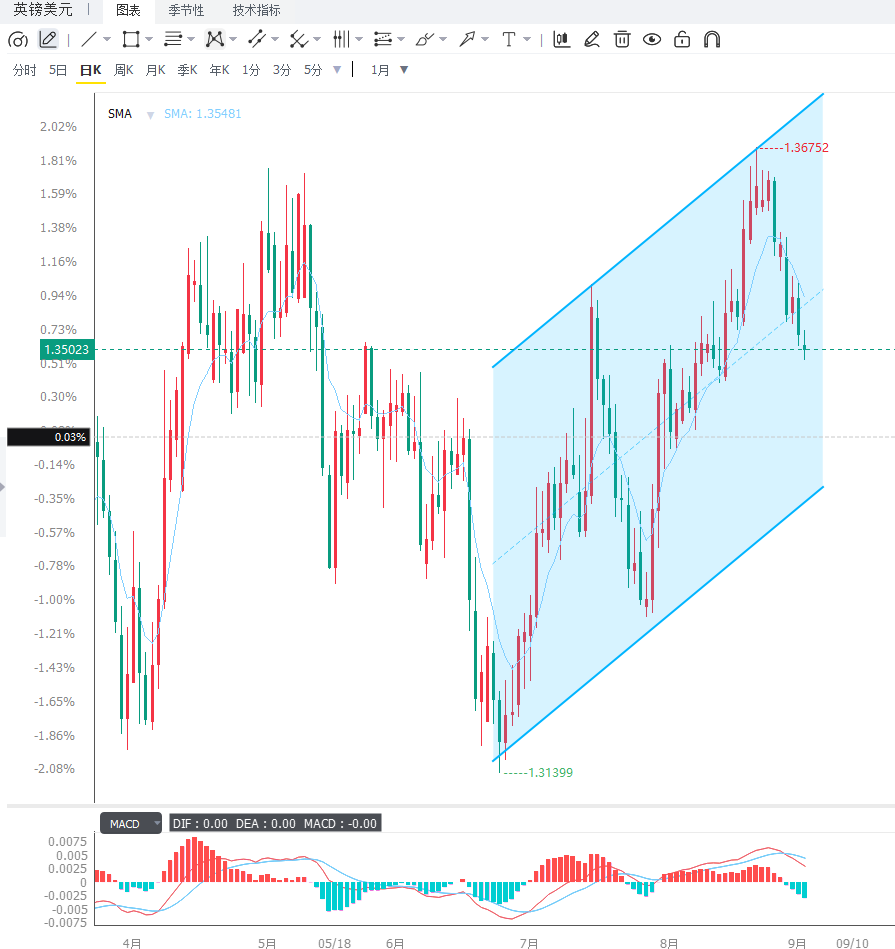
The pound/dollar pair continued its weakness in Asian trading on Wednesday, falling for the second consecutive session and trading around 1.3500. The dollar has recently regained market favor, primarily due to the rapid rise in US Treasury yields and renewed inflation concerns fueled by rising international oil prices, prompting investors to reassess the Federal Reserve's future policy path. Against the backdrop of a renewed hawkish shift in interest rate expectations, the pound/dollar pair faces significant downward pressure in the short term.  The global bond market has recently experienced a significant sell-off, with US Treasuries also under pressure. The yield on the 10-year US Treasury note rose to 4.80%, reaching its highest level since early 2025. The rapid rise in yields directly increases the attractiveness of holding dollar assets and expands the dollar's yield advantage relative to other major currencies. For GBP/USD, rising US Treasury yields often mean stronger fundamental support for dollar bulls, especially given that the Bank of England's policy expectations have not yet fully translated into a real interest rate advantage. Rising oil prices further reinforce this logic. Continued tensions in the Middle East and increased energy transportation risks have driven a rapid rebound in oil prices. Rising energy prices may be transmitted back to US inflation through transportation, production, and consumption channels, fueling market concerns about inflation remaining above target levels. For the Federal Reserve, this means that the scope for interest rate cuts may be limited, and there is even a risk of revisiting the possibility of rate hikes in the future. Recent statements from Federal Reserve officials have further strengthened interest rate support for the dollar. Federal Reserve Governor Michael Barr stated that US inflation remains high, and if inflation fails to improve further, monetary policy may still involve interest rate hikes. This means that even without a significant deterioration in the US labor market, the Federal Reserve will not easily signal a more accommodative policy stance. From a policy perspective, the core challenge facing the Federal Reserve has shifted from simply addressing economic growth to balancing inflation and employment. If energy prices continue to rise while the economy maintains some resilience, the pace of inflation decline may slow again. In this scenario, market expectations for Fed rate cuts will be suppressed, US Treasury yields may remain high, and the dollar will receive further support. However, recent US economic data is not entirely positive. The JOLTS job openings rose to 7.27 million in July, but fell short of market expectations; the US ISM Manufacturing PMI fell to 54.6 in August from 55.6 in July. Although manufacturing activity has slowed, the index remains in expansion territory, indicating that the US economy has not yet shown significant signs of slowing down. Therefore, the current data combination is insufficient to drive the market to quickly shift towards expectations of comprehensive easing. It is worth noting that US fiscal risk is becoming a potential constraint on the dollar's medium-term trend. As US government interest payments increase, the term premium for long-term Treasury bonds may continue to widen. Some market institutions believe that while US Treasury bonds are still relatively strong compared to other major bond markets, this does not completely eliminate fiscal risk. If the market begins to focus more on the sustainability of US debt in the future, the dollar may experience temporary pressure. In the UK, interest rate expectations are becoming a significant factor supporting the pound. The market currently anticipates the Bank of England may tighten by approximately 32 basis points by the end of the year, with a near 70% probability of a rate hike in November and an 80% chance of a further hike in February next year. This creates some competition with US interest rate expectations, meaning the pound is not entirely without interest rate support. Inflation in the UK retail market further reinforces this expectation. A UK retail price survey showed that shop price inflation accelerated significantly in August, reaching a two-year high. If commodity price pressures persist, the Bank of England will face greater inflationary constraints when formulating monetary policy. For the pound, higher interest rate expectations can partially offset the pressure from a stronger dollar. Therefore, the current fundamentals for GBP/USD are not unilaterally bearish. In the short term, the dollar is clearly in control, driven by rising US Treasury yields and energy prices; however, renewed inflation in the UK is limiting market expectations for further easing by the Bank of England. Whether the exchange rate can stop falling depends crucially on the speed of changes in interest rate expectations in both the US and the UK. If US inflationary pressures intensify further due to rising oil prices, while employment and economic data remain resilient, US Treasury yields may continue to remain high, and the pound/dollar pair will face further downside risk. Conversely, if the US job market cools significantly, or fiscal risks become a significant factor in dollar pricing again, a decline in US Treasury yields could weaken the dollar's advantage, and the pound could regain upward momentum. Currently, the market also needs to pay attention to speeches by Bank of England officials, US employment data, and subsequent inflation indicators. Especially given the significant fluctuations in oil prices, whether energy prices can continue to transmit to core inflation will directly affect the future policy choices of the Federal Reserve and the Bank of England, and will also be a crucial variable for the short-to-medium-term trend of the pound/dollar pair. From a daily chart perspective, the pound/dollar pair has gradually weakened after recent pullbacks from its highs, currently trading around 1.3500, with short-term bullish momentum clearly weakening. If the price continues to trade below 1.3550, the overall upside potential may be limited, with the first support level to watch being 1.3480, and further down to around 1.3450; if the weakness continues and breaks below this area, around 1.3380 may become the next support level. The key resistance levels to watch are 1.3550, 1.3600, and 1.3650, with the 1.3600 area being a crucial point of contention between bulls and bears in the short term. Only a sustained rise above 1.3600 can alleviate recent downward pressure. Looking at the 4-hour chart, GBP/USD is exhibiting a short-term downward trend with gradually lower highs, indicating that dollar buying still holds the upper hand. The 1.3500 level is both a psychological barrier and a current battleground for bulls and bears; a decisive break below this level could extend the short-term downtrend. Conversely, a significant buying surge at this level, pushing the price above 1.3550, could trigger a technical rebound and test the resistance around 1.3600. Currently, the technical structure lacks a clear reversal signal; therefore, short-term trading should focus on breakouts of key support and resistance levels rather than chasing the market within the range.
  Editor's Summary: The main pressures currently facing the GBP/USD pair stem from soaring US Treasury yields, rising oil prices, and increasing expectations of a potential Fed rate hike. However, renewed inflationary pressures in the UK and expectations of further tightening by the Bank of England this year provide some buffer for the pound. In the short term, the US dollar remains in control, with 1.3500 being a key support level to watch. A breach of this level could open up further downside potential; conversely, if US yields decline while expectations of a UK rate hike continue to rise, the GBP/USD pair could potentially rebound towards 1.3600. Overall, future price movements will largely depend on US and UK interest rate expectations and the secondary impact of energy prices on inflation.
The global bond market has recently experienced a significant sell-off, with US Treasuries also under pressure. The yield on the 10-year US Treasury note rose to 4.80%, reaching its highest level since early 2025. The rapid rise in yields directly increases the attractiveness of holding dollar assets and expands the dollar's yield advantage relative to other major currencies. For GBP/USD, rising US Treasury yields often mean stronger fundamental support for dollar bulls, especially given that the Bank of England's policy expectations have not yet fully translated into a real interest rate advantage. Rising oil prices further reinforce this logic. Continued tensions in the Middle East and increased energy transportation risks have driven a rapid rebound in oil prices. Rising energy prices may be transmitted back to US inflation through transportation, production, and consumption channels, fueling market concerns about inflation remaining above target levels. For the Federal Reserve, this means that the scope for interest rate cuts may be limited, and there is even a risk of revisiting the possibility of rate hikes in the future. Recent statements from Federal Reserve officials have further strengthened interest rate support for the dollar. Federal Reserve Governor Michael Barr stated that US inflation remains high, and if inflation fails to improve further, monetary policy may still involve interest rate hikes. This means that even without a significant deterioration in the US labor market, the Federal Reserve will not easily signal a more accommodative policy stance. From a policy perspective, the core challenge facing the Federal Reserve has shifted from simply addressing economic growth to balancing inflation and employment. If energy prices continue to rise while the economy maintains some resilience, the pace of inflation decline may slow again. In this scenario, market expectations for Fed rate cuts will be suppressed, US Treasury yields may remain high, and the dollar will receive further support. However, recent US economic data is not entirely positive. The JOLTS job openings rose to 7.27 million in July, but fell short of market expectations; the US ISM Manufacturing PMI fell to 54.6 in August from 55.6 in July. Although manufacturing activity has slowed, the index remains in expansion territory, indicating that the US economy has not yet shown significant signs of slowing down. Therefore, the current data combination is insufficient to drive the market to quickly shift towards expectations of comprehensive easing. It is worth noting that US fiscal risk is becoming a potential constraint on the dollar's medium-term trend. As US government interest payments increase, the term premium for long-term Treasury bonds may continue to widen. Some market institutions believe that while US Treasury bonds are still relatively strong compared to other major bond markets, this does not completely eliminate fiscal risk. If the market begins to focus more on the sustainability of US debt in the future, the dollar may experience temporary pressure. In the UK, interest rate expectations are becoming a significant factor supporting the pound. The market currently anticipates the Bank of England may tighten by approximately 32 basis points by the end of the year, with a near 70% probability of a rate hike in November and an 80% chance of a further hike in February next year. This creates some competition with US interest rate expectations, meaning the pound is not entirely without interest rate support. Inflation in the UK retail market further reinforces this expectation. A UK retail price survey showed that shop price inflation accelerated significantly in August, reaching a two-year high. If commodity price pressures persist, the Bank of England will face greater inflationary constraints when formulating monetary policy. For the pound, higher interest rate expectations can partially offset the pressure from a stronger dollar. Therefore, the current fundamentals for GBP/USD are not unilaterally bearish. In the short term, the dollar is clearly in control, driven by rising US Treasury yields and energy prices; however, renewed inflation in the UK is limiting market expectations for further easing by the Bank of England. Whether the exchange rate can stop falling depends crucially on the speed of changes in interest rate expectations in both the US and the UK. If US inflationary pressures intensify further due to rising oil prices, while employment and economic data remain resilient, US Treasury yields may continue to remain high, and the pound/dollar pair will face further downside risk. Conversely, if the US job market cools significantly, or fiscal risks become a significant factor in dollar pricing again, a decline in US Treasury yields could weaken the dollar's advantage, and the pound could regain upward momentum. Currently, the market also needs to pay attention to speeches by Bank of England officials, US employment data, and subsequent inflation indicators. Especially given the significant fluctuations in oil prices, whether energy prices can continue to transmit to core inflation will directly affect the future policy choices of the Federal Reserve and the Bank of England, and will also be a crucial variable for the short-to-medium-term trend of the pound/dollar pair. From a daily chart perspective, the pound/dollar pair has gradually weakened after recent pullbacks from its highs, currently trading around 1.3500, with short-term bullish momentum clearly weakening. If the price continues to trade below 1.3550, the overall upside potential may be limited, with the first support level to watch being 1.3480, and further down to around 1.3450; if the weakness continues and breaks below this area, around 1.3380 may become the next support level. The key resistance levels to watch are 1.3550, 1.3600, and 1.3650, with the 1.3600 area being a crucial point of contention between bulls and bears in the short term. Only a sustained rise above 1.3600 can alleviate recent downward pressure. Looking at the 4-hour chart, GBP/USD is exhibiting a short-term downward trend with gradually lower highs, indicating that dollar buying still holds the upper hand. The 1.3500 level is both a psychological barrier and a current battleground for bulls and bears; a decisive break below this level could extend the short-term downtrend. Conversely, a significant buying surge at this level, pushing the price above 1.3550, could trigger a technical rebound and test the resistance around 1.3600. Currently, the technical structure lacks a clear reversal signal; therefore, short-term trading should focus on breakouts of key support and resistance levels rather than chasing the market within the range. Editor's Summary: The main pressures currently facing the GBP/USD pair stem from soaring US Treasury yields, rising oil prices, and increasing expectations of a potential Fed rate hike. However, renewed inflationary pressures in the UK and expectations of further tightening by the Bank of England this year provide some buffer for the pound. In the short term, the US dollar remains in control, with 1.3500 being a key support level to watch. A breach of this level could open up further downside potential; conversely, if US yields decline while expectations of a UK rate hike continue to rise, the GBP/USD pair could potentially rebound towards 1.3600. Overall, future price movements will largely depend on US and UK interest rate expectations and the secondary impact of energy prices on inflation.
- Risk Warning and Disclaimer
- The market involves risk, and trading may not be suitable for all investors. This article is for reference only and does not constitute personal investment advice, nor does it take into account certain users’ specific investment objectives, financial situation, or other needs. Any investment decisions made based on this information are at your own risk.