After twice encountering resistance above 160, and repeatedly failing to break through support below: Amid global bond market panic, what should the USD/JPY pair watch next?
2026-09-02 19:30:04
On Wednesday (September 2), the global bond sell-off continued, with US Treasury yields rising further, reaching 4.810% for the 10-year Treasury. The US dollar rose to 160.389 against the Japanese yen before falling back to around 159.90. Signals of a September rate hike by the Bank of Japan and pressure from the US Treasury Secretary regarding the yen's undervaluation amplified volatility in carry trades. A stronger dollar weighed on gold, while oil prices consolidated at high levels.  Global bond yields rose, with Japan's 10-year yield breaking 3% for the first time in 30 years, and the USD/JPY pair fluctuating around 160. Traders are truly concerned about whether the Bank of Japan will raise interest rates in September, whether US Treasury yields will continue to rise, and whether the US's weakness towards the yen will escalate into concrete action. This article translates publicly available information into risk and sentiment language: where are the chart support and resistance levels, how policy signals change expectations, and which events might amplify volatility. The positions mentioned in this article are for observation and reference only and do not constitute investment advice.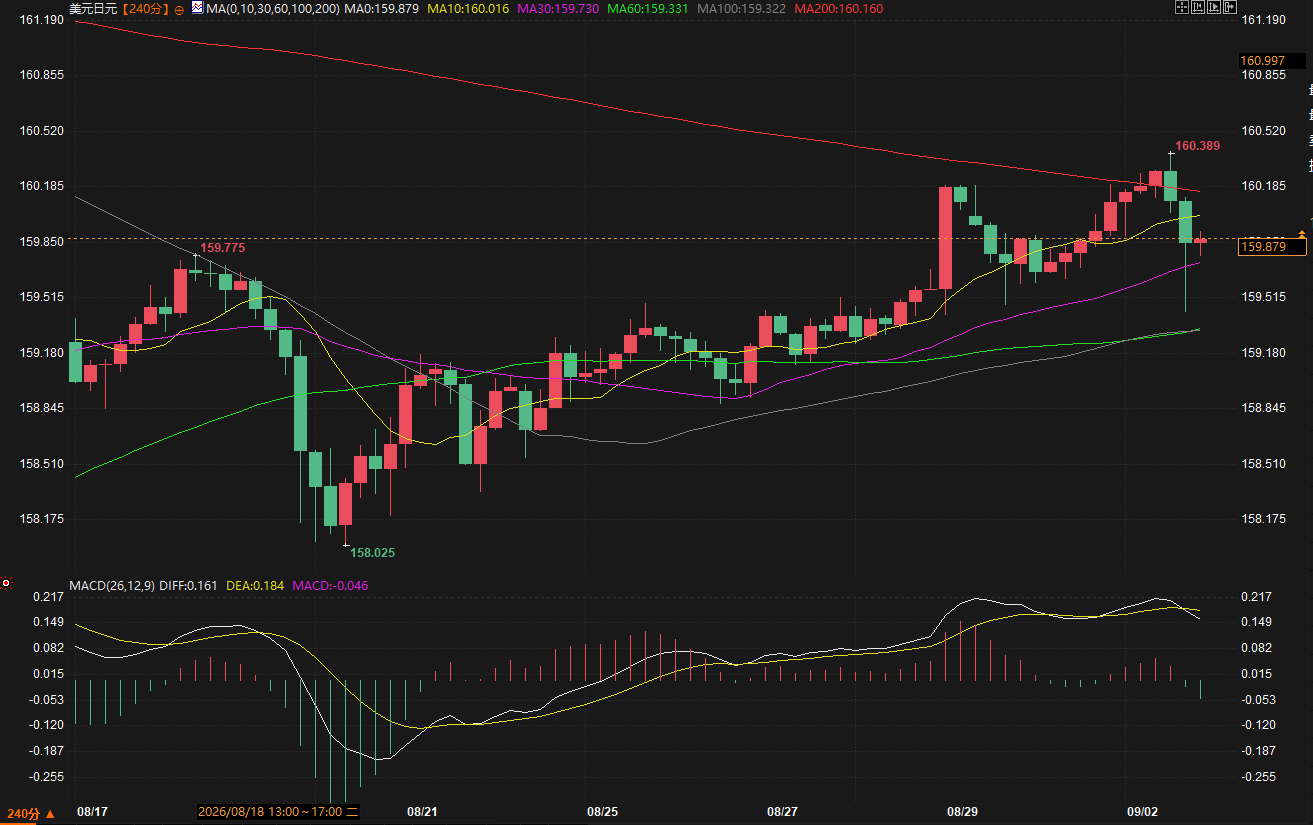
Global bond yields rose, with Japan's 10-year yield breaking 3% for the first time in 30 years, and the USD/JPY pair fluctuating around 160. Traders are truly concerned about whether the Bank of Japan will raise interest rates in September, whether US Treasury yields will continue to rise, and whether the US's weakness towards the yen will escalate into concrete action. This article translates publicly available information into risk and sentiment language: where are the chart support and resistance levels, how policy signals change expectations, and which events might amplify volatility. The positions mentioned in this article are for observation and reference only and do not constitute investment advice.US Treasury yields continued to rise, and the USD/JPY pair tested its upper resistance level.
US Treasury yields rose across the board, with the 10-year yield climbing to 4.810% and the 2-year yield to 4.405%, while the US dollar index also rose. The US-Japan interest rate differential remained high, pushing the USD/JPY exchange rate to 160.389 overnight. However, prices failed to hold above this level, falling back to around 159.90 during the European session. The G20 summit offered no reassuring signals, and bond selling continued. Spot gold fell 0.46%, pressured by both the dollar and yields.The Bank of Japan's September signal fueled expectations of a rate hike, but disagreements persisted.
The yield on Japanese 10-year government bonds broke 3% for the first time in 30 years, and the yield curve flattened. Hawkish board member Hajime Takada stated that policy normalization has entered a new phase, and a flexible rate hike may be needed in September. Governor Ueda also signaled a debate. The market is discussing the possibility of a 50 basis point rate hike or two consecutive hikes. Major overseas institutions cautioned that Takada is among the few hawks, and his comments should not be overemphasized; if a September rate hike occurs, the tightening pace will be faster than expected, potentially providing short-term support for the yen.US pressure on yen undervaluation raises risk of verbal intervention.
US Treasury Secretary Bessenter met with Ueda, emphasizing anchoring inflation expectations, avoiding excessive exchange rate volatility, and supporting Japan's correction of the yen's undervaluation. This implies that the US is no longer condoning a weak yen. Traders fear that "verbal pressure" will escalate into actual intervention. Policy maneuvering increases upward resistance for the exchange rate and may amplify volatility.Chart support and resistance: resistance above 160, support below 159 needs further confirmation.
The current 240-minute chart shows resistance concentrated at 160.16 and 160.39, corresponding to the 200-day moving average (MA200) and a recent high, respectively. Support levels are at 159.73, 159.43, and 158.03. The price is currently at 159.90, in a consolidation zone between support and resistance. The MACD has formed a bearish crossover at a high level, and the price has broken below the MA10 and MA20, indicating weakening short-term momentum; however, the MA60, MA100, and MA200 are still trending upwards, suggesting the long-term structure has not weakened. If the price fails to regain 160.16, the support levels of 159.73 and 159.43 will be tested; if it breaks below 159.43, 158.03 becomes the next level to watch.Trend Outlook
In the short term, USD/JPY may find direction within the 159.43-160.39 range. If US Treasury yields continue to rise, the price still has upward momentum to test 160.16-160.39; if the Bank of Japan signals a stronger rate hike or the US continues to exert pressure, the exchange rate may retrace to 159.73 and 159.43. In the long term, the USD/JPY interest rate differential continues to provide support, but the normalization of Japanese policy and the tightening stance of the US limit upside potential. High volatility may continue, and a clear unilateral trend is currently unclear.Frequently Asked Questions
Why is the USD/JPY pair fluctuating around 160? Rising US Treasury yields support the dollar, while expectations of a Bank of Japan rate hike and pressure from the US are limiting upward potential, creating a tug-of-war between bulls and bears near the resistance zone. Is a September rate hike by the Bank of Japan likely? Both Ueda and Takata have released signals, fueling market discussion, but Takata is among the hawkish minority, and overseas institutions warn against over-pricing; if a rate hike occurs, the tightening pace will be faster than expected. How do US Treasury yields affect the yen and gold? Rising US Treasury yields widen the USD/JPY interest rate differential, negatively impacting the yen; simultaneously, rising real interest rates and a stronger dollar are suppressing gold, with overnight gold prices falling 0.46%. Where are the support and resistance levels? Resistance levels are at 160.16 and 160.39; support levels are at 159.73, 159.43, and 158.03. The price is currently around 159.90, between support and resistance. Will US pressure trigger intervention? The US Treasury Secretary's support for correcting the yen's undervaluation increases policy uncertainty. The market needs to be wary of the tail risk of verbal pressure escalating into actual intervention, but there is no clear timetable yet.- Risk Warning and Disclaimer
- The market involves risk, and trading may not be suitable for all investors. This article is for reference only and does not constitute personal investment advice, nor does it take into account certain users’ specific investment objectives, financial situation, or other needs. Any investment decisions made based on this information are at your own risk.