Gold prices rebounded, while volatility in the yen cross-currency market weighed on the dollar.
2026-09-03 01:18:03
On Wednesday (September 2), spot gold rebounded sharply during the US trading session, recovering all of its previous losses. A sudden strengthening of the yen triggered a broad sell-off of the dollar, coupled with a decline in US Treasury yields, providing a double boost to the precious metal. At the time of writing, spot gold was trading around $4373, up nearly 1.0% on the day; previously, gold prices had fallen to a daily low of $4282, the lowest level since August 7.  The US dollar fell sharply against the Japanese yen during the US trading session, after the pair approached the 160 level, leading to speculation that Japanese authorities had intervened in the foreign exchange market again. The yen's strength spread to all yen crosses, with the euro/yen, pound/yen, and Australian dollar/yen all experiencing significant declines. However, there is currently no official confirmation of Japanese intervention in the foreign exchange market. Weaker-than-expected US labor market data also weighed on the dollar. The ADP private sector employment report showed that the US private sector added 38,000 jobs in August, lower than the market expectation of 47,000 and the previous month's figure of 46,000. The US dollar index (DXY) is currently around 99.55, down 0.12% from its August 14 high of 99.86. Even with a short-term recovery in gold prices, the overall environment for gold remains challenging. After several weeks of relative calm, renewed conflict in the Middle East, rising oil prices, renewed inflation concerns, and a sell-off in global bonds have all contributed to this situation. The yield on the benchmark 10-year U.S. Treasury note touched 4.81%, a new high since October 2023, before falling back to around 4.79%. Higher yields increase the opportunity cost of holding gold, a non-interest-bearing asset, putting downward pressure on gold prices. New York Fed President John Williams stated on Wednesday, "The rise in yields stems from strong economic fundamentals and a positive economic outlook, not from inflation expectations." He also pointed out a correlation between bond yield movements and the Middle East conflict. Regarding monetary policy, the market has increased its bets on the Fed starting a rate hike in September. Last week, Fed Chairman Kevin Warsh's hawkish comments on inflation at the Jackson Hole global central bank symposium further strengthened expectations of a rate hike. The CME FedWatch Tool shows that the probability of a rate hike at the September 15-16 meeting has risen to approximately 64%, compared to only 36% a week ago. Against this backdrop, if the dollar sell-off continues, gold is expected to continue its short-term recovery. However, hawkish expectations from the Fed, high U.S. Treasury yields, and the inflation risks from the Middle East conflict will limit further upside potential for gold prices. Traders will now focus on Friday's US non-farm payrolls report, which will change market expectations regarding the Fed's interest rate path and drive the next round of price movements for the dollar, Treasury yields, and gold. Technical Analysis: Bears Struggle to Break Below 100-Day Moving Average Support Spot gold is currently holding just above the 100-day simple moving average around $4361, providing fragile downside protection, but the price remains below the Bollinger Band middle line (approximately $4450).
 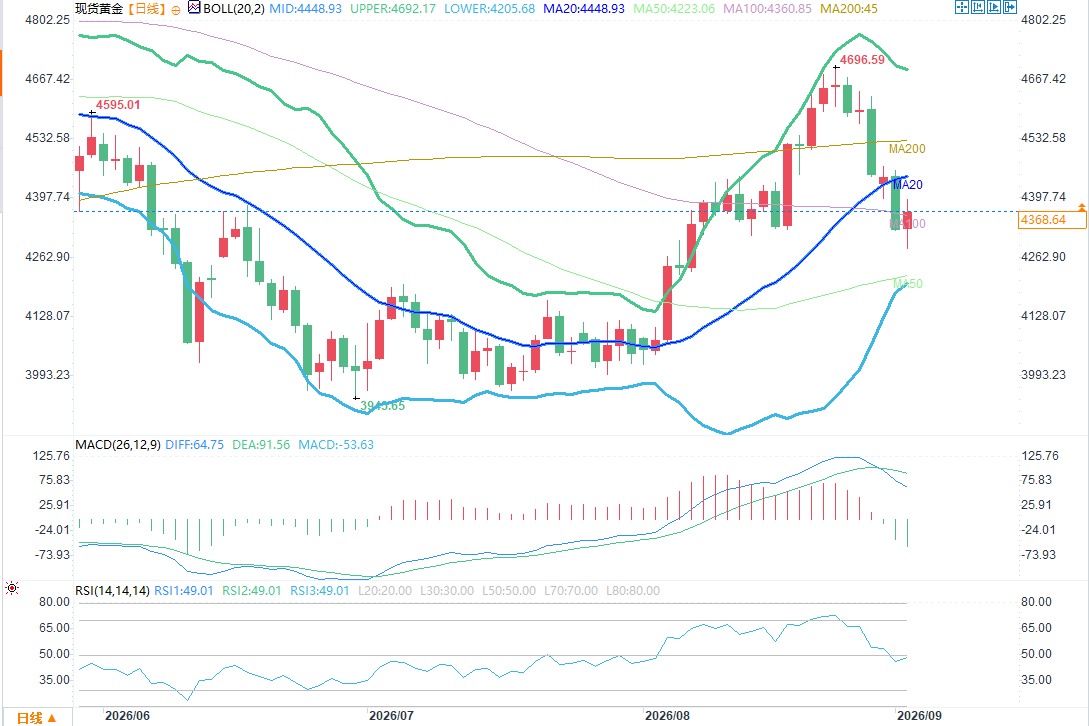 (Spot Gold Daily Chart Source: FX678) The daily Relative Strength Index (RSI) is hovering around the 50 level, while the MACD histogram remains in negative territory; both indicators suggest weakening bullish momentum, and the current gold price is generally trending towards a neutral range-bound pattern. On the upside, the first resistance level is at the 20-period Bollinger Band moving average around $4450; if the bulls regain control, the next significant resistance level is the upper Bollinger Band at $4685. On the downside, the 100-day moving average at $4361 provides immediate support, followed by the lower Bollinger Band at $4215. If selling pressure intensifies further and the gold price falls deeply, the next key support level will be the psychological level of $4000.
The US dollar fell sharply against the Japanese yen during the US trading session, after the pair approached the 160 level, leading to speculation that Japanese authorities had intervened in the foreign exchange market again. The yen's strength spread to all yen crosses, with the euro/yen, pound/yen, and Australian dollar/yen all experiencing significant declines. However, there is currently no official confirmation of Japanese intervention in the foreign exchange market. Weaker-than-expected US labor market data also weighed on the dollar. The ADP private sector employment report showed that the US private sector added 38,000 jobs in August, lower than the market expectation of 47,000 and the previous month's figure of 46,000. The US dollar index (DXY) is currently around 99.55, down 0.12% from its August 14 high of 99.86. Even with a short-term recovery in gold prices, the overall environment for gold remains challenging. After several weeks of relative calm, renewed conflict in the Middle East, rising oil prices, renewed inflation concerns, and a sell-off in global bonds have all contributed to this situation. The yield on the benchmark 10-year U.S. Treasury note touched 4.81%, a new high since October 2023, before falling back to around 4.79%. Higher yields increase the opportunity cost of holding gold, a non-interest-bearing asset, putting downward pressure on gold prices. New York Fed President John Williams stated on Wednesday, "The rise in yields stems from strong economic fundamentals and a positive economic outlook, not from inflation expectations." He also pointed out a correlation between bond yield movements and the Middle East conflict. Regarding monetary policy, the market has increased its bets on the Fed starting a rate hike in September. Last week, Fed Chairman Kevin Warsh's hawkish comments on inflation at the Jackson Hole global central bank symposium further strengthened expectations of a rate hike. The CME FedWatch Tool shows that the probability of a rate hike at the September 15-16 meeting has risen to approximately 64%, compared to only 36% a week ago. Against this backdrop, if the dollar sell-off continues, gold is expected to continue its short-term recovery. However, hawkish expectations from the Fed, high U.S. Treasury yields, and the inflation risks from the Middle East conflict will limit further upside potential for gold prices. Traders will now focus on Friday's US non-farm payrolls report, which will change market expectations regarding the Fed's interest rate path and drive the next round of price movements for the dollar, Treasury yields, and gold. Technical Analysis: Bears Struggle to Break Below 100-Day Moving Average Support Spot gold is currently holding just above the 100-day simple moving average around $4361, providing fragile downside protection, but the price remains below the Bollinger Band middle line (approximately $4450). (Spot Gold Daily Chart Source: FX678) The daily Relative Strength Index (RSI) is hovering around the 50 level, while the MACD histogram remains in negative territory; both indicators suggest weakening bullish momentum, and the current gold price is generally trending towards a neutral range-bound pattern. On the upside, the first resistance level is at the 20-period Bollinger Band moving average around $4450; if the bulls regain control, the next significant resistance level is the upper Bollinger Band at $4685. On the downside, the 100-day moving average at $4361 provides immediate support, followed by the lower Bollinger Band at $4215. If selling pressure intensifies further and the gold price falls deeply, the next key support level will be the psychological level of $4000.
- Risk Warning and Disclaimer
- The market involves risk, and trading may not be suitable for all investors. This article is for reference only and does not constitute personal investment advice, nor does it take into account certain users’ specific investment objectives, financial situation, or other needs. Any investment decisions made based on this information are at your own risk.