One chart: The Baltic Dry Index rises sharply, ushering in a boom in dry bulk shipping.
2026-09-03 01:33:03
The latest data shows that the Baltic Dry Index (BDI) reached 3331 points on September 2, 2026, a new high since December 4, 2023, representing a 5.51% increase compared to the previous month, the largest increase since July 8, 2026. Looking at the short-term charts, the BDI has seen positive growth 8 times, negative growth 3 times, and zero growth 0 times in the last 11 BDI data points. Specifically, the Panamax Freight Index (BPI) reached 2429 points, up 2.92% from the previous month; the Capesize Freight Index (BCI) reached 5642 points, up 8.06%; and the Supramax Freight Index (BSI) reached 1657 points, up 0.42%. For detailed charts of the latest 720-day and 10-year trends of the Baltic Dry Index and its three main sub-indices, please refer to the charts specially created by FX678. 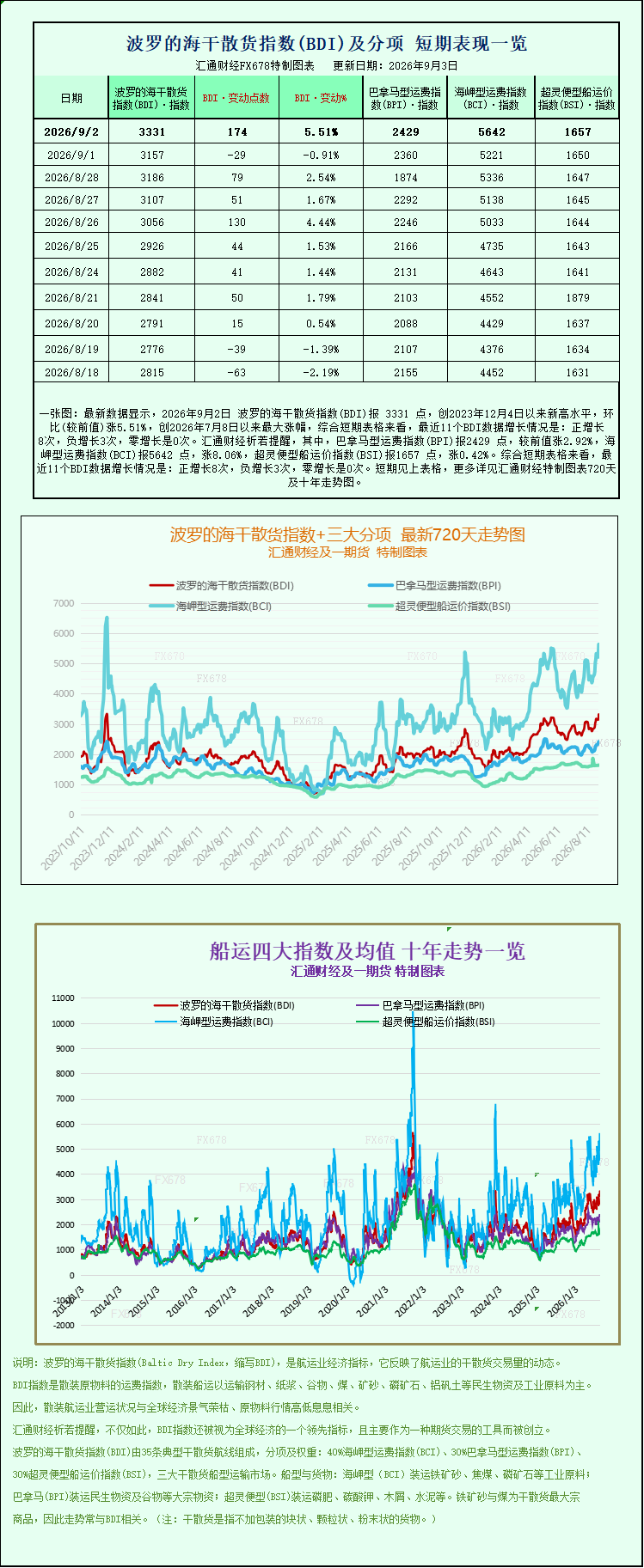 On September 2, 2026, it was reported that driven by a comprehensive strengthening of freight rates across all ship types, the Baltic Dry Index (BDI), a bellwether for the global dry bulk shipping market, climbed to its highest level since December 2023 on Wednesday, fully demonstrating a significant increase in the activity of international bulk raw material maritime trade. The Baltic Dry Index rose 174 points in a single day, an increase of 5.5%, closing at 3331 points, a high point in nearly three years. Indices for all ship types rose simultaneously, indicating a broad-based expansion of the shipping market's prosperity. The Baltic Dry Index primarily tracks charter rates for three main types of dry bulk vessels: Capesize, Panamax, and Supramax, corresponding to the ocean shipping of commodities such as iron ore, coal, and grain. The rise and fall of the index directly reflects changes in the global supply and demand pattern of industrial raw materials and agricultural products by sea. In this round of market activity, Capesize vessels, the largest in size, have become the core force driving the index upward. The Capesize index surged 421 points, or 8.1%, to close at 5642, also setting a new high since December 2023. These vessels, with a deadweight tonnage of approximately 150,000 tons, primarily transport basic industrial raw materials such as iron ore and coking coal. Their average daily spot earnings rose by $3,819 to $47,666, significantly improving shipowner profitability. The Panamax market also saw a marked recovery, with the Panamax index rising 69 points, or 2.9%, to 2429, a more than three-month high. Panamax vessels typically carry 60,000-70,000 tons of coal or grain and are the mainstay of transoceanic grain and thermal coal trade. Average daily charter rates increased by $628 to $21,865, as the gradual commencement of new North American soybean and corn exports provided stable cargo support for Panamax vessels. Smaller Supramax vessels saw a relatively moderate increase, with the Supramax index rising 7 points, or 0.4%, to 1657. These vessels have shallow drafts, are suitable for a wide range of ports, and handle small-batch bulk cargo transshipment globally, thus strengthening in tandem with the broader market. Notably, while shipping freight rates surged, iron ore futures moved in the opposite direction, declining in price. This divergence stems from a misalignment in the fundamentals of the upstream and downstream of the industry chain: on the one hand, rising coking coal prices continue to squeeze steel companies' profit margins, suppressing their production enthusiasm; on the other hand, iron ore inventories at major ports remain relatively high, leading to a general market perception of ample raw material supply, directly suppressing iron ore futures performance. In other words, the rise in shipping freight rates is largely driven by increased demand from long-haul cargo releases and longer shipping routes, rather than a surge in downstream steel industry demand. Commodity spot prices remain constrained by domestic steel mill profits and inventory levels, creating a unique market situation of "rising shipping costs and weakening iron ore prices." From a deeper market perspective, the recent surge in dry bulk freight rates is the result of a confluence of factors. As the third quarter draws to a close, the traditional peak season for global dry bulk shipping officially begins, with concentrated shipments of iron ore, coal, and North American grains generating a significant increase in new shipping volumes. Simultaneously, the commissioning of some new iron ore projects has led to increased long-distance maritime trade, lengthening the overall average shipping distance and amplifying demand per tonne mile. This necessitates more vessels to transport the same volume of cargo, providing strong support for freight rates. On the supply side, the pace of new deliveries to the global dry bulk fleet is limited, coupled with new environmental regulations constraining the operational efficiency of older vessels, limiting the expansion of available shipping capacity and further amplifying the upward elasticity of freight rates. However, structural differentiation exists within the market, with large Capesize vessels experiencing significantly larger price increases, while the increases for small and medium-sized vessels are relatively limited. This reflects that current incremental demand in the market is concentrated on large-tonnage cargoes such as iron ore and bulk coal. Looking ahead, market participants need to continuously monitor two key variables: first, the actual export pace of global bulk commodities in the fourth quarter, including changes in shipments of grains from the Americas and minerals from Australia and Brazil; and second, the recovery of profits in the downstream steel industry. If steel mills continue to face pressure to reduce production, it may conversely affect iron ore shipping volumes, putting downward pressure on high freight rates. The Baltic Dry Index's recent near three-year high directly reflects the current tight balance between supply and demand in the international dry bulk shipping market. However, it also reminds market participants that a booming shipping market does not equate to a comprehensive strengthening of downstream real demand. The divergence between shipping and commodity prices also necessitates that investors consider the fundamentals of the shipping market and the commodity spot market separately, and rationally predict future market trends.
On September 2, 2026, it was reported that driven by a comprehensive strengthening of freight rates across all ship types, the Baltic Dry Index (BDI), a bellwether for the global dry bulk shipping market, climbed to its highest level since December 2023 on Wednesday, fully demonstrating a significant increase in the activity of international bulk raw material maritime trade. The Baltic Dry Index rose 174 points in a single day, an increase of 5.5%, closing at 3331 points, a high point in nearly three years. Indices for all ship types rose simultaneously, indicating a broad-based expansion of the shipping market's prosperity. The Baltic Dry Index primarily tracks charter rates for three main types of dry bulk vessels: Capesize, Panamax, and Supramax, corresponding to the ocean shipping of commodities such as iron ore, coal, and grain. The rise and fall of the index directly reflects changes in the global supply and demand pattern of industrial raw materials and agricultural products by sea. In this round of market activity, Capesize vessels, the largest in size, have become the core force driving the index upward. The Capesize index surged 421 points, or 8.1%, to close at 5642, also setting a new high since December 2023. These vessels, with a deadweight tonnage of approximately 150,000 tons, primarily transport basic industrial raw materials such as iron ore and coking coal. Their average daily spot earnings rose by $3,819 to $47,666, significantly improving shipowner profitability. The Panamax market also saw a marked recovery, with the Panamax index rising 69 points, or 2.9%, to 2429, a more than three-month high. Panamax vessels typically carry 60,000-70,000 tons of coal or grain and are the mainstay of transoceanic grain and thermal coal trade. Average daily charter rates increased by $628 to $21,865, as the gradual commencement of new North American soybean and corn exports provided stable cargo support for Panamax vessels. Smaller Supramax vessels saw a relatively moderate increase, with the Supramax index rising 7 points, or 0.4%, to 1657. These vessels have shallow drafts, are suitable for a wide range of ports, and handle small-batch bulk cargo transshipment globally, thus strengthening in tandem with the broader market. Notably, while shipping freight rates surged, iron ore futures moved in the opposite direction, declining in price. This divergence stems from a misalignment in the fundamentals of the upstream and downstream of the industry chain: on the one hand, rising coking coal prices continue to squeeze steel companies' profit margins, suppressing their production enthusiasm; on the other hand, iron ore inventories at major ports remain relatively high, leading to a general market perception of ample raw material supply, directly suppressing iron ore futures performance. In other words, the rise in shipping freight rates is largely driven by increased demand from long-haul cargo releases and longer shipping routes, rather than a surge in downstream steel industry demand. Commodity spot prices remain constrained by domestic steel mill profits and inventory levels, creating a unique market situation of "rising shipping costs and weakening iron ore prices." From a deeper market perspective, the recent surge in dry bulk freight rates is the result of a confluence of factors. As the third quarter draws to a close, the traditional peak season for global dry bulk shipping officially begins, with concentrated shipments of iron ore, coal, and North American grains generating a significant increase in new shipping volumes. Simultaneously, the commissioning of some new iron ore projects has led to increased long-distance maritime trade, lengthening the overall average shipping distance and amplifying demand per tonne mile. This necessitates more vessels to transport the same volume of cargo, providing strong support for freight rates. On the supply side, the pace of new deliveries to the global dry bulk fleet is limited, coupled with new environmental regulations constraining the operational efficiency of older vessels, limiting the expansion of available shipping capacity and further amplifying the upward elasticity of freight rates. However, structural differentiation exists within the market, with large Capesize vessels experiencing significantly larger price increases, while the increases for small and medium-sized vessels are relatively limited. This reflects that current incremental demand in the market is concentrated on large-tonnage cargoes such as iron ore and bulk coal. Looking ahead, market participants need to continuously monitor two key variables: first, the actual export pace of global bulk commodities in the fourth quarter, including changes in shipments of grains from the Americas and minerals from Australia and Brazil; and second, the recovery of profits in the downstream steel industry. If steel mills continue to face pressure to reduce production, it may conversely affect iron ore shipping volumes, putting downward pressure on high freight rates. The Baltic Dry Index's recent near three-year high directly reflects the current tight balance between supply and demand in the international dry bulk shipping market. However, it also reminds market participants that a booming shipping market does not equate to a comprehensive strengthening of downstream real demand. The divergence between shipping and commodity prices also necessitates that investors consider the fundamentals of the shipping market and the commodity spot market separately, and rationally predict future market trends.
- Risk Warning and Disclaimer
- The market involves risk, and trading may not be suitable for all investors. This article is for reference only and does not constitute personal investment advice, nor does it take into account certain users’ specific investment objectives, financial situation, or other needs. Any investment decisions made based on this information are at your own risk.