The Fed's third-in-command said the surge in US Treasury yields reflects a strong economy, but the probability of a rate hike is already 62%. Who should we believe for the dollar?
2026-09-03 10:58:05
New York Federal Reserve President John Williams said on Wednesday (September 3) that the recent surge in U.S. Treasury yields reflects a strong economy driven by AI and data center investment, rather than market failure, a statement that helped alleviate investor concerns about bond market volatility. As a permanent voting member of the FOMC, Williams' views carry particular weight. He stated that rising yields are "more about the economy influencing financial conditions than financial conditions influencing the economy"—a crucial distinction: a surge in yields caused by dysfunction requires a more decisive policy response, while a surge driven by strong growth expectations supports patience and data reliance. Williams is taking a wait-and-see approach to a September rate hike, noting that inflation expectations remain well anchored, despite price pressures from tariffs and the U.S.-Iran conflict. He pointed out that recent inflation data is encouraging, but cautioned against overinterpreting short-term data. 
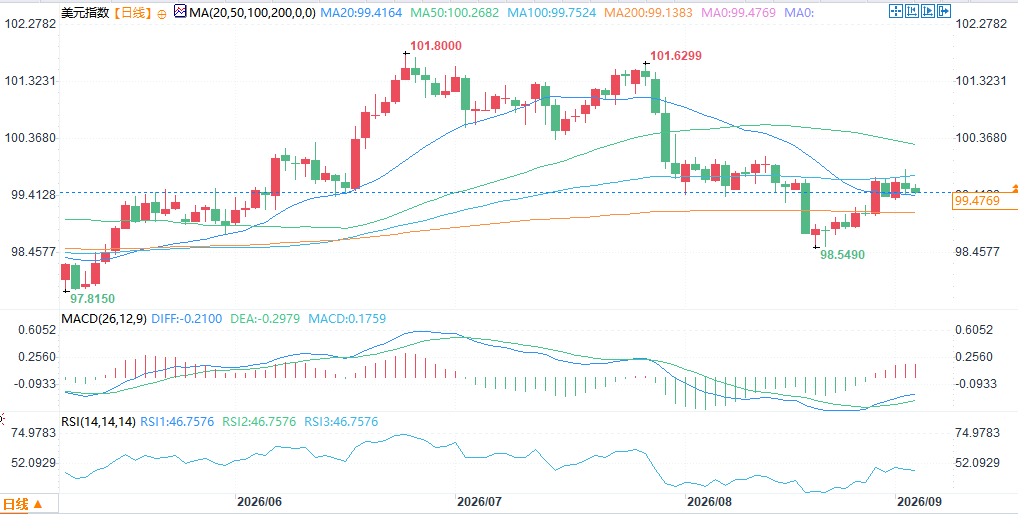 (US Dollar Index Daily Chart, Source: FX678) At 10:56 Beijing time, the US Dollar Index was at 99.46.
Williams: Soaring yields reflect a strong economy, not market failure.
New York Federal Reserve President Williams recently stated that the recent significant surge in U.S. Treasury yields primarily reflects strong economic fundamentals driven by large-scale investment in artificial intelligence and data centers, rather than a failure or dysfunction in the bond market. As a permanent voting member of the Federal Open Market Committee (FOMC), his views carry significant weight in the market. Williams pointed out that the current rise in yields is "more a reflection of economic fundamentals influencing financial conditions than financial conditions impacting the economy." He further distinguished between two scenarios: if the yield surge is triggered by market dysfunction, a more decisive policy response is needed, including potential direct intervention; while if it stems from strong growth expectations, a patient and data-dependent policy stance is supported. Williams explicitly categorized the current situation as the latter, suggesting that the Fed does not currently need to actively suppress bond yields through policy action, and the market should focus more on the sustainability of economic momentum itself.A wait-and-see attitude is expected regarding a September rate hike; anchoring inflation expectations is key.
Williams is clearly taking a wait-and-see approach regarding a September rate hike. He stated, "There are currently no clear signs that monetary policy is sufficient to push inflation back to its target over the next year or two, or that further action is needed." He acknowledged that recent inflation data has been generally encouraging, but emphasized the need to avoid overinterpreting short-term fluctuations. Williams specifically pointed out that inflation expectations remain well anchored—a core prerequisite for the Fed to tolerate price volatility in the short term without taking aggressive action. He would be prepared to take more decisive action should inflation expectations show signs of decoupling. CME data shows that the market's probability of a September rate hike has risen to approximately 62%. His remarks suggest that the final rate hike decision will depend more on whether underlying inflation and growth data validate the current yield trend, rather than simply on the level of yields themselves.Institutional Views
While Williams' narrative of a "strong economy" provided reassurance to the market, institutional opinions on the short-term direction of the US dollar are not entirely aligned—rising expectations of interest rate hikes are providing new support for the dollar, while medium-term structural concerns pose a potential headwind. ING's latest FX strategy team believes the dollar still has upward momentum in the short term. Although rising long-term US Treasury yields have triggered concerns about a "dollar devaluation trade" (the market worries that the Treasury may expand repurchase operations again), Fed Chairman Warsh's hawkish remarks and rising energy prices have significantly boosted expectations of a September rate hike. ING points out that the cyclical Fed policy narrative is likely to outweigh structural devaluation concerns, and the dollar index is expected to gradually move towards the 100.10–100.20 range, with further upside potential. MUFG, in its latest monthly outlook, provides a clear path: the dollar index is expected to close at approximately 100.19 in Q3 2026, fall back to 98.07 in Q4, and then further decline to the 96.5–96.2 range in the first half of 2027. In the short term, supported by rising expectations of a Fed rate hike and geopolitical risks, the index is expected to hold near 100; however, the medium-term outlook is bearish. The main logic is that the tightening pace of other major central banks (especially the ECB and the Bank of Japan) will narrow the interest rate differential advantage, while the continued pressure from the US fiscal deficit and Treasury supply, coupled with potential policy uncertainty, will gradually weaken the dollar's attractiveness. MUFG emphasizes that while the September Fed meeting is crucial, even if a rate hike occurs, it will be difficult to change the medium-term weakening trend of the dollar.Summarize
Williams stated that the surge in yields reflects a strong economy rather than market failure, and he remains cautious about a September rate hike, with inflation expectations well anchored. CME data shows a roughly 62% probability of a September rate hike. The US dollar may remain relatively strong in the short term, but the tug-of-war between yield movements and rate hike expectations continues. Williams' remarks provided the market with a narrative of a "strong economy," but rising rate hike expectations mean that the dollar's upward trend may continue until data shows a turning point. Pay attention to subsequent AI investment data and the evolution of inflation expectations. (US Dollar Index Daily Chart, Source: FX678) At 10:56 Beijing time, the US Dollar Index was at 99.46.
- Risk Warning and Disclaimer
- The market involves risk, and trading may not be suitable for all investors. This article is for reference only and does not constitute personal investment advice, nor does it take into account certain users’ specific investment objectives, financial situation, or other needs. Any investment decisions made based on this information are at your own risk.