The dollar fell sharply against the yen as expectations of a Bank of Japan rate hike increased and the dollar weakened.
2026-09-03 14:06:07
The USD/JPY pair remained under pressure, falling back to around 157.30 during Thursday's Asian trading session. The strengthening yen was the main factor driving the decline, with the Bank of Japan's recent policy signals clearly leaning towards tightening, and market pricing in a September rate hike rapidly intensifying. Latest market information shows that the yen rose to around 157.55, its strongest level in nearly a month, indicating a significant increase in market expectations for the Bank of Japan to accelerate policy normalization.  Bank of Japan Governor Kazuo Ueda previously stated that the central bank will discuss whether to adjust interest rates at its September meeting, focusing on assessing whether inflation risks have risen further. Meanwhile, BOJ policy board member Hajime Takada recently proposed a more flexible path for interest rate hikes, prompting the market to reassess the pace and magnitude of future BOJ rate hikes. Currently, the market has largely priced in a 25 basis point rate hike in September, with some traders even discussing the possibility of a larger increase. This change directly weakens the interest rate differential logic previously relied upon by USD/JPY. For some time, the significant interest rate differential between the US and Japan has been a major factor driving the yen's weakness, but as the BOJ gradually releases more hawkish policy signals, the market is beginning to pre-indulge the possibility of further increases in Japanese interest rates. If Japanese government bond yields remain high, the attractiveness of yen assets may further improve, prompting adjustments in some carry trades. The US dollar itself also faces new pressure. US ADP private sector employment increased by only 38,000 in August, lower than the market expectation of 47,000 and also lower than the revised 46,000 in July. The significant slowdown in job growth has made investors more concerned about whether the US labor market is showing signs of a sustained cooling. Latest market pricing indicates a roughly 62% probability of a Fed rate hike in September, which remains high. However, if Friday's non-farm payroll data is significantly weaker than expected, the market may lower its rate hike bets again. Currently, the market expects US non-farm payrolls to increase by approximately 56,000-58,000 in August, with the unemployment rate remaining around 4.1%. If actual employment figures significantly exceed expectations, while the unemployment rate remains stable or even declines, US Treasury yields may rise again, providing support for the US dollar and potentially leading to a rebound in USD/JPY. Conversely, if the non-farm payroll data worsens further, Fed rate hike expectations may decrease, while Bank of Japan rate hike expectations remain high, further narrowing the interest rate advantage of USD/JPY. Furthermore, market speculation about Japanese intervention in the foreign exchange market has increased short-term yen volatility. After USD/JPY quickly fell below 159, some market participants linked this to signs of potential "currency checks" by Japanese authorities. However, the latest analysis suggests that this round of rapid yen appreciation is more likely due to a repricing of Bank of Japan policy expectations rather than any new direct intervention. From a broader market perspective, the situation in the Middle East remains a significant variable influencing the US dollar and the Japanese yen. High oil prices may push up global inflationary pressures, thus limiting the easing space of major central banks; however, given the significantly deteriorating risk sentiment, the yen may still benefit from safe-haven demand. The current decline in the US dollar index further weakens the upward momentum of USD/JPY. Therefore, the main contradiction in USD/JPY has shifted from simply the US-Japan interest rate differential to the policy game between the Bank of Japan's interest rate hike expectations and US employment data . Before Friday's non-farm payrolls report, the market may maintain a bearish but highly volatile trading pattern. On the daily chart, USD/JPY is currently trading around 157.30 , having broken below the 200-day moving average of approximately 158.47 and further approaching the psychological level of 157, indicating a significantly strengthened short-term bearish structure. At the same time, the price is below the 10-day moving average of 159.27, the 21-day moving average of 159.14, and the 100-day moving average of 159.99, with the moving averages above forming a dense resistance. The RSI has dropped to around 33, and the MACD remains negative, indicating that bearish momentum is dominant. However, the RSI is approaching oversold territory, suggesting a possible technical rebound after the continuous decline. The first resistance level to watch is the 158.00 area, formed by the 21-day and 10-day moving averages. A successful break above this level would alleviate short-term downward pressure. Further resistance lies at the 100-day moving average around 158.60 ; a break above this level could lead to a retest of the upper Bollinger Band around 160.00. The first support level is around 157.00 , close to the lower Bollinger Band and recent lows. A break below this level could see the price move towards 156.67 or even 156.00 for support. On the 4-hour chart, USD/JPY remains in a clear downtrend, and the rebound after the price quickly broke below 159 has been limited. The area around 157.00 is currently a key battleground between bulls and bears. If the price can hold this support level, a technical correction and a retest of the 157.70-158.20 range are possible. However, if 157.00 is breached, the bears could further extend their advantage. Considering the current RSI, MACD, and moving average structures, the short-term trend remains one of downward consolidation. Only a sustained move above 159.20 could potentially reverse the current consolidation pattern.
 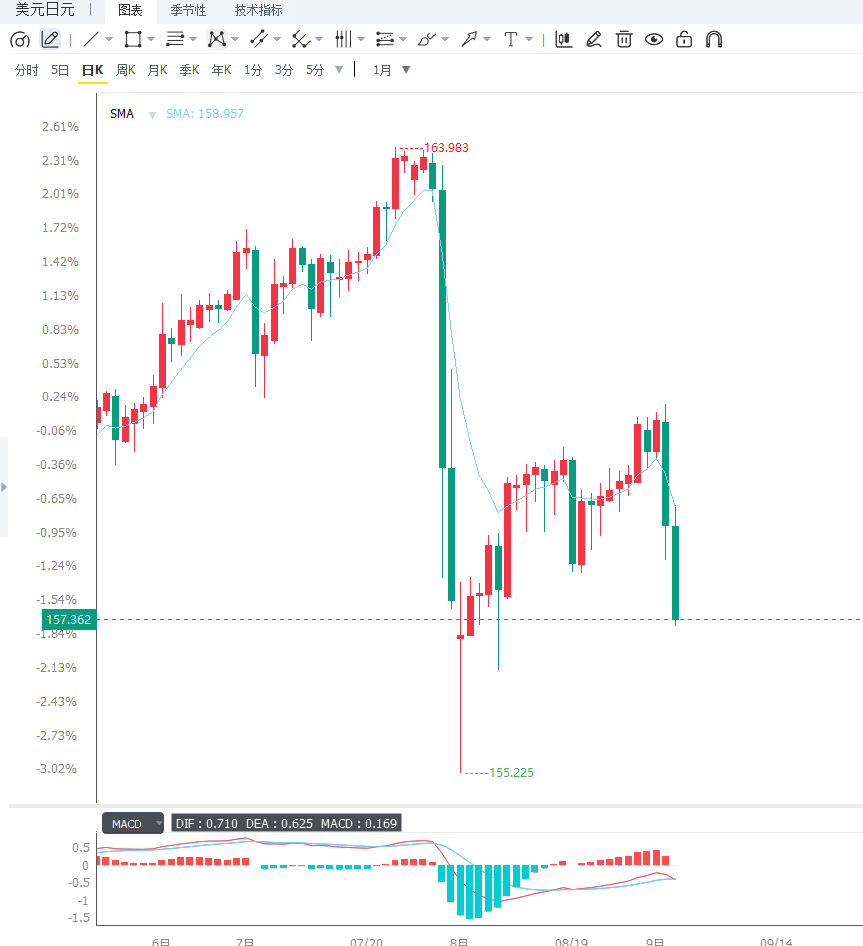 The USD/JPY pair is currently pressured by three factors : rising expectations of a Bank of Japan rate hike, strengthened expectations of yen policy normalization, and weak US employment data . The key in the short term lies in whether the 157.00 support level can hold, and whether Friday's US non-farm payrolls data will further alter expectations for the Federal Reserve's policy. If the non-farm payrolls are weak and the Bank of Japan maintains a hawkish stance, USD/JPY may continue to decline; if US employment data is significantly stronger than expected, the exchange rate may still rebound towards the 158.20 and 159.00 areas. Overall, the market is currently bearish in the short term, but the technical support around 157.00 is strong, and a rapid reversal should be anticipated before the data release.
Bank of Japan Governor Kazuo Ueda previously stated that the central bank will discuss whether to adjust interest rates at its September meeting, focusing on assessing whether inflation risks have risen further. Meanwhile, BOJ policy board member Hajime Takada recently proposed a more flexible path for interest rate hikes, prompting the market to reassess the pace and magnitude of future BOJ rate hikes. Currently, the market has largely priced in a 25 basis point rate hike in September, with some traders even discussing the possibility of a larger increase. This change directly weakens the interest rate differential logic previously relied upon by USD/JPY. For some time, the significant interest rate differential between the US and Japan has been a major factor driving the yen's weakness, but as the BOJ gradually releases more hawkish policy signals, the market is beginning to pre-indulge the possibility of further increases in Japanese interest rates. If Japanese government bond yields remain high, the attractiveness of yen assets may further improve, prompting adjustments in some carry trades. The US dollar itself also faces new pressure. US ADP private sector employment increased by only 38,000 in August, lower than the market expectation of 47,000 and also lower than the revised 46,000 in July. The significant slowdown in job growth has made investors more concerned about whether the US labor market is showing signs of a sustained cooling. Latest market pricing indicates a roughly 62% probability of a Fed rate hike in September, which remains high. However, if Friday's non-farm payroll data is significantly weaker than expected, the market may lower its rate hike bets again. Currently, the market expects US non-farm payrolls to increase by approximately 56,000-58,000 in August, with the unemployment rate remaining around 4.1%. If actual employment figures significantly exceed expectations, while the unemployment rate remains stable or even declines, US Treasury yields may rise again, providing support for the US dollar and potentially leading to a rebound in USD/JPY. Conversely, if the non-farm payroll data worsens further, Fed rate hike expectations may decrease, while Bank of Japan rate hike expectations remain high, further narrowing the interest rate advantage of USD/JPY. Furthermore, market speculation about Japanese intervention in the foreign exchange market has increased short-term yen volatility. After USD/JPY quickly fell below 159, some market participants linked this to signs of potential "currency checks" by Japanese authorities. However, the latest analysis suggests that this round of rapid yen appreciation is more likely due to a repricing of Bank of Japan policy expectations rather than any new direct intervention. From a broader market perspective, the situation in the Middle East remains a significant variable influencing the US dollar and the Japanese yen. High oil prices may push up global inflationary pressures, thus limiting the easing space of major central banks; however, given the significantly deteriorating risk sentiment, the yen may still benefit from safe-haven demand. The current decline in the US dollar index further weakens the upward momentum of USD/JPY. Therefore, the main contradiction in USD/JPY has shifted from simply the US-Japan interest rate differential to the policy game between the Bank of Japan's interest rate hike expectations and US employment data . Before Friday's non-farm payrolls report, the market may maintain a bearish but highly volatile trading pattern. On the daily chart, USD/JPY is currently trading around 157.30 , having broken below the 200-day moving average of approximately 158.47 and further approaching the psychological level of 157, indicating a significantly strengthened short-term bearish structure. At the same time, the price is below the 10-day moving average of 159.27, the 21-day moving average of 159.14, and the 100-day moving average of 159.99, with the moving averages above forming a dense resistance. The RSI has dropped to around 33, and the MACD remains negative, indicating that bearish momentum is dominant. However, the RSI is approaching oversold territory, suggesting a possible technical rebound after the continuous decline. The first resistance level to watch is the 158.00 area, formed by the 21-day and 10-day moving averages. A successful break above this level would alleviate short-term downward pressure. Further resistance lies at the 100-day moving average around 158.60 ; a break above this level could lead to a retest of the upper Bollinger Band around 160.00. The first support level is around 157.00 , close to the lower Bollinger Band and recent lows. A break below this level could see the price move towards 156.67 or even 156.00 for support. On the 4-hour chart, USD/JPY remains in a clear downtrend, and the rebound after the price quickly broke below 159 has been limited. The area around 157.00 is currently a key battleground between bulls and bears. If the price can hold this support level, a technical correction and a retest of the 157.70-158.20 range are possible. However, if 157.00 is breached, the bears could further extend their advantage. Considering the current RSI, MACD, and moving average structures, the short-term trend remains one of downward consolidation. Only a sustained move above 159.20 could potentially reverse the current consolidation pattern. The USD/JPY pair is currently pressured by three factors : rising expectations of a Bank of Japan rate hike, strengthened expectations of yen policy normalization, and weak US employment data . The key in the short term lies in whether the 157.00 support level can hold, and whether Friday's US non-farm payrolls data will further alter expectations for the Federal Reserve's policy. If the non-farm payrolls are weak and the Bank of Japan maintains a hawkish stance, USD/JPY may continue to decline; if US employment data is significantly stronger than expected, the exchange rate may still rebound towards the 158.20 and 159.00 areas. Overall, the market is currently bearish in the short term, but the technical support around 157.00 is strong, and a rapid reversal should be anticipated before the data release.
- Risk Warning and Disclaimer
- The market involves risk, and trading may not be suitable for all investors. This article is for reference only and does not constitute personal investment advice, nor does it take into account certain users’ specific investment objectives, financial situation, or other needs. Any investment decisions made based on this information are at your own risk.