The pound has firmly held above 1.3490; Friday's US non-farm payroll data could trigger significant volatility.
2026-09-03 15:20:04
This week, the foreign exchange market is once again facing a crucial window of opportunity. During Thursday's early European session, the pound sterling continued its modest rise against the dollar, trading around 1.3490, supported by a weaker dollar. The market is holding its breath awaiting two major catalysts: a public speech by Bank of England Governor Andrew Bailey, scheduled for 16:50 Beijing time on Friday (September 4th); and the release of the US August non-farm payrolls report at 20:30 on the same day. Following Federal Reserve Chairman Kevin Warsh's unexpectedly hawkish remarks at the Jackson Hole symposium last Friday, the atmosphere of battle between bulls and bears in the currency market has intensified sharply. Whether the pound can maintain its gains under the shadow of a strong dollar has become the focus of market attention.
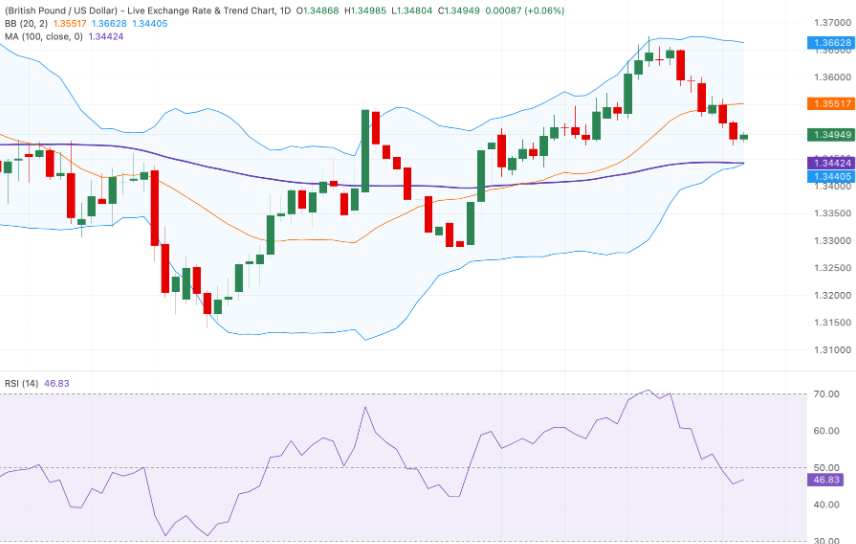
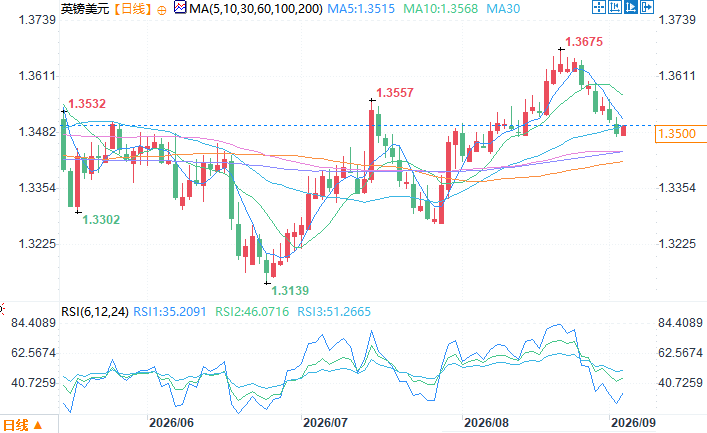 GBP/USD daily chart source: EasyTrade. At 15:17 Beijing time on September 3, GBP/USD was trading at 1.3495/96.
The Federal Reserve Chairman's hawkish stance has fueled expectations of interest rate hikes.
Last Friday's Jackson Hole symposium became a key turning point for the markets. Federal Reserve Chairman Kevin Warsh delivered hawkish remarks far exceeding market expectations, significantly increasing investor bets on a September rate hike. Warsh explicitly pledged to bring inflation back to the 2% target range and hinted that there was still room for further interest rate increases. This statement contrasted sharply with the previously widely anticipated policy path, directly boosting expectations of a stronger dollar index and adding uncertainty to the short-term performance of non-US currencies, including the British pound. Analysts at UOB interpreted Warsh's strong emphasis on inflation risks, coupled with his explicit commitment to price stability and refusal to pre-determine future policy direction, as all signs reinforced the assessment of increased policy tightening risks this year. However, analysts also cautioned that there might be a possibility of "talking the talk but not walking the walk," and the gap between words and actions still needs time to be verified; investors should not prematurely bet on a single direction.Optimistic signals emerging from within the Bank of England
News from the UK also resonated with the market. On Tuesday, Bank of England policymaker Catherine Mann stated that the UK economy had shown stronger signs of growth since the last monetary policy meeting. Mann added that the labor market had stabilized and inflation was slightly stronger than previously expected. These statements, to some extent, supported market pricing in a Bank of England rate hike this year, providing fundamental support for the pound. Market statistics show that as of Tuesday, financial markets had largely priced in a Bank of England rate hike before the end of the year, although the probability of a rate hike at the September policy meeting remained low at around 15%. In other words, while the market is optimistic about the overall policy path this year, it remains cautious about immediate action, which partly explains why the pound's rebound has been relatively mild.Politically calm prevailed, and sentiment towards the pound remained generally stable.
From a political perspective, the recent calm in British politics has provided a relatively stable environment for the pound. Scotiabank strategists point out that the domestic political situation is uneventful, and political dynamics are also quite limited, offering few clues for investors seeking domestic drivers. The strategists further emphasize that the pound's recent strength since Burnham became Prime Minister at the end of June has been largely supported by political sentiment; however, the current lack of new policy signals reduces the catalysts available for trading, and the market may enter a brief period of waiting.Technical Analysis: 1.3440 Becomes a Key Watershed
From a technical chart perspective, the GBP/USD pair maintains a mildly bullish trend on the daily chart. The exchange rate is currently firmly above the 100-day moving average and trading near the lower Bollinger Band, indicating continued buying interest on dips and relatively solid downside demand. However, the price remains capped by the middle Bollinger Band, and the 14-day Relative Strength Index (RSI) is at 46.8, suggesting relatively weak market momentum and the lack of a clear one-sided trend. Short-term trading is more likely to be range-bound. On the upside, the first resistance level is around the middle Bollinger Band at 1.3550; a successful break above this level would target the May 8 high of 1.3637, with further upside potential to challenge the upper Bollinger Band at 1.3665. On the downside, market attention is focused on the 1.3440 area, where the 100-day moving average intersects with the lower Bollinger Band. This area forms a relatively tight demand support zone. If it is effectively broken, it may mean the start of a deeper correction, at which point the downside target may be the low of 1.3342 on July 13.Conclusion
In summary, the British pound is currently at a critical juncture, caught in a tug-of-war between bulls and bears. A weaker dollar and optimistic statements from the Bank of England provide support, but fluctuating interest rate hike expectations and technical headwinds limit its upside potential. Friday's US August non-farm payroll report will be a crucial factor in determining the short-term direction. If the data deviates significantly from market expectations, the 1.3440 to 1.3550 range may see a breakout. Investors should closely monitor this key juncture and await a clearer direction. GBP/USD daily chart source: EasyTrade. At 15:17 Beijing time on September 3, GBP/USD was trading at 1.3495/96.
- Risk Warning and Disclaimer
- The market involves risk, and trading may not be suitable for all investors. This article is for reference only and does not constitute personal investment advice, nor does it take into account certain users’ specific investment objectives, financial situation, or other needs. Any investment decisions made based on this information are at your own risk.