A weakening dollar coupled with rising oil prices caused the USD/CAD pair to fall for the second consecutive day; be wary of a potential break below key support levels.
2026-09-03 14:28:06
The USD/CAD pair fell for the second consecutive trading day, trading around 1.3830 during Thursday's Asian session. The Canadian dollar has recently received multiple supports: the overall pressure on the US dollar and the continued high oil prices have enhanced the relative advantage of the commodity currency, the Canadian dollar. Latest market data shows that the USD/CAD pair previously touched a high of around 1.3939 before retreating significantly.  One of the key reasons for the pressure on the US dollar stems from weakening signals in the US labor market. The latest ADP data shows that US private sector employment increased by only 38,000 in August, lower than the market expectation of 47,000 and also lower than the revised 46,000 in July. This significant slowdown in job growth has led the market to reassess the resilience of the US economy and the Federal Reserve's policy space. However, the interest rate market still maintains high expectations for a Fed rate hike in September, with the latest pricing indicating a probability of around two-thirds , meaning the dollar has not completely lost its interest rate advantage. Going forward, US initial jobless claims data and the August non-farm payroll report released on Friday will be the main catalysts for the USD/CAD exchange rate. If non-farm payrolls continue to show significant weakness, the market may further reduce its bets on a Fed rate hike, thus pushing the dollar weaker, and USD/CAD may continue to test recent lows. Conversely, if employment data shows renewed resilience in the labor market and Fed rate hike expectations rise again, the dollar may gain upward momentum. The Canadian dollar itself is also significantly supported by the oil market. Currently, WTI crude oil prices remain above $90 , and the situation in the Middle East and shipping risks in the Strait of Hormuz continue to impact energy supply expectations. High oil prices typically benefit the Canadian currency, a product of energy exports. Therefore, the weakening US dollar and rising oil prices further increased downward pressure on USD/CAD. Meanwhile, the Bank of Canada has increased its focus on upside risks to inflation, prompting the market to reassess future Canadian interest rate policy. The Canadian dollar had previously weakened significantly during periods of US dollar strength, but with improved expectations for Canadian interest rates and rising oil prices, CAD regained buying support. However, the medium-term trend of USD/CAD cannot be simply defined as one-sidedly bearish. If the market re-trades to Fed rate hikes, a rebound in US Treasury yields, or further pressure from Middle East tensions pushing up oil prices and triggering new inflation concerns, the US dollar may still find some support. Scotiabank points out that if USD/CAD can consistently break through the key technical resistance level of 1.3930 , the possibility of further gains towards the 1.40 level will significantly increase. Therefore, currently, it is more appropriate to focus on the relative strength of the US dollar and the Canadian dollar in the USD/CAD pair: in the short term, pay close attention to whether US employment data further weakens expectations of rate hikes, while also monitoring whether oil prices can continue to remain above $90. If weak US dollar data coincides with high oil prices, the downward pressure on USD/CAD could intensify further. On the daily chart, USD/CAD is currently around 1.3830 , with the price still below the 9-period and 50-period EMAs, indicating the short-term bearish structure remains unchanged. The 14-day RSI is around 41.2, which, while in bearish territory, hasn't reached typical oversold levels, suggesting further downside potential. The primary resistance is currently at the 9-period EMA around 1.3858 , with further resistance at the 50-period EMA around 1.3941 . A retest of 1.3941 would target the psychological level of 1.4000. On the downside, the key support level to watch is 1.3825-1.3830 ; a break below this level could open up further downside in the short term, while the important medium-term support level remains at 1.3482 . Looking at shorter timeframes, the current technical signals for USD/CAD are clearly bearish. Latest technical indicators show that the RSI has fallen to around 27 , while the MACD remains negative, indicating that bearish momentum still dominates. However, some oscillators have entered oversold territory, so a technical rebound should be anticipated after the continuous decline. In the short term, if the price reclaims the 1.3850-1.3860 area, it may correct towards 1.3880-1.3900; if the rebound fails to break through the resistance near 1.3880, a further decline is still likely. If it falls below 1.3825 , then 1.3800 and lower levels will become the focus of market attention.
 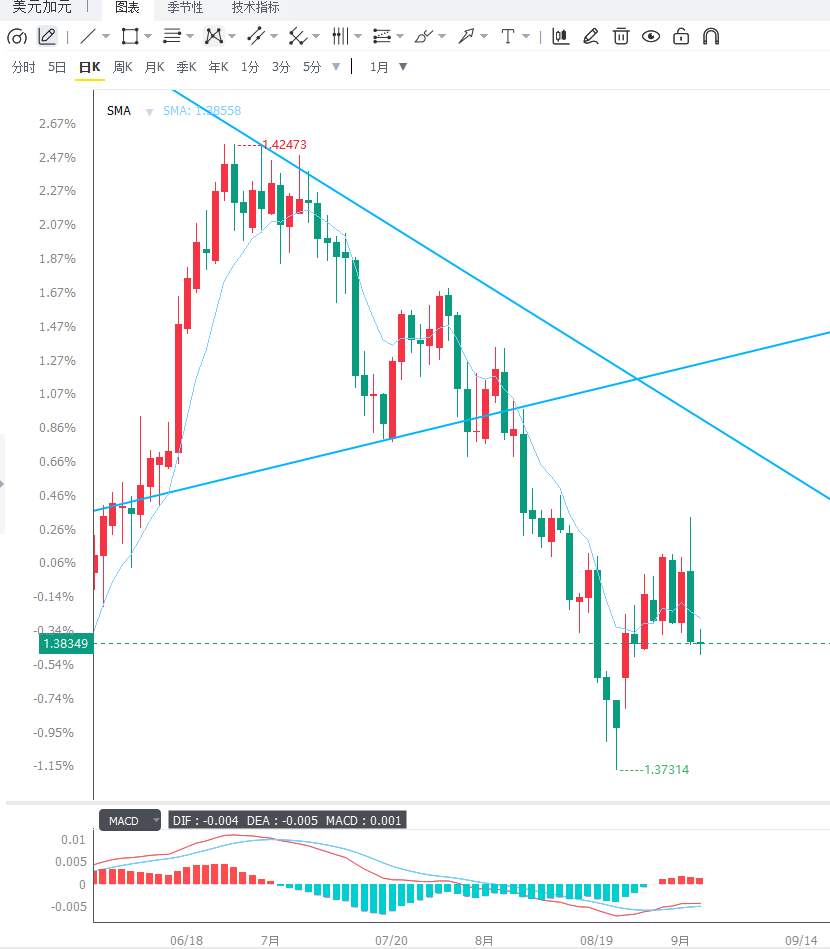 The core contradiction in the USD/CAD pair has shifted from the previous dollar rebound to a combination of factors: cooling US employment, high oil prices, and a strengthening Canadian dollar . In the short term, the 1.3825 level is a key support. If the US non-farm payrolls data is further weaker than expected, USD/CAD may continue its decline; conversely, strong employment data that reignites expectations of a Fed rate hike could see the pair rebound towards the 1.3940 and 1.4000 areas. Overall, USD/CAD is likely to maintain a weak and volatile trading pattern ahead of the release of key US employment data.
One of the key reasons for the pressure on the US dollar stems from weakening signals in the US labor market. The latest ADP data shows that US private sector employment increased by only 38,000 in August, lower than the market expectation of 47,000 and also lower than the revised 46,000 in July. This significant slowdown in job growth has led the market to reassess the resilience of the US economy and the Federal Reserve's policy space. However, the interest rate market still maintains high expectations for a Fed rate hike in September, with the latest pricing indicating a probability of around two-thirds , meaning the dollar has not completely lost its interest rate advantage. Going forward, US initial jobless claims data and the August non-farm payroll report released on Friday will be the main catalysts for the USD/CAD exchange rate. If non-farm payrolls continue to show significant weakness, the market may further reduce its bets on a Fed rate hike, thus pushing the dollar weaker, and USD/CAD may continue to test recent lows. Conversely, if employment data shows renewed resilience in the labor market and Fed rate hike expectations rise again, the dollar may gain upward momentum. The Canadian dollar itself is also significantly supported by the oil market. Currently, WTI crude oil prices remain above $90 , and the situation in the Middle East and shipping risks in the Strait of Hormuz continue to impact energy supply expectations. High oil prices typically benefit the Canadian currency, a product of energy exports. Therefore, the weakening US dollar and rising oil prices further increased downward pressure on USD/CAD. Meanwhile, the Bank of Canada has increased its focus on upside risks to inflation, prompting the market to reassess future Canadian interest rate policy. The Canadian dollar had previously weakened significantly during periods of US dollar strength, but with improved expectations for Canadian interest rates and rising oil prices, CAD regained buying support. However, the medium-term trend of USD/CAD cannot be simply defined as one-sidedly bearish. If the market re-trades to Fed rate hikes, a rebound in US Treasury yields, or further pressure from Middle East tensions pushing up oil prices and triggering new inflation concerns, the US dollar may still find some support. Scotiabank points out that if USD/CAD can consistently break through the key technical resistance level of 1.3930 , the possibility of further gains towards the 1.40 level will significantly increase. Therefore, currently, it is more appropriate to focus on the relative strength of the US dollar and the Canadian dollar in the USD/CAD pair: in the short term, pay close attention to whether US employment data further weakens expectations of rate hikes, while also monitoring whether oil prices can continue to remain above $90. If weak US dollar data coincides with high oil prices, the downward pressure on USD/CAD could intensify further. On the daily chart, USD/CAD is currently around 1.3830 , with the price still below the 9-period and 50-period EMAs, indicating the short-term bearish structure remains unchanged. The 14-day RSI is around 41.2, which, while in bearish territory, hasn't reached typical oversold levels, suggesting further downside potential. The primary resistance is currently at the 9-period EMA around 1.3858 , with further resistance at the 50-period EMA around 1.3941 . A retest of 1.3941 would target the psychological level of 1.4000. On the downside, the key support level to watch is 1.3825-1.3830 ; a break below this level could open up further downside in the short term, while the important medium-term support level remains at 1.3482 . Looking at shorter timeframes, the current technical signals for USD/CAD are clearly bearish. Latest technical indicators show that the RSI has fallen to around 27 , while the MACD remains negative, indicating that bearish momentum still dominates. However, some oscillators have entered oversold territory, so a technical rebound should be anticipated after the continuous decline. In the short term, if the price reclaims the 1.3850-1.3860 area, it may correct towards 1.3880-1.3900; if the rebound fails to break through the resistance near 1.3880, a further decline is still likely. If it falls below 1.3825 , then 1.3800 and lower levels will become the focus of market attention. The core contradiction in the USD/CAD pair has shifted from the previous dollar rebound to a combination of factors: cooling US employment, high oil prices, and a strengthening Canadian dollar . In the short term, the 1.3825 level is a key support. If the US non-farm payrolls data is further weaker than expected, USD/CAD may continue its decline; conversely, strong employment data that reignites expectations of a Fed rate hike could see the pair rebound towards the 1.3940 and 1.4000 areas. Overall, USD/CAD is likely to maintain a weak and volatile trading pattern ahead of the release of key US employment data.
- Risk Warning and Disclaimer
- The market involves risk, and trading may not be suitable for all investors. This article is for reference only and does not constitute personal investment advice, nor does it take into account certain users’ specific investment objectives, financial situation, or other needs. Any investment decisions made based on this information are at your own risk.