Gold Trading Alert: Waller's "surprise" dovish shift sharply reduces expectations of a September rate hike, sending gold prices soaring 2% to a one-week high.
2026-09-04 07:52:04
On Thursday (September 3), spot gold surged to $4,510.90 per ounce, its highest level since August 28, before closing at $4,473.53 per ounce, a daily gain of nearly 2%. Gold futures rose even more, closing up 2.8% at $4,539.9. This strong rally was a result of dovish comments from Federal Reserve Governor Waller, a simultaneous weakening of the dollar and US Treasury yields, and geopolitical turmoil in the Middle East. Against the backdrop of easing interest rate expectations and intertwined macroeconomic uncertainties, gold has regained its strong appeal. 
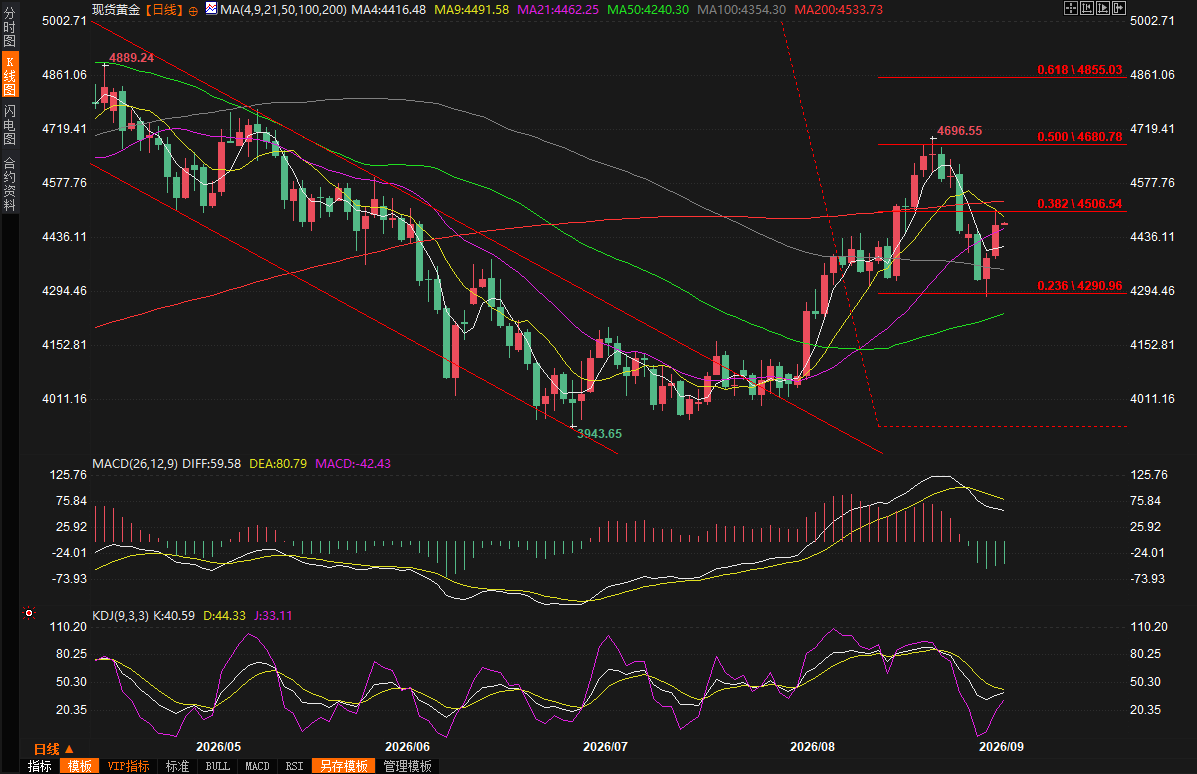 (Spot gold daily chart, source: FX678) At 07:48 Beijing time, spot gold is currently trading at $4475.15 per ounce.
I. Waller's "surprise" dovish shift instantly shattered market bets on interest rate hikes.
Ahead of the Federal Reserve's September policy meeting, the market was generally hawkish. Fed Chairman Warsh's hawkish remarks at the Jackson Hole symposium had previously boosted the probability of a September rate hike to over 65%. However, Fed Governor Waller, known as a "swing hawk," released a strongly dovish signal at an event on September 3rd, exceeding market expectations. Waller explicitly stated that if the upcoming August inflation data confirmed easing inflationary pressures, he would favor maintaining the current interest rate at the policy meeting on September 15-16. He even quoted John Lennon, urging that "inflation be given a chance to cool down," advocating against premature rate hikes and allowing the cooling process to develop fully. However, Waller did not completely close the door to rate hikes—he emphasized that if inflation data was overheated, he would consider supporting a rate hike, and a slight acceleration in inflation could lead him to support a tighter policy. This statement quickly triggered a chain reaction in the financial markets. According to the CME FedWatch tool, the market's probability of a Fed rate hike in September plummeted from about 62% before Waller's speech to about 50%. The 10-year Treasury yield fell 3.8 basis points to 4.756%, marking its biggest one-day drop since August 25; the 2-year Treasury yield fell 5.6 basis points to 4.33%. The dollar index also weakened, briefly touching a near two-week low of 98.83. StoneX senior market strategist Bob Haberkorn commented, "More and more traders are beginning to agree with the view that the Fed may raise rates once, but there may not be much room for further rate adjustments afterward." Evercore ISI analysts also pointed out in a report that Waller's remarks echoed previous statements by New York Fed President Williams, posing a substantial challenge to the view that the Fed will raise rates in the near future.II. Gold's "Perfect Storm": Multiple Positive Factors Resonate and Drive Up Gold Prices
The reason Waller's dovish comments could so dramatically impact gold prices lies in the highly sensitive negative correlation between gold and the Federal Reserve's interest rate expectations. When expectations of interest rate hikes rise, the opportunity cost of holding non-yielding gold increases, and funds tend to flow to higher-yielding dollar assets; conversely, when expectations of interest rate hikes cool, the valuation pressure on gold eases. On September 3rd, multiple positive factors converged in a rare manner. The decline in US Treasury yields directly reduced the opportunity cost of holding gold; a weaker dollar made dollar-denominated gold cheaper for overseas buyers; and the previous day, gold prices had just fallen to their lowest level since August 7th, and the technical demand for a rebound from oversold conditions also provided impetus for the bulls. Spot gold reached a high of $4510.90 per ounce during the session, ultimately closing at $4473.53 per ounce, a gain of approximately 1.96%. Technically, gold prices began a one-sided upward trend from the stage low of $4283, breaking through multiple key levels. The Relative Strength Index (RSI) indicates that momentum has turned mildly bullish, suggesting that gold prices may continue to rise, with the next resistance level at $4,533, where the 200-day simple moving average is located.III. The Double-Edged Sword of Geopolitics: The Delicate Game Between Safe-Haven and Inflation
Just two days before Waller's speech, tensions in the Middle East escalated dramatically. On Tuesday, the United States launched a large-scale airstrike against targets of the Iranian Islamic Revolutionary Guard Corps along the Strait of Hormuz. Iran retaliated by striking US military bases in Kuwait, Iraq, Jordan, Qatar, and Bahrain. Iran claimed that a US airstrike hit a house where a wedding was taking place, killing five people and injuring nearly 70. This conflict pushed international oil prices up for the fourth consecutive trading day, with Brent crude futures briefly touching $97.59 per barrel, a new high since July 24. The surge in oil prices reignited market concerns about inflation, precisely the Federal Reserve's biggest headache. In fact, in the preceding trading days, it was the inflation concerns stemming from the Middle East conflict, coupled with hawkish comments from Federal Reserve Chairman Warsh, that jointly drove up US Treasury yields, pushing gold prices to a two-week low below $4,300. This creates a complex situation for gold: on the one hand, the escalation of the Middle East conflict should have activated gold's safe-haven appeal; but on the other hand, rising oil prices have increased inflation expectations, reinforcing the logic behind the Federal Reserve's interest rate hikes. When geopolitical risks are primarily transmitted through inflation and interest rates, gold's safe-haven appeal often temporarily fails. Waller's dovish comments were so effective in boosting gold prices precisely because they broke the negative transmission chain of "rising oil prices → rising inflation → increased interest rate hike expectations → downward pressure on gold prices." Furthermore, no confirmed clashes have occurred since Wednesday noon, indicating initial signs of de-escalation in the latest round of escalation. President Trump's senior aides are pushing to avoid further escalation of the war with Iran before the November midterm elections to prevent damage to the Republican Party's electoral prospects. Sources say the White House will consider escalating military action after the November 3rd election.IV. Key variables for the market outlook: Non-farm payroll and CPI data will determine the outcome.
While Waller's dovish remarks provided strong short-term support for gold prices, the market is not certain that the Federal Reserve will not raise interest rates. Waller himself explicitly stated that his decision will "largely depend" on the August inflation data to be released next week. Investors are currently closely watching two key data releases: the US August non-farm payrolls report to be released on September 4th, with economists expecting an increase of 56,000 jobs in August, reversing the 23,000 decrease in July, and the unemployment rate expected to remain at 4.1%; and the August CPI and PPI inflation reports to be released on September 11th. These two data points will directly determine the market's pricing of a rate hike at the September FOMC meeting—if the data is weak, rate hike expectations may cool further, providing more room for a gold price rebound; if the data is strong, it will further strengthen tightening expectations and put pressure on gold prices. The August ISM Services PMI data showed that the input price index jumped from 70.3 in July to 72.6, the highest since August 2022. This high reading indicates that inflationary pressures remain stubborn, and the threshold for the Federal Reserve to hold rates steady at its September meeting is not low.V. Medium- to Long-Term Perspective: The Bullish Logic for Gold Has Not Disappeared
While short-term price movements are subject to fluctuations in expectations surrounding Federal Reserve policy, the underlying logic supporting a long-term bull market for gold remains solid. Looking at global central bank gold purchasing trends, central banks worldwide continue to increase their gold reserves. A World Gold Council survey shows that 45% of central banks plan to increase their gold reserves in the next 12 months, a record high. Goldman Sachs Research predicts that global central banks will purchase an average of 50 tons of gold per month in 2026, significantly higher than the average of 17 tons per month before 2022. The People's Bank of China has increased its gold reserves for 21 consecutive months. From the perspective of the US dollar credit system, high global debt, high deficits, and rising interest payments continue to erode the long-term real returns of sovereign credit assets. Geopolitical divisions, financial sanctions, and reserve diversification are constantly enhancing the strategic allocation value of gold. RBC Capital Markets predicts that driven by geopolitical instability, global de-dollarization, and market concerns about dollar depreciation, gold prices are expected to rise to $5,000 per ounce by 2026. However, the door to a September rate hike is not completely closed; the upcoming non-farm payroll and CPI data will be key variables determining the short-term direction of gold prices. Every fluctuation in interest rate hike expectations could trigger sharp volatility in gold prices. The probability of at least a 25 basis point rate hike this year remains above 80%, which may limit the upside potential for gold prices. (Spot gold daily chart, source: FX678) At 07:48 Beijing time, spot gold is currently trading at $4475.15 per ounce.
- Risk Warning and Disclaimer
- The market involves risk, and trading may not be suitable for all investors. This article is for reference only and does not constitute personal investment advice, nor does it take into account certain users’ specific investment objectives, financial situation, or other needs. Any investment decisions made based on this information are at your own risk.