The yen surged! Suspected intervention coupled with divergent signals from the Federal Reserve raises the question: can the 155 level hold?
2026-09-04 08:28:04
On Friday (September 4) during Asian trading hours, the USD/JPY pair continued its decline from the previous day, falling approximately 1.8% overnight to 155.79. It is currently trading around 155.70. Intervention by the Japanese Ministry of Finance is suspected, coupled with a continued cooling of expectations for a Fed rate hike, both factors contributing to the downward pressure on the exchange rate. Takada's hawkish remarks may have been merely the trigger; the magnitude and suddenness of the drop are more consistent with official intervention. New York Fed President Williams stated that a September rate hike is "not yet certain," and Governor Waller indicated that if inflation continues to cool in August, he supports holding rates steady, reducing the probability of a Fed rate hike from 64% to 54%. 
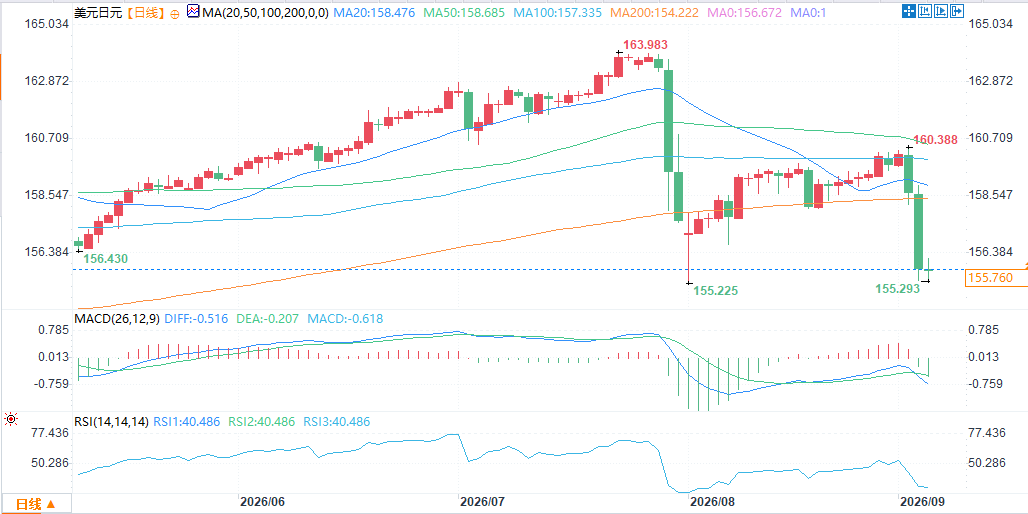 (USD/JPY daily chart, source: FX678) At 8:22 Beijing time, USD/JPY was trading at 155.69/70.
The dollar fell sharply against the yen amid a confluence of suspected intervention and divergent signals from the Federal Reserve.
On Thursday, the US dollar fell sharply against the Japanese yen, seemingly due to a confluence of intervention by the Japanese Ministry of Finance and a cooling of expectations for a Federal Reserve rate hike. Hajime Takata's hawkish remarks may have been merely the trigger; the magnitude and suddenness of the drop are more consistent with official intervention. If Wednesday marked the start of a new round of intervention, Japanese authorities still have room to maneuver on Friday (the IMF framework allows for a maximum of three interventions every six months, each lasting no more than three business days). New York Fed President Williams stated that a September rate hike is "not yet certain," and Governor Waller indicated support for holding rates steady if inflation continues to cool in August, lowering the probability of a Fed rate hike from 64% to 54%. This sharp drop exhibits typical signs of intervention: a steep decline in prices within a short period, significantly increased trading volume, and a price pattern almost identical to that before the Japanese intervention at the end of July. While Takata's hawkish comments attracted market attention, they alone cannot explain such a rapid drop; they are more often seen as the trigger for official action. According to the IMF framework, Japanese authorities can intervene a maximum of three times within six months, each lasting no more than three business days. Therefore, if Wednesday is indeed the start of a new round of action, there is still room for further maneuver on Friday. Meanwhile, signals within the Federal Reserve diverged significantly. Williams explicitly stated that a September rate hike was not yet certain, while Waller emphasized that if inflation continued its cooling trend, it would support maintaining the current interest rate. This directly pushed the probability of a September rate hike shown by CME FedWatch down from 64% to 54%. The combination of internal and external factors put significant pressure on the USD/JPY exchange rate on Thursday, and market caution regarding potential intervention intensified.Lower US Treasury yields provide fundamental support; non-farm payroll data becomes key.
The correlation between USD/JPY and US Treasury yields has risen to 0.99, with lower Treasury yields providing fundamental support for the decline. The market is focused on Friday's US non-farm payroll data – an expected increase of only about 55,000, with a potential downward surprise in August, possibly leading to a second consecutive period of negative growth. The Federal Reserve has never raised interest rates after two consecutive periods of negative growth, and a rise in the unemployment rate due to increased participation could further drive a dovish repricing. USD/JPY may fluctuate between 155 and 158 in the short term, with the non-farm payroll data determining the direction: weak data could push the exchange rate further down to 154; strong data could trigger a sharp reversal. Currently, the correlation coefficient between USD/JPY and the 10-year US Treasury yield has risen to an extremely high level of 0.99, indicating that the two are moving almost perfectly in sync. The continued decline in US Treasury yields directly weakens the relative attractiveness of the dollar from the perspective of interest rate parity and capital flows, providing solid fundamental support for the exchange rate's decline. Market focus is now entirely on Friday's US non-farm payroll report. The market generally expects only about 55,000 new jobs, and the August data shows a tendency for downward revision, which, if realized, could result in two consecutive months of negative growth. Historical experience clearly shows that the Federal Reserve has never chosen to raise interest rates immediately after two consecutive periods of negative job growth. If the unemployment rate rises in tandem with the labor force participation rate, it will further strengthen the market's repricing of a dovish policy path, lowering the probability of a rate hike and dragging down the dollar. In the short term, USD/JPY is expected to fluctuate within the 155-158 range, with the non-farm payroll data becoming the ultimate catalyst for direction: significantly weak data could accelerate the exchange rate towards 154 or even lower, while unexpectedly strong data could trigger a large-scale short covering and a sharp reversal.Summarize
Suspected intervention and divergent signals from the Federal Reserve drove a sharp drop in the USD/JPY pair, while lower US Treasury yields provided support. Non-farm payroll data is a key variable – weak data could push further down, while strong data could trigger a reversal. The USD/JPY pair is likely to trade in the 155-158 range in the short term, with attention focused on signals of intervention from Japanese authorities and US data. Weak non-farm payroll data could push the exchange rate towards 154; strong data could lead to a rebound to the 158-159 area. Be wary of the risk of significant volatility following the release of non-farm payroll data. (USD/JPY daily chart, source: FX678) At 8:22 Beijing time, USD/JPY was trading at 155.69/70.- Risk Warning and Disclaimer
- The market involves risk, and trading may not be suitable for all investors. This article is for reference only and does not constitute personal investment advice, nor does it take into account certain users’ specific investment objectives, financial situation, or other needs. Any investment decisions made based on this information are at your own risk.