The Australian dollar has climbed above 0.7200! The US dollar factor is gaining traction, but domestic demand in Australia is dragging it down.
2026-09-04 08:16:04
On Friday (September 4th) during Asian trading hours, the Australian dollar continued its gains from the previous day, currently hovering around 0.7200 against the US dollar. Federal Reserve Governor Waller's dovish comments lowered the probability of a September rate hike from 64% to 54%, putting downward pressure on the US dollar. The US August ISM Services PMI rose to 55.4 from 54.1 (exceeding expectations), with the prices paid component rising to 72.6 from 70.3, indicating continued inflationary pressure. Initial jobless claims rose to 206,000 from 204,000 (slightly higher than the expected 205,000). 
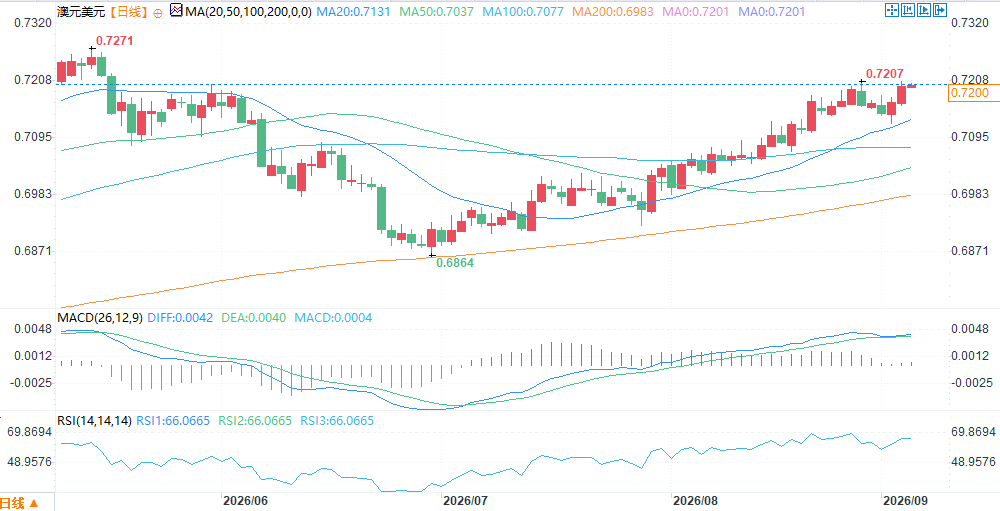 (Australian dollar to US dollar daily chart, source: EasyForex) At 8:11 Beijing time, the Australian dollar to US dollar exchange rate was 0.7199/7200.
Waller's dovish remarks put pressure on the US dollar, benefiting the Australian dollar and causing it to strengthen.
Federal Reserve Governor Waller stated that if inflation continues its downward trend, he supports maintaining the current interest rate, lowering the probability of a September rate hike from 64% to 54%, putting downward pressure on the dollar. The US August ISM Services PMI rose to 55.4 from 54.1, exceeding expectations, while the prices paid component rose to 72.6 from 70.3, indicating continued inflationary pressure. Initial jobless claims rose slightly to 206,000 from 204,000. Waller warned that a strong CPI data next week could lead to a rate hike, providing potential support for the dollar. Waller's remarks quickly changed market pricing expectations for the Fed's policy path. He emphasized that the improvement in the three-month annualized inflation trend is more relevant, and explicitly stated that if this downward trend continues, he would likely support maintaining the current interest rate in September. This relatively dovish stance directly caused the probability of a September rate hike shown by CME FedWatch to quickly fall from approximately 64% to around 54%, putting downward pressure on the dollar index. Meanwhile, hawkish signals from Bank of Japan officials boosted the yen, further dragging the dollar index below 99.00, creating a double whammy. Although the US August ISM Services PMI unexpectedly rose to 55.4, with the prices paid sub-index jumping to 72.6, indicating continued stickiness in service sector inflation, and initial jobless claims rose slightly to 206,000, the market was more focused on Waller's positive interpretation of inflation trends. As a risk-sensitive currency, the Australian dollar clearly benefited from the overall weakening of the US dollar, successfully breaking through the 0.7200 level against the dollar. However, Waller maintained a data-dependent stance, cautioning that if next week's CPI data strengthens again, he might still shift to supporting interest rate hikes. This leaves room for a dollar rebound and also means that the Australian dollar's upward movement is not without resistance.Moody's: Australia's seemingly robust GDP figures cannot mask weak domestic demand; risk of a November rate hike increases.
Waller's dovish stance opened a window for the Australian dollar to rise, but Australia's own economic weakness is casting doubt on the sustainability of this rally. Moody's Analytics' head of economics, Nguyen, pointed out that while Australia's second-quarter GDP figures look decent, the underlying foundation is weak—private investment is declining, people are saving more than spending, and the trade surplus is mainly supported by reduced overseas travel, not stronger exports. Persistent weak domestic demand and a high savings rate indicate insufficient confidence among households and businesses, with economic growth relying more on temporary external factors than on endogenous drivers. While Moody's still bets the Reserve Bank of Australia (RBA) will not raise rates in September, it believes the risk of a rate hike in November is increasing. Nguyen specifically emphasized that if core inflation reaches 0.9% or higher in the third quarter, the RBA will have no choice but to raise interest rates to prevent a resurgence of price pressures.The market is focused on the non-farm payroll data, and the Australian dollar is biased towards a short-term bullish trend.
The market is focused on Friday's US non-farm payroll data and unemployment rate to gauge the Fed's policy path in September. Weak data could further lower expectations of a rate hike and support the Australian dollar; strong data could increase the probability of a rate hike and limit the Australian dollar's upside. Friday's non-farm payroll report and unemployment rate have become core variables in current market pricing. Traders generally believe this data will directly determine the Fed's policy stance at its September meeting. If non-farm payrolls significantly fall short of expectations and the unemployment rate unexpectedly rises, the market will further lower the probability of a rate hike, and the US dollar may continue to weaken, providing additional upward momentum for the Australian dollar, potentially pushing it towards 0.7250 or even higher. Conversely, strong non-farm payroll data and a low unemployment rate could reignite expectations of a September rate hike, pushing the US dollar higher and limiting the Australian dollar's upside. Currently, the Australian dollar's short-term technical and fundamental outlook is bullish: on the one hand, the US dollar index is pressured by Waller's dovish comments and a stronger yen; on the other hand, Australia's own commodity exports and risk appetite environment are relatively favorable. However, market sentiment is highly sensitive, and any unexpected employment data could trigger rapid position adjustments. Investors should closely monitor immediate changes in FedWatch probabilities after the non-farm payrolls data release, as well as the position reaction of the Australian dollar against the US dollar around the 0.7200 level. Overall, the Australian dollar is expected to maintain a short-term bullish bias before the non-farm payrolls data is released, but volatility is expected to increase significantly, and the final direction will depend on the actual performance of the US labor market. (Australian dollar to US dollar daily chart, source: EasyForex) At 8:11 Beijing time, the Australian dollar to US dollar exchange rate was 0.7199/7200.- Risk Warning and Disclaimer
- The market involves risk, and trading may not be suitable for all investors. This article is for reference only and does not constitute personal investment advice, nor does it take into account certain users’ specific investment objectives, financial situation, or other needs. Any investment decisions made based on this information are at your own risk.