Expectations of a Fed rate cut have resurfaced, sending gold rebounding to $4,480 as it awaits guidance from US non-farm payroll data.
2026-09-04 10:10:04
Gold prices continued their rebound in early Asian trading on Friday, with spot gold (XAU/USD) returning to around $4,480 per ounce. Previously, gold prices had been pressured by fluctuating expectations regarding Federal Reserve policy, particularly as the market repriced in the possibility of a September rate hike. However, as Fed officials signaled a greater reliance on economic data, investors began to reduce their bets on further monetary tightening, providing gold with a temporary recovery momentum.  A key turning point in market sentiment this week came from differing statements by Federal Reserve officials regarding the future path of interest rates. Previously, Fed Chairman Kevin Warsh's hawkish remarks at the Jackson Hole symposium had boosted market expectations for a September rate hike, putting pressure on gold, a non-interest-bearing asset, due to a stronger dollar and rising Treasury yields. As the market further digested these comments, investors began to refocus on whether US inflation and employment data would support further rate hikes. Fed Governor Christopher Waller subsequently released a relatively dovish policy signal. He stated that if August inflation continued to show signs of improvement, maintaining the current interest rate in September would still be a reasonable option; however, if inflation data was significantly overheated, a rate hike could not be completely ruled out. This statement did not represent a complete shift to easing, but rather a further emphasis that monetary policy would be adjusted based on future economic data, thereby reducing market concerns about a continuous tightening of policy by the Fed in the short term. According to data from the Chicago Mercantile Exchange's interest rate futures market, investors now expect a 25 basis point rate hike in September with a probability of approximately 50.2%, significantly lower than the 63.2% before Waller's speech. This change indicates that the market has readjusted its pricing of the previously hawkish policy stance. While the probability of an interest rate hike remains high, marginal changes suggest that some of the policy premium previously accumulated by dollar bulls is fading, giving gold some breathing room. Market strategists believe that in the absence of clear forward guidance from the Federal Reserve, gold will remain highly dependent on changes in interest rate expectations in the coming trading days. For gold, what truly matters is not whether a single official is hawkish or dovish, but whether inflation, employment, and economic growth data can alter the market's assessment of the actual interest rate path. As long as investors believe that the room for further increases in US interest rates is limited, the opportunity cost of holding gold may decrease, thus providing support for gold prices. US employment market data has therefore become the most important short-term catalyst for the current market. The US August non-farm payroll report will be released on Friday, with the market expecting approximately 56,000 new non-farm jobs and an unemployment rate expected to remain at 4.1%. If actual job growth is significantly lower than this level, and the unemployment rate rises, the market may further reduce expectations for a September rate hike, putting pressure on the dollar and US Treasury yields, while gold is expected to gain new upward momentum. Conversely, if non-farm payrolls significantly exceed expectations, it indicates that the US labor market remains resilient, strengthening the case for the Federal Reserve to maintain a tight policy stance. In this scenario, the market may increase the probability of a September rate hike, leading to a rebound in the dollar and higher real interest rates, while gold may face profit-taking pressure. Therefore, the "surprise" of the non-farm payroll data may be more important than the data itself; the market is truly focused on the magnitude of the deviation between employment performance and expectations and its impact on the Fed's policy path. From an inflation perspective, the market is currently in a delicate balance. If energy prices remain high, they may be transmitted to overall inflation through costs, but if core inflation remains under control, the necessity for the Fed to continue raising rates will be limited. HSBC analysts believe that as long as rising energy prices do not significantly translate into higher core inflation, the likelihood of further rate hikes by the Fed in the near term remains limited. This assessment reduces the risk of gold facing sustained policy pressure. However, the current rebound in gold does not mean that the upward trend has been fully re-established. US monetary policy remains highly uncertain, and the market's pricing in the September meeting still has considerable room for adjustment. If inflation data picks up again or the job market shows unexpected resilience, the US dollar may regain its interest rate advantage, and gold will face downward pressure once more. Meanwhile, the market structure of gold itself is also worth noting. After the significant fluctuations in gold prices previously, some short-term funds have begun to quickly adjust their positions based on the Federal Reserve's expectations. In this environment, any important macroeconomic data could amplify intraday gold price volatility. Investors need to pay special attention to the synchronized changes in US Treasury yields and the US dollar index. If gold price increases are accompanied by a weakening dollar and falling yields, the rebound is usually more sustained; if gold price increases lack support from the dollar and interest rate markets, a rapid pullback after short-term fund inflows should be anticipated. From a daily chart perspective, gold is currently maintaining a relatively positive recovery pattern, with prices rising back above the 100-day moving average and near the Bollinger Band's middle line, indicating that the previous correction did not completely destroy the medium-term bullish structure. The daily Relative Strength Index (RSI) is around 55.3, having moved out of the previously potentially overbought zone, but still within the neutral-to-strong range, meaning that market momentum is recovering, but has not yet reached an extremely strong state. The first resistance level to watch is around $4550. A decisive break above this level could open up further upside potential to test previous highs. On the downside, key support lies around the Bollinger Band middle line at $4460, followed by the 100-day moving average around $4360. A break below this area could see gold prices seek support near $4245. Looking at the 4-hour chart, gold has formed a short-term rebound structure, with prices retesting key moving average areas, indicating improved short-term market momentum. However, there is still some room before reaching the important resistance level, so a pullback after a rally cannot be ruled out. If the non-farm payroll data is weaker than expected and pushes the dollar significantly lower, gold could break through to around $4550; a firm hold above this level could further strengthen short-term bullish momentum. Conversely, if the US employment data is significantly stronger than expected, a break below $4460 could trigger a market correction, with $4360 becoming the next key area to watch.
 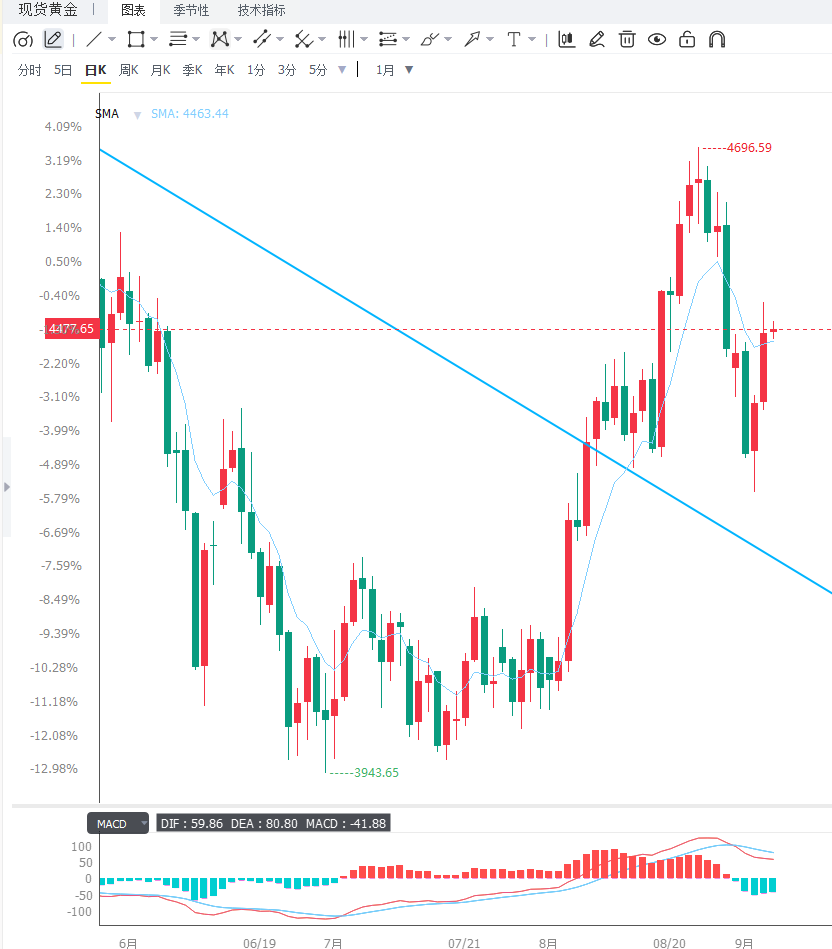 Editor's Summary: The core issue in the current gold market has gradually shifted from "whether the Federal Reserve will continue to raise interest rates" to "whether US economic data can support continued tightening." After Waller emphasized data dependence, expectations for a September rate hike cooled somewhat, creating a window for a gold price rebound. However, the approximately 50% probability of a rate hike means that policy risks have not disappeared. In the short term, the US August non-farm payrolls will determine the next direction of the dollar and interest rate markets, and will also directly affect the pace of gold's breakout or pullback. If employment cools significantly, gold is expected to further challenge the $4550 resistance level; if employment shows strong resilience again, the $4460 and even $4360 support levels may be tested. Currently, more attention should be paid to the transmission between data and policy expectations.
A key turning point in market sentiment this week came from differing statements by Federal Reserve officials regarding the future path of interest rates. Previously, Fed Chairman Kevin Warsh's hawkish remarks at the Jackson Hole symposium had boosted market expectations for a September rate hike, putting pressure on gold, a non-interest-bearing asset, due to a stronger dollar and rising Treasury yields. As the market further digested these comments, investors began to refocus on whether US inflation and employment data would support further rate hikes. Fed Governor Christopher Waller subsequently released a relatively dovish policy signal. He stated that if August inflation continued to show signs of improvement, maintaining the current interest rate in September would still be a reasonable option; however, if inflation data was significantly overheated, a rate hike could not be completely ruled out. This statement did not represent a complete shift to easing, but rather a further emphasis that monetary policy would be adjusted based on future economic data, thereby reducing market concerns about a continuous tightening of policy by the Fed in the short term. According to data from the Chicago Mercantile Exchange's interest rate futures market, investors now expect a 25 basis point rate hike in September with a probability of approximately 50.2%, significantly lower than the 63.2% before Waller's speech. This change indicates that the market has readjusted its pricing of the previously hawkish policy stance. While the probability of an interest rate hike remains high, marginal changes suggest that some of the policy premium previously accumulated by dollar bulls is fading, giving gold some breathing room. Market strategists believe that in the absence of clear forward guidance from the Federal Reserve, gold will remain highly dependent on changes in interest rate expectations in the coming trading days. For gold, what truly matters is not whether a single official is hawkish or dovish, but whether inflation, employment, and economic growth data can alter the market's assessment of the actual interest rate path. As long as investors believe that the room for further increases in US interest rates is limited, the opportunity cost of holding gold may decrease, thus providing support for gold prices. US employment market data has therefore become the most important short-term catalyst for the current market. The US August non-farm payroll report will be released on Friday, with the market expecting approximately 56,000 new non-farm jobs and an unemployment rate expected to remain at 4.1%. If actual job growth is significantly lower than this level, and the unemployment rate rises, the market may further reduce expectations for a September rate hike, putting pressure on the dollar and US Treasury yields, while gold is expected to gain new upward momentum. Conversely, if non-farm payrolls significantly exceed expectations, it indicates that the US labor market remains resilient, strengthening the case for the Federal Reserve to maintain a tight policy stance. In this scenario, the market may increase the probability of a September rate hike, leading to a rebound in the dollar and higher real interest rates, while gold may face profit-taking pressure. Therefore, the "surprise" of the non-farm payroll data may be more important than the data itself; the market is truly focused on the magnitude of the deviation between employment performance and expectations and its impact on the Fed's policy path. From an inflation perspective, the market is currently in a delicate balance. If energy prices remain high, they may be transmitted to overall inflation through costs, but if core inflation remains under control, the necessity for the Fed to continue raising rates will be limited. HSBC analysts believe that as long as rising energy prices do not significantly translate into higher core inflation, the likelihood of further rate hikes by the Fed in the near term remains limited. This assessment reduces the risk of gold facing sustained policy pressure. However, the current rebound in gold does not mean that the upward trend has been fully re-established. US monetary policy remains highly uncertain, and the market's pricing in the September meeting still has considerable room for adjustment. If inflation data picks up again or the job market shows unexpected resilience, the US dollar may regain its interest rate advantage, and gold will face downward pressure once more. Meanwhile, the market structure of gold itself is also worth noting. After the significant fluctuations in gold prices previously, some short-term funds have begun to quickly adjust their positions based on the Federal Reserve's expectations. In this environment, any important macroeconomic data could amplify intraday gold price volatility. Investors need to pay special attention to the synchronized changes in US Treasury yields and the US dollar index. If gold price increases are accompanied by a weakening dollar and falling yields, the rebound is usually more sustained; if gold price increases lack support from the dollar and interest rate markets, a rapid pullback after short-term fund inflows should be anticipated. From a daily chart perspective, gold is currently maintaining a relatively positive recovery pattern, with prices rising back above the 100-day moving average and near the Bollinger Band's middle line, indicating that the previous correction did not completely destroy the medium-term bullish structure. The daily Relative Strength Index (RSI) is around 55.3, having moved out of the previously potentially overbought zone, but still within the neutral-to-strong range, meaning that market momentum is recovering, but has not yet reached an extremely strong state. The first resistance level to watch is around $4550. A decisive break above this level could open up further upside potential to test previous highs. On the downside, key support lies around the Bollinger Band middle line at $4460, followed by the 100-day moving average around $4360. A break below this area could see gold prices seek support near $4245. Looking at the 4-hour chart, gold has formed a short-term rebound structure, with prices retesting key moving average areas, indicating improved short-term market momentum. However, there is still some room before reaching the important resistance level, so a pullback after a rally cannot be ruled out. If the non-farm payroll data is weaker than expected and pushes the dollar significantly lower, gold could break through to around $4550; a firm hold above this level could further strengthen short-term bullish momentum. Conversely, if the US employment data is significantly stronger than expected, a break below $4460 could trigger a market correction, with $4360 becoming the next key area to watch. Editor's Summary: The core issue in the current gold market has gradually shifted from "whether the Federal Reserve will continue to raise interest rates" to "whether US economic data can support continued tightening." After Waller emphasized data dependence, expectations for a September rate hike cooled somewhat, creating a window for a gold price rebound. However, the approximately 50% probability of a rate hike means that policy risks have not disappeared. In the short term, the US August non-farm payrolls will determine the next direction of the dollar and interest rate markets, and will also directly affect the pace of gold's breakout or pullback. If employment cools significantly, gold is expected to further challenge the $4550 resistance level; if employment shows strong resilience again, the $4460 and even $4360 support levels may be tested. Currently, more attention should be paid to the transmission between data and policy expectations.
- Risk Warning and Disclaimer
- The market involves risk, and trading may not be suitable for all investors. This article is for reference only and does not constitute personal investment advice, nor does it take into account certain users’ specific investment objectives, financial situation, or other needs. Any investment decisions made based on this information are at your own risk.