How far can the New Zealand dollar rebound go after the Reserve Bank of New Zealand postpones its interest rate hike to December?
2026-09-04 15:02:06
The Reserve Bank of New Zealand raised interest rates as expected this week, but the tone of its statement suggested that the next move is more likely in December than October. Swap data shows that the probability of a rate hike in October is only 31%, while the probability of a rate hike in December is close to 100%. Governor Brehman stated that further rate hikes are possible, but policymakers want time to assess the economic impact of the implemented rate hikes. 
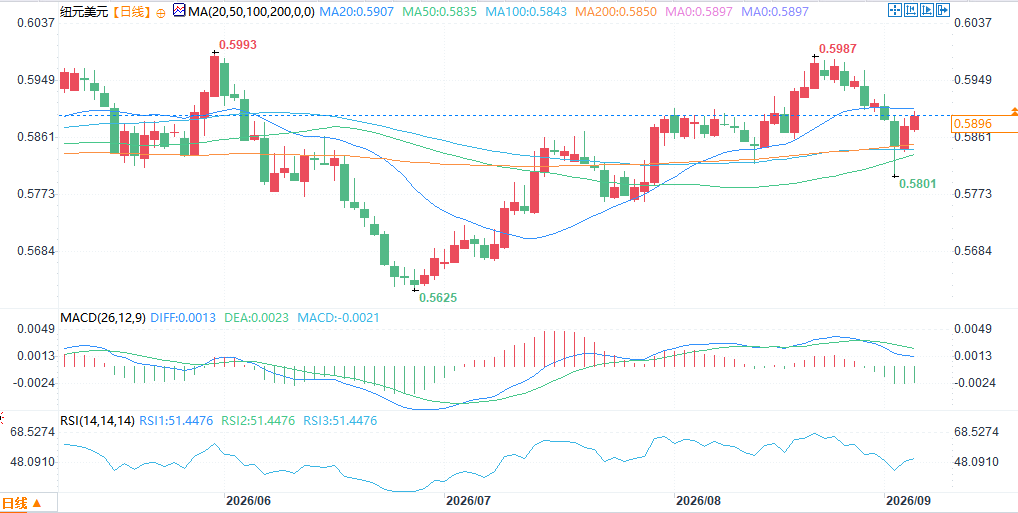 (NZD/USD daily chart, source: EasyForex) At 14:50 Beijing time, the NZD/USD exchange rate was 0.5894/95.
Reserve Bank of New Zealand: December rate hike more likely than October
The Reserve Bank of New Zealand (RBNZ) raised interest rates for the second consecutive week, but the market interpreted the statement's tone as indicating that the next rate hike is more likely in December than October. Swap data showed only a 31% probability of a rate hike in October, while the probability of a December hike was close to 100%. Governor Brehman stated that further rate hikes were possible, but policymakers wanted time to assess the impact of the implemented rate hikes. Assistant President Silk stated that the committee clearly understood that further tightening was possible and dependent on the outlook, and that the current path made December "more likely than October," while emphasizing that the path would not be predetermined and would be adjusted flexibly based on data. Following this meeting, the market quickly adjusted its pricing for the subsequent policy path. Although the RBNZ raised rates twice in a row, demonstrating its continued firm stance against inflation, the overall wording of the statement was cautious and did not release a strong signal of another action in October. The swap market reacted accordingly, significantly lowering the probability of an October rate hike to only 31%, while the probability of a December rate hike was almost fully priced in. Following the meeting, Chairman Brehman clarified that further rate hikes remain within the toolbox, but the Committee prefers to have sufficient time to observe the actual transmission effects of previous rate hikes on the economy and inflation. Assistant Chairman Silk added that the Monetary Policy Committee unanimously agreed that further tightening is possible and entirely dependent on the latest data and changes in the outlook; based on current information, December is more in line with a gradual pace than October. She also emphasized that the Committee will not lock in any path in advance and will maintain a high degree of flexibility, adjusting its stance as needed based on inflation, employment, and growth data. This statement preserves hawkish space while reducing the urgency of another near-term rate hike.Inflation forecasts delayed; four members warn of inflation risks.
The Reserve Bank of New Zealand (RBNZ) has postponed its timeline for inflation to return to its target – projecting inflation at 3.9% by the end of 2026 and only returning to the 2% target midpoint by early 2028 (later than previously forecast). Four of the six members of the Monetary Policy Committee expressed concern about inflation risks, including the transmission of fuel and freight costs from the Middle East conflict, businesses raising prices to capitalize on the economic recovery, and inflation in non-tradable goods such as insurance and electricity. Despite these risks, Andrew Silk stated they were not enough to cause disagreement with the committee. The New Zealand dollar may come under pressure in the short term as the timing of an interest rate hike has been postponed to December, with expectations for an October rate hike falling sharply. The latest forecast shows a significant slowdown in the return of inflation to the target. The RBNZ expects inflation to remain high at 3.9% by the end of 2026 and not fall back to the 2% target midpoint until early 2028, a significant delay from previous expectations. This adjustment reflects policymakers' growing concerns about price stickiness. Of the six members of the Monetary Policy Committee, four expressed clear concern about upside inflation risks, with key concerns including: the potential for the Middle East situation to push up fuel prices and international freight rates, which could then be transmitted domestically; businesses potentially raising prices to restore profit margins as the economy gradually recovers; and structural pressures from continued price increases in non-tradable goods such as insurance and electricity. Despite these risks being thoroughly discussed, Assistant Chair Silk stated that current information is insufficient to create a significant divergence between her and other committee members on policy stance. The New Zealand dollar faces some short-term downward pressure due to the market's interpretation of a delayed interest rate hike pace. The significant decline in expectations for an October rate hike has weakened the currency's attractiveness due to high interest rates; if subsequent data fails to reignite tightening expectations, the New Zealand dollar may continue to be under pressure.NZD/USD: Interest rate hike expectations delayed until December, NZD may face short-term pressure.
The Reserve Bank of New Zealand's signal to postpone its next interest rate hike from October to December is putting short-term pressure on the New Zealand dollar against the US dollar. Swap data shows that the probability of a rate hike in October is only 31%, while it is close to 100% in December, meaning that the market's previous expectation of "continuous rate hikes in October" has failed to materialize, weakening the New Zealand dollar's short-term attractiveness in terms of interest rate differentials. However, the downside for the New Zealand dollar may be limited. First, the December rate hike is almost fully priced in, meaning that the market has begun to prepare for another tightening before the end of the year, rather than completely abandoning the expectation of a rate hike. Second, four members of the Monetary Policy Committee expressed concern about inflation risks, indicating that hawkish forces within the Reserve Bank of New Zealand still dominate, providing medium-term support for the New Zealand dollar. Third, in the US, Waller's dovish comments have lowered the probability of a September rate hike from 64% to 54%, putting overall pressure on the US dollar and providing a bottom support for the New Zealand dollar against the US dollar. If expectations of a December rate hike solidify further or US data is weak, the New Zealand dollar is likely to rebound toward 0.5900; if the market continues to postpone rate hike expectations or the US dollar strengthens, the New Zealand dollar may fall back toward 0.5800.Summarize
The Reserve Bank of New Zealand (RBNZ) has signaled that the next rate hike will likely be in December rather than October, with swaps indicating a 31% probability of a rate hike in October and nearly 100% in December. Inflation forecasts have been postponed to early 2028 to return to the target. Four members warned of inflation risks. The New Zealand dollar may face short-term pressure, awaiting a new direction from the December meeting. The market is focused on the impact of the Middle East situation and the evolution of domestic inflation in New Zealand on the policy path. (NZD/USD daily chart, source: EasyForex) At 14:50 Beijing time, the NZD/USD exchange rate was 0.5894/95.
- Risk Warning and Disclaimer
- The market involves risk, and trading may not be suitable for all investors. This article is for reference only and does not constitute personal investment advice, nor does it take into account certain users’ specific investment objectives, financial situation, or other needs. Any investment decisions made based on this information are at your own risk.