Gold hovers below $4,500, supported by Waller's dovish comments and the looming threat of US-Iran tensions. Tonight's non-farm payrolls report will be the deciding factor.
2026-09-04 15:30:05
On Friday (September 4th) during the European session, spot gold consolidated below $4500/oz, temporarily ending a two-day rebound. The US dollar rebounded slightly ahead of the non-farm payrolls report, putting downward pressure on gold. Federal Reserve Governor Waller's dovish comments lowered the probability of a September rate hike from 64% to 54%, leading to lower US Treasury yields and providing support for gold. However, energy-driven inflation risks (the Hormuz conflict between the US and Iran pushing up oil prices) mean that the possibility of a rate hike remains, limiting gold's upside. 
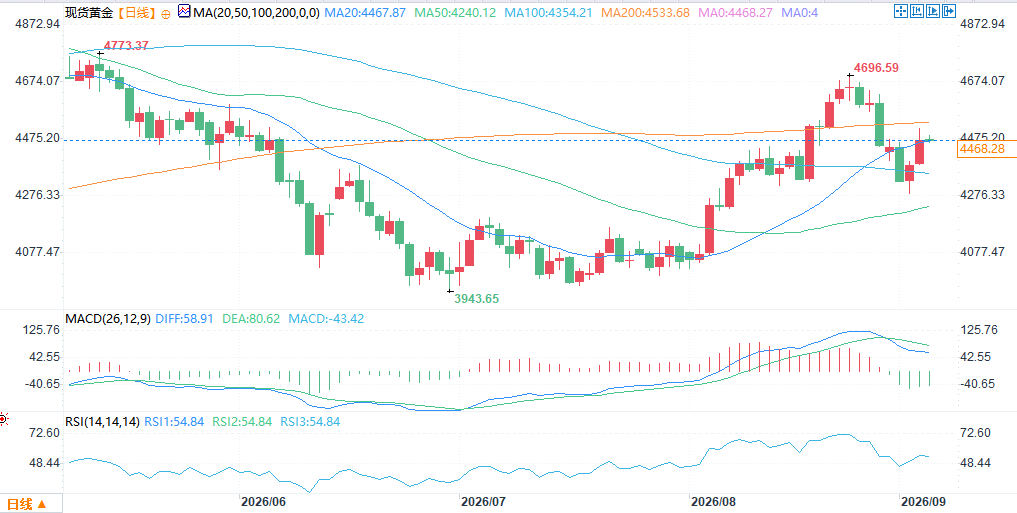 (Spot gold daily chart, source: FX678) At 15:21 Beijing time, spot gold was trading at $4467.77 per ounce.
Non-farm payroll data becomes key in the short term
The US dollar rebounded slightly ahead of the non-farm payrolls report, putting pressure on gold. Waller's dovish comments lowered the probability of a September rate hike from 64% to 54%, and lower US Treasury yields provided a floor for gold. However, energy-driven inflation risks (the US-Iran Strait conflict pushing up oil prices) mean that the possibility of a rate hike remains, limiting gold's upside. Iran targeted US military bases in Kuwait and the UAE on Thursday, and geopolitical risk premiums pushed up oil prices and supported the safe-haven dollar. Meanwhile, Fed Governor Waller's dovish comments lowered the probability of a September rate hike from 64% to 54%, and US Treasury yields subsequently fell, providing a floor for gold prices from a real interest rate perspective. However, the inflation risks from energy prices cannot be ignored. The ongoing US-Iran standoff in the Strait of Hormuz continues to push up oil prices, coupled with Iran's actions on Thursday targeting US military bases in Kuwait and the UAE, significantly increasing geopolitical risk premiums. This not only supported oil prices but also boosted the safe-haven dollar to some extent, thus limiting gold's upside potential. With both bullish and bearish factors at play, gold prices are expected to remain volatile in the short term, with non-farm payroll data set as a key catalyst to break the current balance.TD Securities: Non-farm payrolls are a short-term variable, but the medium-term outlook is improving.
TD Securities points out that non-farm payroll data is a key short-term variable for precious metals, but the medium-term outlook has improved—the theme of dollar depreciation has resurfaced, and a Fed rate hike is far from certain. In its latest analysis, TD Securities emphasizes that non-farm payroll data is currently the most important short-term variable influencing precious metal price movements, but the medium-term outlook for gold has shown signs of improvement. The theme of dollar depreciation has returned to market focus, while a Fed rate hike in September is far from certain, providing a more supportive macroeconomic environment for gold prices. In the short term, gold is expected to fluctuate within the $4450-$4550 range, with the direction depending on the actual performance of the non-farm payroll data: if the data is significantly weak, it may push gold prices to break through the $4500 level and further advance towards the $4550-$4600 area; if the data is unexpectedly strong, it may cause gold prices to fall back to around $4450 to seek support.Summarize
Spot gold is currently consolidating below $4,500. Waller's dovish comments and lower US Treasury yields are providing support, but energy inflation risks and geopolitical tensions limit upside potential. The non-farm payroll data will determine the short-term direction—weak data could push gold above $4,500, while strong data could put downward pressure on prices. Gold may fluctuate between $4,450 and $4,550 in the short term, awaiting new direction from the non-farm payroll data and geopolitical developments. Pay attention to Fed policy signals and developments in the Middle East. (Spot gold daily chart, source: FX678) At 15:21 Beijing time, spot gold was trading at $4467.77 per ounce.
- Risk Warning and Disclaimer
- The market involves risk, and trading may not be suitable for all investors. This article is for reference only and does not constitute personal investment advice, nor does it take into account certain users’ specific investment objectives, financial situation, or other needs. Any investment decisions made based on this information are at your own risk.