Are interest rate differentials obsolete? The market is repricing the pound based on fiscal credibility.
2026-09-04 19:27:05
On Friday, September 4th, the pound sterling was in a phase of repricing due to macroeconomic factors. Recent increased volatility in the global bond market has led investors to refocus on the fiscal stability of highly indebted economies, with the upcoming UK budget announcement being a key focus of market attention. Against this backdrop, the foreign exchange market's focus on the pound has gradually shifted from traditional interest rate differentials to structural factors such as fiscal credibility, government financing environment, and the proportion of UK government bonds held by overseas investors. Market analysts believe that the UK government bond market possesses a unique risk transmission mechanism: a significant proportion of UK government debt is held by overseas investors. When fiscal policy uncertainty increases, foreign capital flows may amplify bond market volatility and further impact exchange rate performance. Meanwhile, the monetary policy paths of the Bank of Japan, the European Central Bank, and the Federal Reserve are still in a period of adjustment, and the increasingly complex global capital allocation environment also exposes the pound to more external variables. 
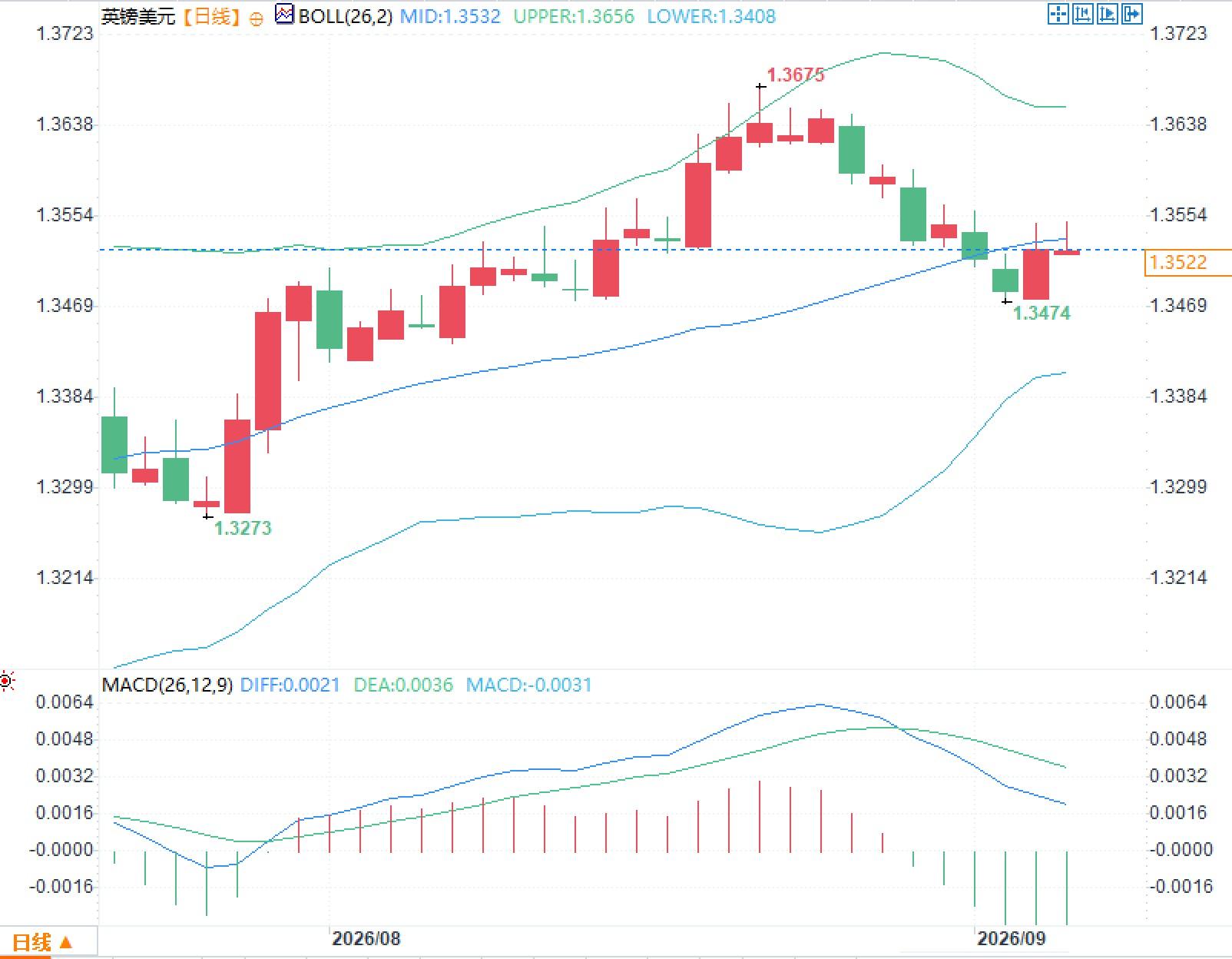 The Bollinger Bands indicator shows that the upper band had previously expanded upwards, indicating increased volatility in the earlier period; as prices have corrected, the channel has gradually converged, reflecting a decrease in short-term market volatility. As for the MACD indicator, the fast and slow lines have shifted from an expanding state to a converging state. Key factors influencing the pound market going forward will continue to include developments in UK fiscal policy, changes in risk appetite in the global bond market, policy expectations of major central banks, and economic data performance. Especially given the significant uncertainty surrounding the global interest rate environment, exchange rate fluctuations may reflect more of a reallocation of macro funds than a single factor.
The proportion of UK government bonds held by foreign investors has become a key focus in the exchange rate market.
A key reason for the concern surrounding UK fiscal risk lies in its government debt structure. According to data from the UK Office for Budget Responsibility, overseas investors hold approximately 30% of UK government bonds. This proportion means that when market doubts arise regarding fiscal policy, overseas capital activity can become a significant variable affecting bond market stability. Compared to some major economies, the UK government bond market has a higher proportion of overseas holdings, making it more sensitive to changes in international investor sentiment. If global investors increase their assessment of uncertainty regarding the fiscal deficit, debt growth, or budget policy, bond yields may be affected, while the exchange rate market typically adjusts through changes in risk premiums. In recent years, the Bank of England has been continuously reducing its balance sheet, decreasing its holdings of UK government bonds through quantitative tightening. This means the government bond market relies more heavily on private investors and international capital to absorb supply. In stable market conditions, this structure does not create significant pressure, but when budget policy is questioned or global bond market volatility increases, the high proportion of foreign holdings can amplify market reactions. The UK's fiscal problems do not simply stem from the size of its debt, but rather from the complex relationship between fiscal policy, economic growth expectations, and financing costs. Market focus is shifting from single economic data points to policy credibility and changes in capital flows.With the budget deadline approaching, fiscal policy has become a key variable in the valuation of the pound.
Ahead of the UK budget announcement in October, markets will be highly sensitive to details of fiscal policy. The budget not only affects future government spending and revenue arrangements but also influences investors' assessments of the sustainability of UK debt. Uncertainty surrounding fiscal policy manifests in several ways, including how the government will balance public spending needs with fiscal discipline, how it will maintain market confidence in its debt management capabilities, and whether policy changes will impact economic growth expectations. For the exchange rate market, fiscal factors typically influence the market through three channels: First, they affect government bond yields. Yields may change when investors demand higher risk compensation. Second, they affect capital flows. Exchange rate volatility may occur if international investors adjust their asset allocations. Third, they affect monetary policy expectations. The interaction between fiscal policy and the inflation path influences market assessments of the Bank of England's future policy space. Therefore, the current focus in the pound market is not just on the budget itself, but also on the policy coordination capabilities behind it.The market has entered a technical adjustment phase, and is awaiting further confirmation from the fundamentals.
Looking at the daily chart of GBP/USD, the exchange rate previously experienced a significant rebound, reaching a relatively high level, before undergoing a period of consolidation. Currently, the price has fallen back to near the middle Bollinger Band, indicating that the market is digesting profit-taking pressure from the previous rise. The Bollinger Bands indicator shows that the upper band had previously expanded upwards, indicating increased volatility in the earlier period; as prices have corrected, the channel has gradually converged, reflecting a decrease in short-term market volatility. As for the MACD indicator, the fast and slow lines have shifted from an expanding state to a converging state. Key factors influencing the pound market going forward will continue to include developments in UK fiscal policy, changes in risk appetite in the global bond market, policy expectations of major central banks, and economic data performance. Especially given the significant uncertainty surrounding the global interest rate environment, exchange rate fluctuations may reflect more of a reallocation of macro funds than a single factor.Frequently Asked Questions
Question 1: Why does the proportion of UK government bonds held overseas affect the pound sterling market? Answer: A high proportion of UK government bonds held by overseas investors means that changes in international investor sentiment can influence exchange rates through the bond market. When investors reassess fiscal risks, bond prices, yields, and capital flows may change in tandem, thus increasing volatility in the pound sterling market. Question 2: Why has UK budget policy become a recent focus of market attention? Answer: Budget policy determines the government's future fiscal arrangements and also influences market assessments of debt management capabilities and economic growth prospects. If investors perceive uncertainty in fiscal policy, they may increase their risk assessment; therefore, budget information often becomes an important factor to observe in the exchange rate market.- Risk Warning and Disclaimer
- The market involves risk, and trading may not be suitable for all investors. This article is for reference only and does not constitute personal investment advice, nor does it take into account certain users’ specific investment objectives, financial situation, or other needs. Any investment decisions made based on this information are at your own risk.