Despite lingering hawkish expectations and upcoming data releases, gold remains strong.
2026-09-04 18:32:05
On Friday during Asian trading hours, spot gold saw a slight pullback, failing to hold the $4,500 mark and potentially ending its two-day winning streak, but still retaining most of Thursday's gains. The price of gold rose and then fell, primarily pressured by a slight recovery in the US dollar, but it still managed to hold onto recent gains. Firstly, the CPI data may be more important, as the labor market is generally in a low-volatility zone. Given the poor employment data last time, this time there might be a significant rebound, but even with an unexpected rebound, it will still remain in a low-volatility zone. As for inflation data, the overall trend is more important. If the Federal Reserve wants to raise interest rates, it must convince the market; otherwise, why should this inflation data reflect the overall trend? 
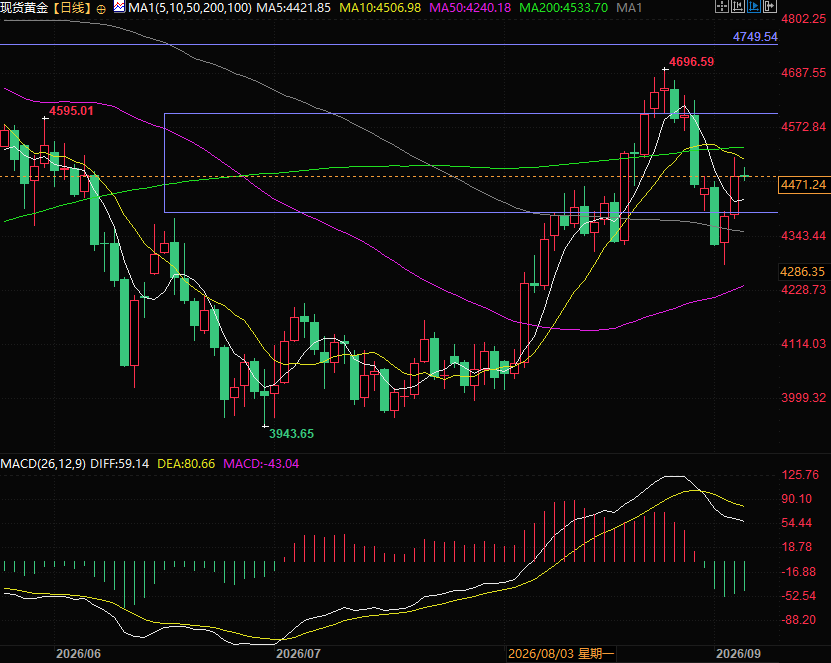 (Spot gold daily chart, source: FX678) At 18:28 Beijing time, spot gold is currently trading at $4470 per ounce.
Extreme fluctuations in non-farm payroll data drive market dynamics due to monthly expectation gaps.
The core logic behind this non-farm payrolls report stems from the extreme anomaly in the US job market. Last month, the US non-farm payrolls data recorded a rare negative figure of -23,000 jobs, indicating a net loss of employment. This is an extremely unexpected situation in non-farm payroll statistics, completely shattering the market's preconceived notion of a steady recovery in the US labor market and significantly cooling market expectations for interest rate hikes. Entering this month, the market generally anticipates a significant rebound in non-farm payrolls data, with mainstream economists expecting around 55,000 new jobs added in August. The labor market is expected to recover from last month's slump, and this difference in expectations has become the core theme of recent financial market speculation.Divergent policy statements from the Federal Reserve intensify uncertainty surrounding a September rate hike.
The extreme contrast in employment data directly triggered a divergence in policy statements within the Federal Reserve. Fed Chairman Warsh was the first to release hawkish signals, based on the prediction of unusually weak non-farm payrolls last month and a high probability of a recovery in employment this month, coupled with inflation having exceeded the Fed's 2% annual target for 65 consecutive months. He strongly stated that a September rate hike was not ruled out, reigniting market concerns about a tightening of monetary policy by the Fed. However, subsequent Fed Governor Waller, New York Fed President Williams, and other officials released reassuring remarks, collectively offsetting the hawkish tone. Waller explicitly stated that, barring unexpected inflation data, he favored keeping interest rates unchanged at the September FOMC meeting, emphasizing that a September rate hike was not a certainty and that the decision would be entirely anchored to the latest inflation data from August. Williams also added that there were positive signs of a cooling inflation trend, requiring further data verification, and that there was no need to hastily tighten policy. This mix of bullish and bearish statements led to market disagreement regarding the Fed's policy direction in September.Rising energy prices are pushing up overall inflation; can rent act as a stabilizer?
The uncertainty surrounding inflation has further exacerbated the volatility in gold prices. The core contradiction in this round of inflationary struggle lies in the offsetting effect between energy prices and core inflation. Recently, international oil prices have continued to rise, approaching their highest level since July 24th. This, coupled with ongoing geopolitical tensions in the Middle East, escalating US-Iran conflict, the Strait of Hormuz standoff, and Iran's repeated attacks on US military bases, has pushed up the prices of crude oil, diesel, and other refined oil products. Currently, US distillate fuel inventories are at historically low levels for this time of year, and refinery capacity is nearing its limit. Combined with the overlapping demand from the heating season in the Northern Hemisphere, the busy farming season, and the planting season in the Southern Hemisphere, the upward trend in refined oil prices is unlikely to reverse in the short term, continuously increasing overall inflationary pressure in the US, providing temporary support for the US dollar, and limiting the upside potential of gold. However, the key anchor for core inflation is housing rent data. Recently, US rents have remained generally stable, showing no signs of significant increases, effectively offsetting the upward inflationary pressure from rising energy prices. Therefore, this round of inflation data is likely to show a pattern of a slight increase in overall inflation and a limited increase in core inflation, making it difficult to create a strong inflationary environment that continuously forces the Federal Reserve to raise interest rates.A balanced struggle between bullish and bearish forces limits the downside potential for gold prices.
In summary, the current gold market is facing downward pressure due to a slight rebound in the US dollar, concerns about energy inflation, and expectations of a rebound in non-farm payroll data. However, a Fed rate hike is not a certainty, and even if a rate hike occurs, the rise in US Treasury yields may slow due to the Fed's need to demonstrate its independence. Furthermore, the inability to confirm the overall inflation trend means it's unclear whether inflation will rise next month. The long-term weakening of the US dollar remains unchanged, limiting the downside potential for gold. TD Securities also commented that despite short-term market risks from data volatility and hawkish policy fluctuations, the overall downside for precious metals is limited, and their future performance is promising. (Spot gold daily chart, source: FX678) At 18:28 Beijing time, spot gold is currently trading at $4470 per ounce.
- Risk Warning and Disclaimer
- The market involves risk, and trading may not be suitable for all investors. This article is for reference only and does not constitute personal investment advice, nor does it take into account certain users’ specific investment objectives, financial situation, or other needs. Any investment decisions made based on this information are at your own risk.