A dramatic reversal occurred on non-farm payroll night: layoffs were underway in July, but prices suddenly surged in August! Is the Fed's September rate hike hanging over us again?
2026-09-04 20:46:05
On Friday (September 4th) at 8:30 PM Beijing time, the U.S. Bureau of Labor Statistics released its August non-farm payrolls report. Data showed that non-farm payrolls increased by 162,000 in August, far exceeding market expectations of approximately 55,000 to 56,000; the unemployment rate remained stable at 4.1%, in line with expectations; the private sector added 127,000 jobs, also significantly higher than expected; manufacturing added 16,000 jobs, with the average weekly working hours rising to 34.4 hours. The combined upward revision of the previous two months' data by 55,000, with July's figure initially showing a decrease but now showing an increase of 21,000.  Prior to the data release, the market generally expected a continued slowdown in employment. July's unexpected job losses, coupled with downward revisions to the previous figure, led most institutions to predict between 40,000 and 80,000 jobs lost, with the most optimistic estimate only around 80,000 to 125,000. Institutional accounts continuously shared consensus data before the release, and retail investor discussions largely revolved around "a sharp deterioration in employment" and "increased recession risks." Interest rate futures had already partially priced in the possibility of a rate hike or maintenance in September. On the same day, Canada announced an unexpected loss of 41,700 jobs in August, with the unemployment rate remaining stable, but the US dollar strengthened against the Canadian dollar due to the dominance of US data. After the data release, the market quickly repriced. The US dollar index rose by about 35 points in the short term, reaching a high of 99.35; the 10-year US Treasury yield widened its intraday gains, briefly approaching 4.79%; spot gold plunged more than $70 from near $4470, with intraday losses exceeding 2%, trading in the $4383-$4390 range; US stock futures retreated slightly. Interest rate futures traders significantly increased their bets on a Fed rate hike in September.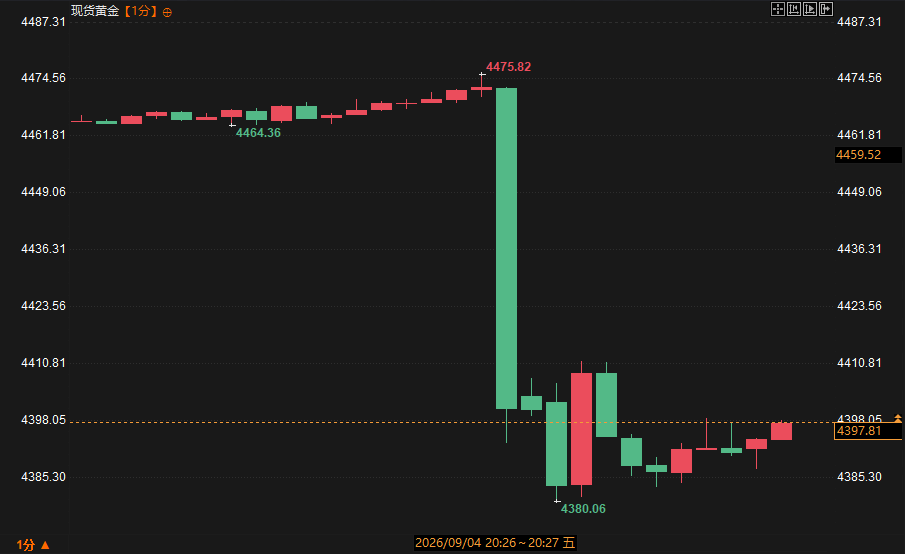
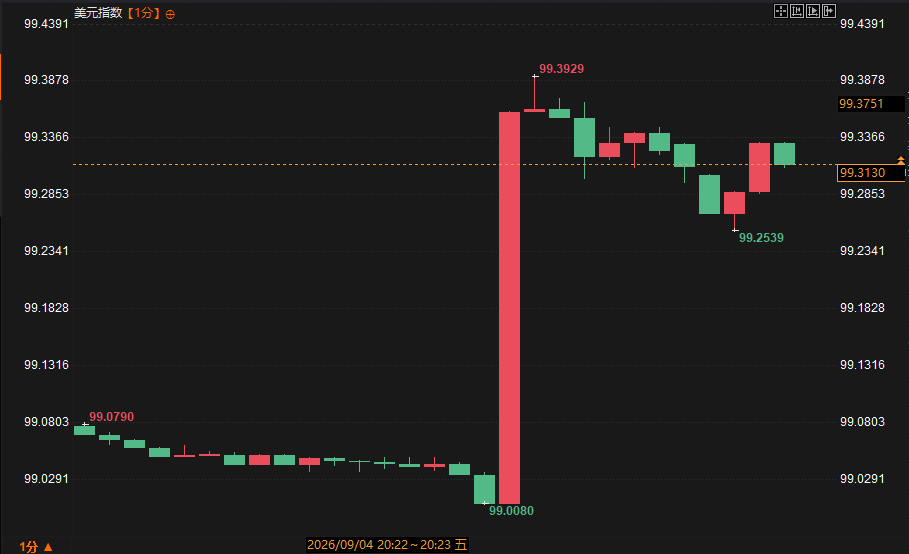
Prior to the data release, the market generally expected a continued slowdown in employment. July's unexpected job losses, coupled with downward revisions to the previous figure, led most institutions to predict between 40,000 and 80,000 jobs lost, with the most optimistic estimate only around 80,000 to 125,000. Institutional accounts continuously shared consensus data before the release, and retail investor discussions largely revolved around "a sharp deterioration in employment" and "increased recession risks." Interest rate futures had already partially priced in the possibility of a rate hike or maintenance in September. On the same day, Canada announced an unexpected loss of 41,700 jobs in August, with the unemployment rate remaining stable, but the US dollar strengthened against the Canadian dollar due to the dominance of US data. After the data release, the market quickly repriced. The US dollar index rose by about 35 points in the short term, reaching a high of 99.35; the 10-year US Treasury yield widened its intraday gains, briefly approaching 4.79%; spot gold plunged more than $70 from near $4470, with intraday losses exceeding 2%, trading in the $4383-$4390 range; US stock futures retreated slightly. Interest rate futures traders significantly increased their bets on a Fed rate hike in September. Deep interconnect analysis
On the fundamental front, this report completely reversed the previous narrative of a sharp deterioration in the labor market. Job gains far exceeded consensus, with both the private and manufacturing sectors showing strong growth. The labor force participation rate rebounded to 61.6%, alleviating concerns that the decline in the participation rate last month might have distorted the unemployment rate. The U-6 broad unemployment rate was 7.7%, indicating that the underemployment situation is manageable. Historically, the average monthly job growth has been significantly lower than usual, and the August figure of 162,000 is not only higher than the 12-month average but also significantly higher than most institutional models. The upward revision of the previous figure further strengthens the resilience signal. The technical indicators and immediate market reactions were highly consistent. Gold broke through several key levels immediately after the data release, quickly retreating from its highs, reflecting the pressure on precious metals from rising risk-free interest rate expectations. The US dollar index and US Treasury yields rose in tandem, consistent with the classic path of "strong employment → higher policy rate expectations → stronger dollar and yields." S&P 500 futures fell slightly, indicating the stock market's caution regarding the recalibration of the interest rate path. Compared to the reactions following similarly strong non-farm payroll data in the past, this reaction was much larger, mainly because previous expectations were overly pessimistic, and the deviation was instantly corrected. The contrasting viewpoints were striking. Before the data release, both institutional and retail investors emphasized the cooling employment situation and room for policy easing; after the release, institutions emphasized that the actual reading was even higher than Wall Street's highest forecast. Retail investor discussions quickly shifted from "recession concerns" to "renewed uncertainty surrounding Fed policy" and "increased probability of a September rate hike." Well-known institutions had previously collectively underestimated the data, but the actual data completely overwhelmed the consensus, making the expectation deviation the core driver of this round of volatility. The weak Canadian employment situation contrasted sharply with the strong US data, but global capital flows were still dominated by US data, and the USD/CAD pair rose by about 70 points in the short term. Overall, the confirmation of fundamental resilience and the instantaneous pricing by technical factors mutually validate each other, and the long-term and short-term logics are consistent: the short-term shock stemmed from the correction of expectations, while the medium-term outlook indicates that the labor market is not as fragile as previously priced in.Trend Outlook
Strong employment data significantly reduced the urgency for a Fed rate cut in September, prompting a recalibration of the market's policy path for the year. Next week's key inflation data will be the new focus; anchored by employment data, inflation readings will determine further evolution of interest rate expectations. On the market front, upward pressure on the dollar and US Treasury yields may continue, putting short-term pressure on interest rate-sensitive assets such as gold; risk assets are becoming increasingly sensitive to policy uncertainty. Going forward, it's necessary to observe the sustainability of employment details and the confirmation of inflation data; market fluctuations may revolve around the interplay of policy expectations.Frequently Asked Questions
Q: Why did the August non-farm payroll data far exceed market expectations? The actual increase was 162,000, significantly higher than the consensus estimate of around 55,000. The private sector and manufacturing sectors made significant contributions, and the previous figure was revised upwards. Previous institutional forecasts were overly pessimistic, amplifying the discrepancy. Q: Why did gold prices fall sharply after the data release? Strong employment data increased expectations that the Fed would maintain or raise interest rates. Rising risk-free interest rates suppressed the attractiveness of holding gold, causing spot gold to plunge by over $70 instantly, with a daily drop exceeding 2%. Q: What does the unemployment rate remaining stable at 4.1% indicate? The unemployment rate met expectations and did not rise. Coupled with a rebound in the labor force participation rate, this indicates that the job market has not deteriorated significantly. The improved participation rate alleviated concerns that previous readings might be distorted. Q: What does this data mean for the Fed's September meeting? It significantly reduces the urgency of a rate cut, and interest rate futures are increasing bets on a September rate hike. The real determinant of the next step remains subsequent inflation data. The resilience of employment allows policy focus to be more concentrated on price stability.- Risk Warning and Disclaimer
- The market involves risk, and trading may not be suitable for all investors. This article is for reference only and does not constitute personal investment advice, nor does it take into account certain users’ specific investment objectives, financial situation, or other needs. Any investment decisions made based on this information are at your own risk.