The non-farm payrolls report of 162,000 was a bombshell: the blame was completely shifted to the CPI.
2026-09-04 21:03:05
US non-farm payrolls surged by 162,000 in August, far exceeding the consensus expectation of 56,000, and the July data turned positive, shattering the pessimistic narrative of a "sharp deterioration in employment." Subsequently, yields on 2-, 5-, and 10-year Treasury bonds all rose, and spot gold quickly plunged 60 points. However, behind the seemingly impeccable data, concerns remain about the true structure of the job market, and the Federal Reserve's policy decisions have completely tilted towards the upcoming CPI data. 
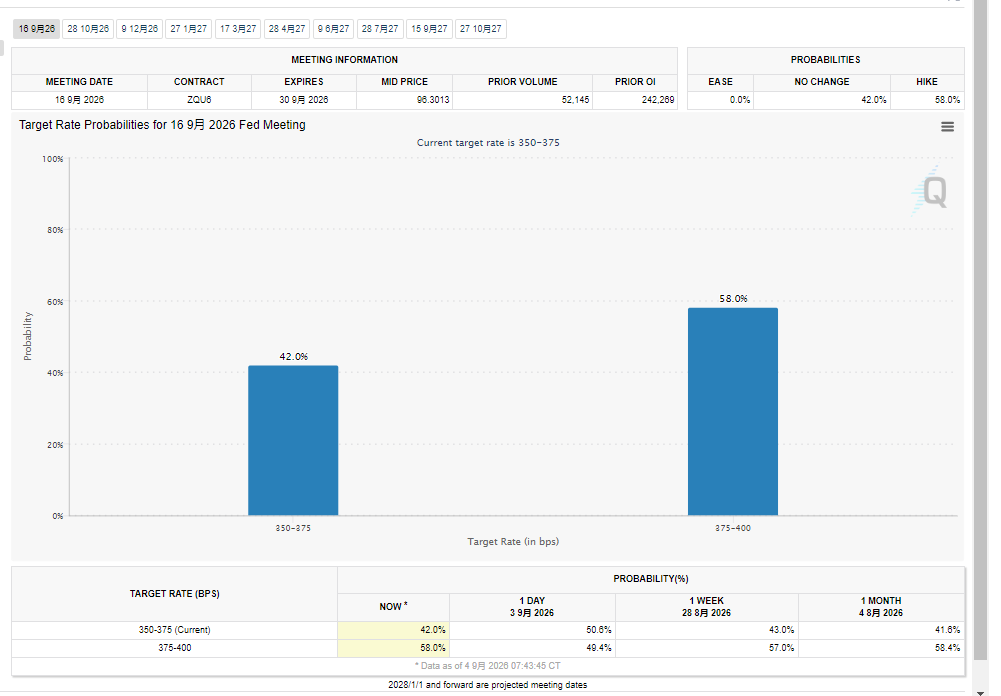 (FedWatch Futures Watch, Source: CME Group)
Why did the data rebound so much?
The unexpectedly large rebound in data is not a single-industry surge, but rather the result of a complex interplay of underlying factors and the release of previously suppressing factors: A concentrated correction of seasonal distortions: The significant reduction of nearly 50,000 local government education jobs in July greatly lowered the base figure for the previous month. In August, with the start of preparations for the new school year, this seasonal replenishment provided a solid foundation for the strong rebound in non-farm payrolls. Private sector resilience stronger than expected: Private sector employment increased by 127,000 (compared to an expected 45,000), with manufacturing even contributing 16,000 jobs against the trend. Working hours rebounded to 34.4 hours, indicating that despite oil price shocks and supply chain pressures, companies did not initiate substantial layoffs but quickly resumed production. The TPS policy drag was overestimated: The market was previously extremely concerned that the revocation of Haiti's Temporary Status Protection (TPS) would directly remove tens of thousands of service and healthcare workers from the payroll list (as Morgan Stanley had previously estimated a drag of over 15,000). However, actual data shows that the labor market's self-digestion and visa conversion capabilities exceeded expectations, and the anticipated supply collapse did not occur.Is the structure completely flawless?
While the surface figures appear impressive, a closer analysis reveals underlying concerns. Firstly, regarding labor supply, although the labor force participation rate has slightly increased from 61.4% to 61.6%, the overall level remains low compared to the beginning of the year. Affected by both tightened immigration policies and a "retirement wave" due to an aging population, the overall labor supply pool is actually shrinking. This means that the "equilibrium number of new jobs" needed to maintain a stable unemployment rate has been lowered to a low of 0 to 50,000 per month, with the high figures masking the supply-side contraction to some extent. Secondly, regarding employment quality, although the broad unemployment rate (U-6) has fallen to 7.7%, indicating that underemployment is manageable, the industry distribution of new jobs remains structurally unbalanced. Most of the job growth is still highly concentrated in defensive or seasonal sectors such as local education, basic healthcare, and low-wage service industries, while recruitment in high-wage and high-productivity sectors remains weak, limiting its contribution to the overall economic growth. Finally, the drag from the external environment has not been eradicated. Although market panic regarding tariff shocks and geopolitical tensions has subsided in the short term, the lagged effects of tariff policies in 2025, as well as oil price volatility and supply chain pressures caused by the Middle East situation, remain a looming threat. Amidst these multiple uncertainties, companies' long-term hiring and investment plans generally remain cautious and conservative. Conclusion: Structurally, the non-farm payrolls report is far from flawless; it exhibits a typical structural characteristic of "overweight in total volume but weak in quality."Have recession fears been completely dispelled?
Yes, at least in the short term, the risk of a "hard landing" has been completely eliminated. The unemployment rate has stabilized at 4.1%, and this stability is based on a proactive rebound in the labor force participation rate, directly dispelling concerns that the unemployment rate is "falsely stable due to people leaving the labor market." With weekly working hours recovering and the unemployment rate not reaching the SAM rule threshold, the US economy is still operating on a typical (slow hiring, slow laying off) virtuous cycle, and the logic of a short-term recession has no basis.The pressure is all on the CPI: The Federal Reserve has no way out.
With the non-farm payroll data clearing away the threat of economic collapse, the Federal Reserve has no excuse to blindly ease monetary policy in order to "save jobs." The focus of the financial markets has shifted entirely to next week's CPI report: Employment is no longer a basis for interest rate cuts: wage growth slowed to 3.0%, indicating that the labor market itself is not generating double-dip inflation pressure, but the 162,000 new jobs mean that demand is highly elastic. Fed Governor Waller previously emphasized that as long as inflation data confirms cooling, the Fed tends to hold rates steady; now, strong employment gives policymakers considerable confidence to remain on the sidelines. If the CPI shows stickiness, a rate hike will become the only option: currently, the market is deeply divided on the policy path for September. High long-term Treasury yields and the 30-year mortgage rate climbing to 6.71% are essentially pricing in "sticky inflation + policy uncertainty." If next week's CPI data is unexpectedly sticky, without the pressure of recession risks, the Fed will lose its legitimacy to hold rates steady, and a resumption of rate hikes may become inevitable. Interest rate futures jumped from 50% to 58% before the data release. (FedWatch Futures Watch, Source: CME Group)
- Risk Warning and Disclaimer
- The market involves risk, and trading may not be suitable for all investors. This article is for reference only and does not constitute personal investment advice, nor does it take into account certain users’ specific investment objectives, financial situation, or other needs. Any investment decisions made based on this information are at your own risk.