Why has the stable relationship between US stocks and US bonds broken down?
2026-09-05 01:26:04
For decades, investors have followed a set of established and reliable rules in regular market trading: whenever US Treasury yields rise, the stock market is likely to follow suit, with the two assets exhibiting a high degree of correlation – a market consensus implicitly accepted by all traders. However, this long-established and reliable trading logic has become completely ineffective in the current market environment, and the stable relationship between stocks and bonds has been utterly broken.  Why is this important? In Wall Street financial markets, this long-term, stable correlation between two asset classes is collectively referred to by professionals as correlation. For pragmatic traders, ordinary investors, and financial professionals, asset correlation is not an abstract theoretical concept, but a directly applicable trading reference, risk control basis, and market judgment standard. When this fixed market pattern that has persisted for over a decade suddenly reverses and completely changes, it is not a minor market fluctuation, but rather signifies a comprehensive adjustment in the underlying judgment logic, investment mentality, and trading strategies of global investors. It also indicates that the overall operating rules, price fluctuation rhythms, and risk landscape of the financial market will enter a completely new stage of development, requiring all subsequent investment operations to adapt to the new rules. Macroeconomic Background Looking back at the financial market trends of the past two decades, the long-term correlation between bond yields and stock prices is not accidental, but a normal pattern that aligns with the economic environment at the time and has a clear, practical logic. The past market environment was generally stable, the economic rhythm was regular, there were no sustained external conflicts, resource shortages, or significant policy changes, and the market's upward and downward logic was simple and straightforward, easily understood by ordinary people.
 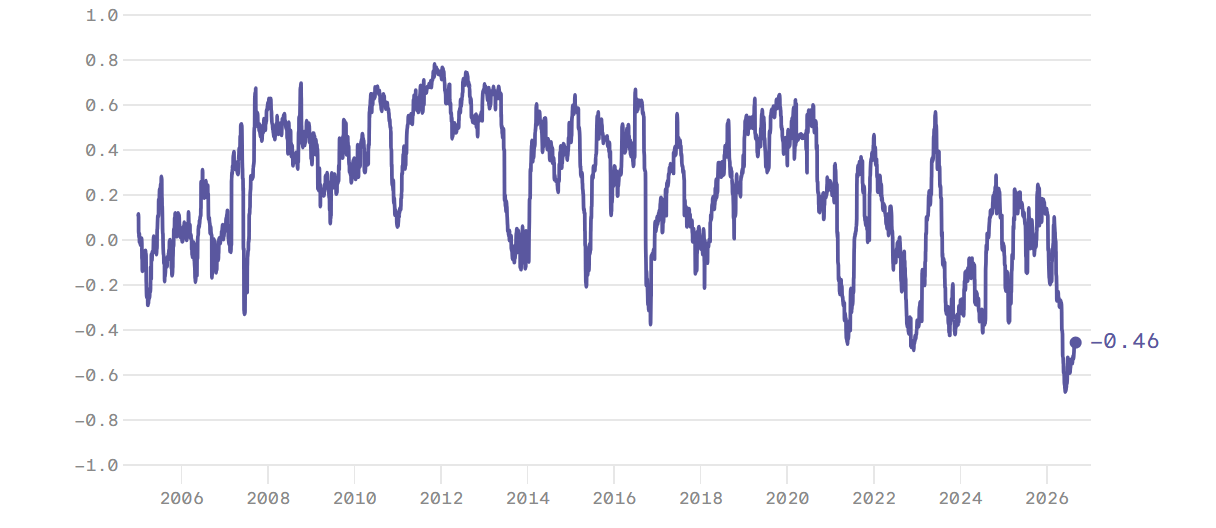 (Three-month rolling correlation between daily S&P 500 returns and changes in the US 10-year Treasury yield) During that period, every rise and fall in bond yields was primarily driven by the overall economic outlook of the United States, with virtually no other confounding variables. The state of the economy directly determined the bond market's performance, which in turn precisely influenced stock market changes, forming a clear, interconnected closed-loop logic. When bond yields consistently rose (typically during the economic upswing of the early 21st century), this was the most direct and clear signal, indicating that the US economy was experiencing strong expansion and steady growth. A positive economy directly led to increased revenue and profits for companies across all industries. With stable and improving business conditions, the investment value of stocks naturally increased. In this highly certain environment, holding stocks and investing in the stock market was a prudent investment choice, ultimately resulting in a stable situation where rising bond yields and simultaneous stock price increases. Conversely, during the outbreak of a financial crisis, bond yields tended to decline. This decline in yields is not a normal market adjustment, but a concrete manifestation of market panic: investors are worried about risks in the financial system and tightening market liquidity, thus predicting an overall economic recession and pressure on various industries. This market environment is extremely unfavorable to the stock market; corporate profits will shrink significantly, and stock prices will be under downward pressure. Therefore, stock prices will fall in tandem with bond yields, resulting in a highly unified trend between stocks and bonds. Recent Developments Recently, the market pattern that had been stable for two decades has been completely overturned. The pattern of synchronized rises and falls in stocks and bonds has completely failed, and the market has shown a completely different new trend. The current market is no longer dominated by a single economic growth rate, but is affected by multiple real-world factors such as geopolitical conflicts, energy prices, policy ambiguity, and computing power demand. Market variables have increased significantly, and the logic of rises and falls has become more complex, concrete, and grounded in reality. A new normal has emerged in the market: whenever bond yields rise, it is basically in response to various real-world negative factors—the continued deterioration of global geopolitical conflicts, significant fluctuations and increases in the prices of core energy sources such as international crude oil, the unclear direction of monetary policy under the new Federal Reserve Chairman Kevin Vash, and the concentrated outbreak of various uncertainties and risks in the market. Under the influence of these concrete negative factors, rising bond yields are no longer a signal of a positive economy, but rather represent escalating market risks and intensified inflationary pressures. Therefore, the stock market is no longer rising in tandem, but is more likely to experience a decline and correction. Looking at specific data and market performance, the price fluctuations of the S&P 500 index and the changes in the yield of the 10-year US Treasury bond have formed a very strong negative correlation. This inverse trend is not a short-term accidental phenomenon, but a continuously strengthening long-term trend. In recent months, the negative correlation between the two has climbed to an extreme level not seen in decades, completely breaking the market norm of the past two decades, and the stock-bond relationship has completely broken down. Market Viewpoint Interpretation: What exactly happened behind the scenes? Viewpoint 1: The world has entered a new macroeconomic environment dominated by scarcity. Since the end of the COVID-19 pandemic, the global economy has completely bid farewell to the old pattern of stable and loose supply, and entered a new era of scarcity economy. Various physical resources, energy, and core computing power resources are no longer in unlimited supply. Geopolitical conflicts, industrial necessities, and resource shortages have become the norm, directly changing the underlying operating logic of the market. The ongoing geopolitical conflicts in regions like Ukraine and Iran have disrupted the global supply of energy and food. Simultaneously, the rapid development of the global artificial intelligence industry has led to a surge in demand for core resources such as AI computing power, servers, and chips, resulting in a persistent shortage. These real scarcity issues directly drive up the prices of various commodities, resources, and means of production globally. This inflationary pressure is rigid and will not change regardless of economic growth rates; prices will remain under pressure whether the economy is growing or slowing down. This means that today's high bond yields no longer represent a strong US economy and cannot support a stock market rally; the traditional stock-bond linkage logic has completely failed. Wei Li, Chief Investment Strategist at Blackstone, clearly explained in her Financial Times column: "The apparent collapse of the historical correlation between stocks and bonds may simply indicate that we are now in a completely different macroeconomic paradigm." In short, it's not that market trends have gone wrong, but rather that the overall economic environment, supply and demand dynamics, and risk logic have fundamentally changed, rendering old investment rules inapplicable. Scotiabank analysts, through reviewing decades of market data, summarized a clear practical pattern: "When the yield on 10-year US Treasury bonds breaks through 5%, asset correlation often turns negative: bond yields rise, and stock prices generally fall. This is roughly how the market operated from the late 1960s to the late 1990s." Currently, with US Treasury yields returning to high levels, the market is naturally replicating the earlier inverse trend, with inverse stock-bond fluctuations becoming the new normal. Viewpoint Two: Increased Uncertainty in US Domestic Policy. Morgan Stanley analysts, after long-term market tracking research, proposed that the frequent changes and ambiguities in various US government economic policies are the core human factor leading to the breakdown of the stable relationship between stocks and bonds. Compared to abstract economic theories, policy changes are the most direct and perceptible market variables for investors. Every policy adjustment directly affects the flow of funds and market sentiment in the bond and stock markets. Analysts emphasized that the US Treasury has recently frequently conducted unconventional artificial interventions in the bond market, attempting to control bond yields and stabilize market trends. However, at the same time, the scale of US federal debt continues to expand and remains high, with relevant control measures almost nonexistent. This approach of "intervening only in market trends without addressing the core debt issue" has led investors to strongly question the stability of the US financial market and the continuity of its policies, resulting in a continued weakening of market confidence. Industry insiders say that the current market performance, characterized by a complete breakdown in the correlation between stocks and bonds, is highly similar to the market situation when Trump introduced the "Liberation Day" tariff policy in April 2025. At that time, the sudden tariff policy disrupted existing trade and market rules, triggering global market panic and directly causing significant fluctuations and chaotic trends in both the stock and bond markets, completely disabling the original correlation. Regarding the landmark market turmoil of 2025, Morgan Stanley analysts reviewed and interpreted it as follows: "At that time, investors began to re-examine the core issue: whether the US dollar and US Treasury bonds, as globally recognized traditional safe-haven assets, could still maintain their absolute safety and stability. Currently, with the renewed escalation of US policy uncertainty, the continued deterioration of the debt problem, and the accumulation of market risks, this core question has resurfaced, directly reshaping the logic of stock and bond price movements and ultimately causing a complete breakdown in their relationship."
Why is this important? In Wall Street financial markets, this long-term, stable correlation between two asset classes is collectively referred to by professionals as correlation. For pragmatic traders, ordinary investors, and financial professionals, asset correlation is not an abstract theoretical concept, but a directly applicable trading reference, risk control basis, and market judgment standard. When this fixed market pattern that has persisted for over a decade suddenly reverses and completely changes, it is not a minor market fluctuation, but rather signifies a comprehensive adjustment in the underlying judgment logic, investment mentality, and trading strategies of global investors. It also indicates that the overall operating rules, price fluctuation rhythms, and risk landscape of the financial market will enter a completely new stage of development, requiring all subsequent investment operations to adapt to the new rules. Macroeconomic Background Looking back at the financial market trends of the past two decades, the long-term correlation between bond yields and stock prices is not accidental, but a normal pattern that aligns with the economic environment at the time and has a clear, practical logic. The past market environment was generally stable, the economic rhythm was regular, there were no sustained external conflicts, resource shortages, or significant policy changes, and the market's upward and downward logic was simple and straightforward, easily understood by ordinary people. (Three-month rolling correlation between daily S&P 500 returns and changes in the US 10-year Treasury yield) During that period, every rise and fall in bond yields was primarily driven by the overall economic outlook of the United States, with virtually no other confounding variables. The state of the economy directly determined the bond market's performance, which in turn precisely influenced stock market changes, forming a clear, interconnected closed-loop logic. When bond yields consistently rose (typically during the economic upswing of the early 21st century), this was the most direct and clear signal, indicating that the US economy was experiencing strong expansion and steady growth. A positive economy directly led to increased revenue and profits for companies across all industries. With stable and improving business conditions, the investment value of stocks naturally increased. In this highly certain environment, holding stocks and investing in the stock market was a prudent investment choice, ultimately resulting in a stable situation where rising bond yields and simultaneous stock price increases. Conversely, during the outbreak of a financial crisis, bond yields tended to decline. This decline in yields is not a normal market adjustment, but a concrete manifestation of market panic: investors are worried about risks in the financial system and tightening market liquidity, thus predicting an overall economic recession and pressure on various industries. This market environment is extremely unfavorable to the stock market; corporate profits will shrink significantly, and stock prices will be under downward pressure. Therefore, stock prices will fall in tandem with bond yields, resulting in a highly unified trend between stocks and bonds. Recent Developments Recently, the market pattern that had been stable for two decades has been completely overturned. The pattern of synchronized rises and falls in stocks and bonds has completely failed, and the market has shown a completely different new trend. The current market is no longer dominated by a single economic growth rate, but is affected by multiple real-world factors such as geopolitical conflicts, energy prices, policy ambiguity, and computing power demand. Market variables have increased significantly, and the logic of rises and falls has become more complex, concrete, and grounded in reality. A new normal has emerged in the market: whenever bond yields rise, it is basically in response to various real-world negative factors—the continued deterioration of global geopolitical conflicts, significant fluctuations and increases in the prices of core energy sources such as international crude oil, the unclear direction of monetary policy under the new Federal Reserve Chairman Kevin Vash, and the concentrated outbreak of various uncertainties and risks in the market. Under the influence of these concrete negative factors, rising bond yields are no longer a signal of a positive economy, but rather represent escalating market risks and intensified inflationary pressures. Therefore, the stock market is no longer rising in tandem, but is more likely to experience a decline and correction. Looking at specific data and market performance, the price fluctuations of the S&P 500 index and the changes in the yield of the 10-year US Treasury bond have formed a very strong negative correlation. This inverse trend is not a short-term accidental phenomenon, but a continuously strengthening long-term trend. In recent months, the negative correlation between the two has climbed to an extreme level not seen in decades, completely breaking the market norm of the past two decades, and the stock-bond relationship has completely broken down. Market Viewpoint Interpretation: What exactly happened behind the scenes? Viewpoint 1: The world has entered a new macroeconomic environment dominated by scarcity. Since the end of the COVID-19 pandemic, the global economy has completely bid farewell to the old pattern of stable and loose supply, and entered a new era of scarcity economy. Various physical resources, energy, and core computing power resources are no longer in unlimited supply. Geopolitical conflicts, industrial necessities, and resource shortages have become the norm, directly changing the underlying operating logic of the market. The ongoing geopolitical conflicts in regions like Ukraine and Iran have disrupted the global supply of energy and food. Simultaneously, the rapid development of the global artificial intelligence industry has led to a surge in demand for core resources such as AI computing power, servers, and chips, resulting in a persistent shortage. These real scarcity issues directly drive up the prices of various commodities, resources, and means of production globally. This inflationary pressure is rigid and will not change regardless of economic growth rates; prices will remain under pressure whether the economy is growing or slowing down. This means that today's high bond yields no longer represent a strong US economy and cannot support a stock market rally; the traditional stock-bond linkage logic has completely failed. Wei Li, Chief Investment Strategist at Blackstone, clearly explained in her Financial Times column: "The apparent collapse of the historical correlation between stocks and bonds may simply indicate that we are now in a completely different macroeconomic paradigm." In short, it's not that market trends have gone wrong, but rather that the overall economic environment, supply and demand dynamics, and risk logic have fundamentally changed, rendering old investment rules inapplicable. Scotiabank analysts, through reviewing decades of market data, summarized a clear practical pattern: "When the yield on 10-year US Treasury bonds breaks through 5%, asset correlation often turns negative: bond yields rise, and stock prices generally fall. This is roughly how the market operated from the late 1960s to the late 1990s." Currently, with US Treasury yields returning to high levels, the market is naturally replicating the earlier inverse trend, with inverse stock-bond fluctuations becoming the new normal. Viewpoint Two: Increased Uncertainty in US Domestic Policy. Morgan Stanley analysts, after long-term market tracking research, proposed that the frequent changes and ambiguities in various US government economic policies are the core human factor leading to the breakdown of the stable relationship between stocks and bonds. Compared to abstract economic theories, policy changes are the most direct and perceptible market variables for investors. Every policy adjustment directly affects the flow of funds and market sentiment in the bond and stock markets. Analysts emphasized that the US Treasury has recently frequently conducted unconventional artificial interventions in the bond market, attempting to control bond yields and stabilize market trends. However, at the same time, the scale of US federal debt continues to expand and remains high, with relevant control measures almost nonexistent. This approach of "intervening only in market trends without addressing the core debt issue" has led investors to strongly question the stability of the US financial market and the continuity of its policies, resulting in a continued weakening of market confidence. Industry insiders say that the current market performance, characterized by a complete breakdown in the correlation between stocks and bonds, is highly similar to the market situation when Trump introduced the "Liberation Day" tariff policy in April 2025. At that time, the sudden tariff policy disrupted existing trade and market rules, triggering global market panic and directly causing significant fluctuations and chaotic trends in both the stock and bond markets, completely disabling the original correlation. Regarding the landmark market turmoil of 2025, Morgan Stanley analysts reviewed and interpreted it as follows: "At that time, investors began to re-examine the core issue: whether the US dollar and US Treasury bonds, as globally recognized traditional safe-haven assets, could still maintain their absolute safety and stability. Currently, with the renewed escalation of US policy uncertainty, the continued deterioration of the debt problem, and the accumulation of market risks, this core question has resurfaced, directly reshaping the logic of stock and bond price movements and ultimately causing a complete breakdown in their relationship."- Risk Warning and Disclaimer
- The market involves risk, and trading may not be suitable for all investors. This article is for reference only and does not constitute personal investment advice, nor does it take into account certain users’ specific investment objectives, financial situation, or other needs. Any investment decisions made based on this information are at your own risk.