A chart shows the Baltic Dry Index rising to a near five-year high, with a significant weekly gain, indicating a strong recovery in the dry bulk shipping market.
2026-09-05 00:04:04
Latest data shows that the Baltic Dry Index (BDI) reached 3628 points on September 4, 2026, a new high since October 28, 2021, up 4.01% month-on-month, marking the third consecutive day of increase (including zero growth). Looking at the short-term charts, the recent 11 BDI data points show: 10 positive increases, 1 negative increase, and 0 zero increases. Specifically, the Panamax Freight Index (BPI) was 2448 points, down 0.37% from the previous value; the Capesize Freight Index (BCI) was 6427 points, up 6.37%; and the Supramax Freight Index (BSI) was 1675 points, up 0.42%. For detailed 720-day and 10-year trend charts of the Baltic Dry Index and its three main sub-indices, please refer to the charts specially created by FX678. 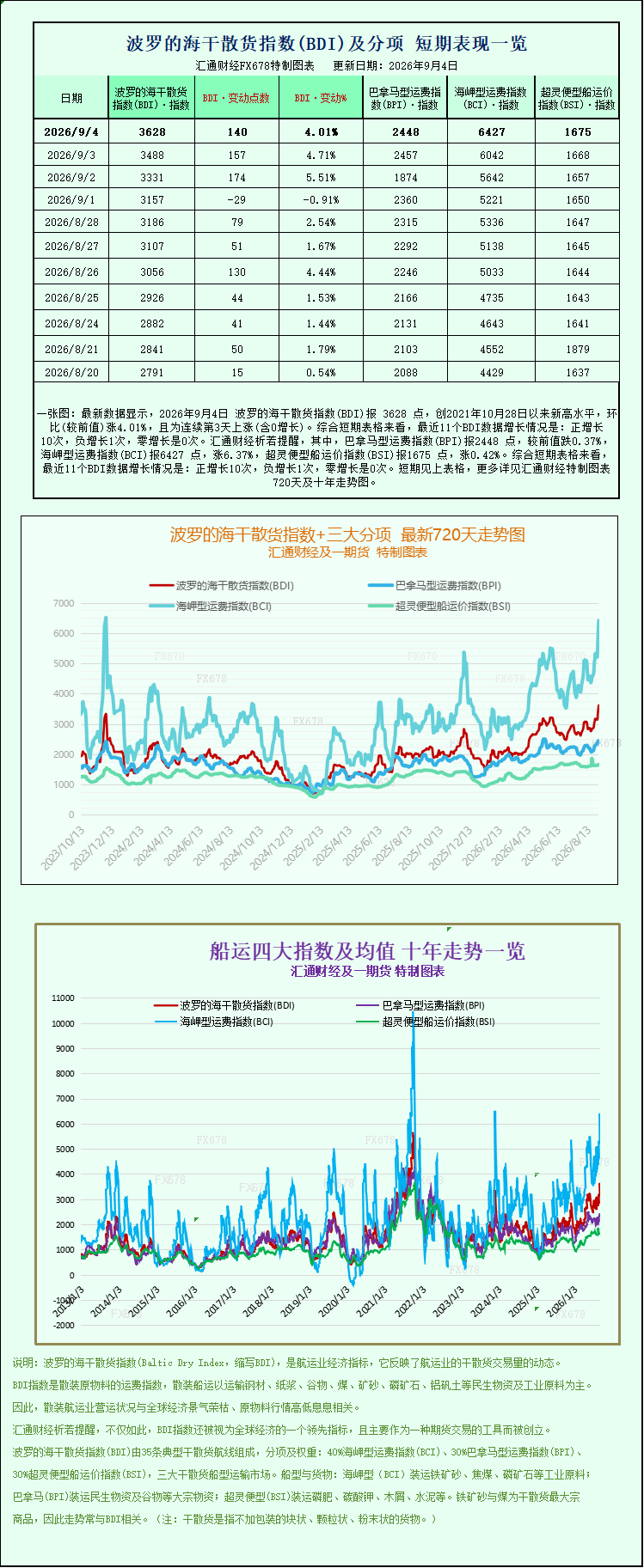 On September 4th, the international dry bulk shipping market witnessed a significant surge, with the Baltic Dry Index (BDI) rising again to its highest level in nearly five years since October 2021, recording a substantial weekly increase and indicating continued improvement in industry sentiment. The core driver of this surge was the explosive rise in freight rates for Capesize vessels, coupled with a recovery in demand from commodity trade, port inventory adjustments, and a tight global shipping capacity structure. This confluence of factors has thoroughly revitalized the global dry bulk shipping market and laid a strong foundation for the shipping industry's performance in the second half of the year. As a core barometer of the global dry bulk shipping market, the Baltic Dry Index (BDI) comprehensively reflects the freight rate levels of international commodity shipping, covering the freight rate trends of the three major bulk carrier types: Capesize, Panamax, and Supramax. It serves as an important indicator for observing the global industrial economy and the activity of commodity trade. Data shows that as of the closing bell on September 4th, the core index rose 140 points, a 4% increase, closing at 3628 points, a new high in nearly five years. The weekly performance was even more impressive, with a cumulative weekly gain of 13.9%, marking a strong upward trend and ending the previous market consolidation. Looking at specific ship types, the market showed significant divergence, with large Capesize bulk carriers leading the index's rise, while smaller vessels remained relatively stable, with some experiencing minor pullbacks. Among them, Capesize vessels, primarily transporting bulk industrial raw materials such as iron ore and coal, performed the strongest. The Capesize bulk carrier index surged 385 points, a 6.4% increase, closing at 6427 points, the highest level since December 2023, with a weekly cumulative gain exceeding 20.4%, demonstrating a very rapid upward momentum. In terms of actual operating returns, the profitability of Capesize vessels has increased significantly. Data shows that the average daily revenue of Capesize vessels with a deadweight tonnage of 150,000 tons, mainly carrying iron ore and thermal coal, surged by $3,493 to $54,791, a weekly increase of 22%, significantly expanding shipowners' profit margins. This surge in Capesize freight rates is primarily driven by the strong recovery in commodity trade, particularly the continued rebound in iron ore demand, which has provided solid support for large dry bulk shipping. It is understood that this round of shipping price increases is closely linked to the pace of China's commodity procurement. Recently, major domestic ports have begun concentrated destocking, and steel mills' restocking demand has continued to be released, boosting the activity of iron ore import trade. Iron ore futures prices have risen for the second consecutive week, and spot trade orders have been concentrated, directly pushing up demand for ocean shipping. At the same time, shipments from major iron ore exporting countries such as Brazil and Guinea have steadily recovered, leading to a concentrated release of freight demand on Atlantic routes. Coupled with periodic weather factors that have limited capacity turnover on some routes, the market supply-demand gap has further widened, contributing to the continued rise in large bulk carrier freight rates. Compared to the surge in prices for large Capesize vessels, the market for small and medium-sized vessels showed a clear divergence, with an overall relatively weak performance. Panamax vessels, primarily used for transporting coal and grains, saw a slight correction, with the Panamax index falling 9 points, or 0.4%, to close at 2448 points; corresponding to a decrease in average daily revenue of $78 to $22035. Panamax vessels mainly serve regional trade and the transport of small to medium-sized bulk commodities. Influenced by stable regional demand and ample supply of small and medium-sized vessels, they lack short-term upward momentum, contrasting sharply with the strong performance of large vessels. Supramax bulk carriers, on the other hand, maintained a slight upward trend, showing relatively stable performance. The Very Large Bulk Carrier Index rose 7 points, or 0.4%, to close at 1675 points, a slight increase that stabilized the fundamentals of the small and medium-sized vessel market. This vessel type is suitable for transporting a variety of small-volume dry bulk cargoes, covering commodities such as grains, building materials, and niche minerals. Demand is generally stable, resulting in smaller fluctuations in freight rates and a more restrained trend. From the perspective of the industry's underlying logic, the recent surge in the Baltic Dry Index (BDI) is the result of multiple factors converging on both the supply and demand sides. On the supply side, the growth rate of new capacity additions to the global dry bulk fleet continues to slow, with new ship orders at historically low levels, resulting in weak growth in effective capacity. Simultaneously, some long-haul routes are affected by geopolitical tensions and weather factors, leading to decreased vessel turnover efficiency and a temporary tightness in available market capacity. On the demand side, global industrial production is steadily recovering, and domestic infrastructure and manufacturing growth-stabilizing policies continue to be implemented, driving a rebound in demand for industrial raw materials. Coupled with the traditional peak shipping season in the third quarter, dry bulk trade orders are being released in a concentrated manner, continuously pushing up shipping rates. Market analysts indicate that the current dry bulk shipping market's prosperity still has room to continue. With the arrival of the traditional peak season for global commodity trade in the fourth quarter, coupled with stable overseas mine shipments and continued domestic restocking demand, demand for large bulk carriers is expected to remain high, and the BDI is likely to maintain a strong upward trend. However, small and medium-sized vessels are constrained by limited demand growth and ample capacity supply, and may continue to fluctuate in the short term, with the market pattern of vessel type differentiation likely to persist. Overall, the Baltic Dry Index's breakthrough of a five-year high not only directly reflects the strong recovery of the global dry bulk shipping market, but also reflects the steady recovery of global industrial economic activity and the continued warming of commodity trade. The subsequent market trend will continue to be deeply influenced by multiple factors such as the global supply and demand pattern, the pace of domestic restocking, and the geopolitical shipping environment.
On September 4th, the international dry bulk shipping market witnessed a significant surge, with the Baltic Dry Index (BDI) rising again to its highest level in nearly five years since October 2021, recording a substantial weekly increase and indicating continued improvement in industry sentiment. The core driver of this surge was the explosive rise in freight rates for Capesize vessels, coupled with a recovery in demand from commodity trade, port inventory adjustments, and a tight global shipping capacity structure. This confluence of factors has thoroughly revitalized the global dry bulk shipping market and laid a strong foundation for the shipping industry's performance in the second half of the year. As a core barometer of the global dry bulk shipping market, the Baltic Dry Index (BDI) comprehensively reflects the freight rate levels of international commodity shipping, covering the freight rate trends of the three major bulk carrier types: Capesize, Panamax, and Supramax. It serves as an important indicator for observing the global industrial economy and the activity of commodity trade. Data shows that as of the closing bell on September 4th, the core index rose 140 points, a 4% increase, closing at 3628 points, a new high in nearly five years. The weekly performance was even more impressive, with a cumulative weekly gain of 13.9%, marking a strong upward trend and ending the previous market consolidation. Looking at specific ship types, the market showed significant divergence, with large Capesize bulk carriers leading the index's rise, while smaller vessels remained relatively stable, with some experiencing minor pullbacks. Among them, Capesize vessels, primarily transporting bulk industrial raw materials such as iron ore and coal, performed the strongest. The Capesize bulk carrier index surged 385 points, a 6.4% increase, closing at 6427 points, the highest level since December 2023, with a weekly cumulative gain exceeding 20.4%, demonstrating a very rapid upward momentum. In terms of actual operating returns, the profitability of Capesize vessels has increased significantly. Data shows that the average daily revenue of Capesize vessels with a deadweight tonnage of 150,000 tons, mainly carrying iron ore and thermal coal, surged by $3,493 to $54,791, a weekly increase of 22%, significantly expanding shipowners' profit margins. This surge in Capesize freight rates is primarily driven by the strong recovery in commodity trade, particularly the continued rebound in iron ore demand, which has provided solid support for large dry bulk shipping. It is understood that this round of shipping price increases is closely linked to the pace of China's commodity procurement. Recently, major domestic ports have begun concentrated destocking, and steel mills' restocking demand has continued to be released, boosting the activity of iron ore import trade. Iron ore futures prices have risen for the second consecutive week, and spot trade orders have been concentrated, directly pushing up demand for ocean shipping. At the same time, shipments from major iron ore exporting countries such as Brazil and Guinea have steadily recovered, leading to a concentrated release of freight demand on Atlantic routes. Coupled with periodic weather factors that have limited capacity turnover on some routes, the market supply-demand gap has further widened, contributing to the continued rise in large bulk carrier freight rates. Compared to the surge in prices for large Capesize vessels, the market for small and medium-sized vessels showed a clear divergence, with an overall relatively weak performance. Panamax vessels, primarily used for transporting coal and grains, saw a slight correction, with the Panamax index falling 9 points, or 0.4%, to close at 2448 points; corresponding to a decrease in average daily revenue of $78 to $22035. Panamax vessels mainly serve regional trade and the transport of small to medium-sized bulk commodities. Influenced by stable regional demand and ample supply of small and medium-sized vessels, they lack short-term upward momentum, contrasting sharply with the strong performance of large vessels. Supramax bulk carriers, on the other hand, maintained a slight upward trend, showing relatively stable performance. The Very Large Bulk Carrier Index rose 7 points, or 0.4%, to close at 1675 points, a slight increase that stabilized the fundamentals of the small and medium-sized vessel market. This vessel type is suitable for transporting a variety of small-volume dry bulk cargoes, covering commodities such as grains, building materials, and niche minerals. Demand is generally stable, resulting in smaller fluctuations in freight rates and a more restrained trend. From the perspective of the industry's underlying logic, the recent surge in the Baltic Dry Index (BDI) is the result of multiple factors converging on both the supply and demand sides. On the supply side, the growth rate of new capacity additions to the global dry bulk fleet continues to slow, with new ship orders at historically low levels, resulting in weak growth in effective capacity. Simultaneously, some long-haul routes are affected by geopolitical tensions and weather factors, leading to decreased vessel turnover efficiency and a temporary tightness in available market capacity. On the demand side, global industrial production is steadily recovering, and domestic infrastructure and manufacturing growth-stabilizing policies continue to be implemented, driving a rebound in demand for industrial raw materials. Coupled with the traditional peak shipping season in the third quarter, dry bulk trade orders are being released in a concentrated manner, continuously pushing up shipping rates. Market analysts indicate that the current dry bulk shipping market's prosperity still has room to continue. With the arrival of the traditional peak season for global commodity trade in the fourth quarter, coupled with stable overseas mine shipments and continued domestic restocking demand, demand for large bulk carriers is expected to remain high, and the BDI is likely to maintain a strong upward trend. However, small and medium-sized vessels are constrained by limited demand growth and ample capacity supply, and may continue to fluctuate in the short term, with the market pattern of vessel type differentiation likely to persist. Overall, the Baltic Dry Index's breakthrough of a five-year high not only directly reflects the strong recovery of the global dry bulk shipping market, but also reflects the steady recovery of global industrial economic activity and the continued warming of commodity trade. The subsequent market trend will continue to be deeply influenced by multiple factors such as the global supply and demand pattern, the pace of domestic restocking, and the geopolitical shipping environment.
- Risk Warning and Disclaimer
- The market involves risk, and trading may not be suitable for all investors. This article is for reference only and does not constitute personal investment advice, nor does it take into account certain users’ specific investment objectives, financial situation, or other needs. Any investment decisions made based on this information are at your own risk.