Gold Trading Alert: Strong Employment Data Shakes Gold Prices; Hormuz Resumes Talks; This Week's CPI a Matter of Life and Death
2026-09-07 07:08:05
Last Friday (September 4th), the release of crucial US employment data completely disrupted the previously relatively calm rhythm of the gold market. Spot gold plummeted by more than 2%, hitting a low of $4364.99 per ounce, before finally closing at $4430.15, a single-day drop of 1%, and a weekly decline of 0.58%. Meanwhile, the December gold futures contract settled at $4476.60, a drop of 1.4%. This non-farm payroll report, which far exceeded market expectations, not only reinforced expectations that the Federal Reserve might raise interest rates this month, but also instantly weakened the appeal of gold as a non-interest-bearing asset. On Saturday, following the release of the employment data, direct clashes between the US and Iran erupted again in the Strait of Hormuz, suddenly escalating geopolitical risks and adding another layer of complexity to the already pressured gold price. Now, on Monday, with the US market closed for Labor Day, global investors are awaiting the release of key inflation data this week, and the short-term fate of gold will be rewritten in this dual game of data and geopolitics. On Monday (September 7) in early Asian trading, spot gold traded in a narrow range, currently around $4,430 per ounce. 
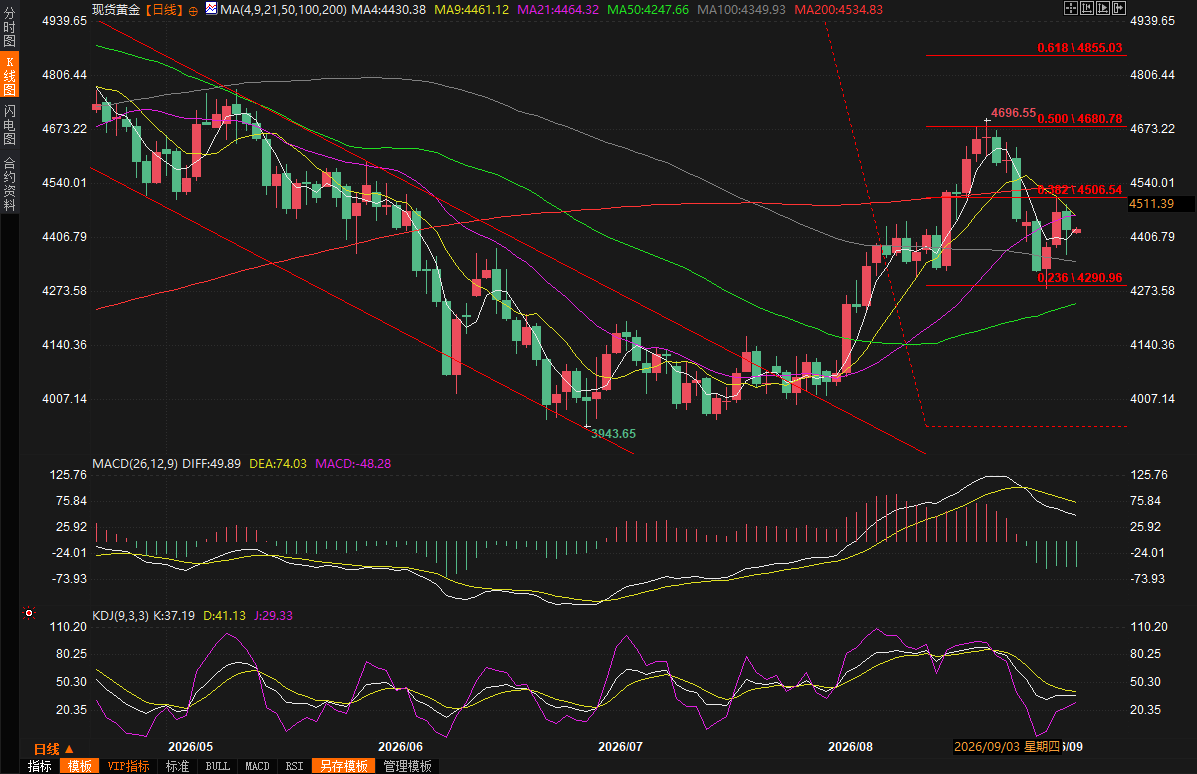 (Spot gold daily chart, source: FX678) At 07:04 Beijing time, spot gold is currently trading at $4429.89 per ounce.
Why are employment data so "damaging"?
To understand the dramatic reaction in gold prices last Friday, we must first return to the non-farm payroll report itself. The US saw a surge of 162,000 non-farm jobs in August, almost three times the market expectation of 56,000, while the unemployment rate remained firmly at 4.1%. More importantly, the July data was significantly revised upwards, from a previously reported decrease of 23,000 to an increase of 21,000. The report conveyed a very clear message: after a period of weakness, the labor market has regained its resilience. The recovery in the leisure and hospitality industry, local government education departments, and the manufacturing and construction sectors collectively supported job growth, while the average weekly working hours extended to 34.4 hours, the longest streak since March 2024. For gold, the strong employment data directly increased market bets on a Federal Reserve rate hike. Short-term interest rate futures showed that the probability of the Federal Reserve raising interest rates at its September 15-16 meeting rose from about 50% before the data release to around 65%, and although it subsequently fell back, it remained around 58%, with a probability of at least one rate hike this year as high as 83%. Independent analyst Tai Wong bluntly stated that the overall non-farm payroll data far exceeded expectations, and the entire report was strong, causing a sharp drop in gold prices. Unless the subsequent CPI report is weak, the possibility of a rate hike in September will greatly increase. Bybit's chief market analyst Han Tan also pointed out that the latest employment report seems to have further opened the door for the Fed to implement its rate hike intentions, and action may be taken as early as this month. At the same time, the US dollar index strengthened, making dollar-denominated gold more expensive for investors holding other currencies. US Treasury yields rose in tandem, with the two-year Treasury yield hitting its highest point since January 2025, and the 10-year yield also rising significantly. Funds are withdrawing from safe-haven assets such as gold and moving into interest rate-sensitive assets, which is the core logic behind the pressure on gold prices last Friday. It is worth noting that despite strong employment, wage growth slowed, rising 3.1% year-on-year in August, lower than the previous value of 3.2%. This provided some support for cooling inflation and also left the market with differing opinions on the future policy path.Inflation data and geopolitical conflicts: a double variable for gold.
The employment data is just the beginning; the key to determining gold's short-term direction lies in the inflation data to be released this week. The market is largely focused on Thursday's Producer Price Index (PPI) and Friday's Consumer Price Index (CPI). Economists expect the core CPI year-on-year increase in August to potentially slow further to 2.4% from 2.5% in July. If the data confirms continued cooling inflation, then those within the Federal Reserve who prefer a wait-and-see approach—for example, Governor Waller previously stated that he would prefer to keep interest rates unchanged if the data confirms easing inflationary pressures—may regain the upper hand, thus easing pressure on gold prices. Conversely, if the inflation data is strong, especially with clear signs of rising energy prices spreading to broader sectors, expectations of interest rate hikes will rise again, and gold may face a new round of selling pressure. Meanwhile, geopolitical risks escalated suddenly over the weekend, injecting new safe-haven support into gold. US and Iranian forces clashed in the Strait of Hormuz and surrounding waters, with the US military striking three Iranian oil tankers, claiming it was a response to the Iranian Revolutionary Guard's ballistic missile launches against two US warships. Iran, meanwhile, threatened to intensify its strikes against U.S. warships in the region and announced it had taken action against relevant vessels. The Strait of Hormuz is a vital global oil shipping route; any escalation of conflict could drive up oil prices and trigger market concerns about supply disruptions. Historically, such geopolitical tensions have often boosted gold's safe-haven appeal in the short term, especially given the uncertainty surrounding the Federal Reserve's policy path.Market Outlook
From a technical perspective, gold prices rebounded quickly after briefly falling below the $4,280 area last week, but the 200-day moving average still poses significant resistance. Some analysts believe the current decline may present a medium-term buying opportunity, especially given the bond market sell-off and rising stock market uncertainty, where investors will continue to seek alternative assets outside the dollar system. A Kitco survey shows that Wall Street analysts' views on gold prices for the coming week are almost evenly divided: approximately 38% are bullish, 31% are bearish, and another 31% expect sideways movement. Retail investors are relatively optimistic, with about 55% predicting a rebound in gold prices. Analysts at Bannockburn Global Forex caution that a break below key support could further test the $4,200 area; while CPM Group recommends remaining on the sidelines this week, believing that gold prices may fluctuate within a wide range of $4,320 to $4,670 in the short term, maintaining high volatility before the Fed's September meeting. Overall, gold is currently caught in a tug-of-war between policy expectations and geopolitical risks. Last Friday's employment data clearly reinforced the risk of interest rate hikes, putting pressure on gold prices; however, the weekend's clashes in the Strait of Hormuz reminded the market that safe-haven demand has not completely subsided. This week's inflation data will be a key variable in breaking the deadlock. If the CPI confirms a cooling trend, gold may find some breathing room or even a rebound after the expectation of an interest rate hike has subsided; if the data is strong again, it may force gold prices to seek further support. Regardless of the outcome, the gold market will remain highly sensitive in the coming days, and investors need to closely monitor the immediate reaction after the data release, as well as whether the geopolitical situation escalates further. In the long term, given the continued global uncertainty and central bank gold purchases, gold's allocation value has not disappeared due to short-term fluctuations; however, short-term traders must be more cautious in dealing with this volatile storm driven by both data and geopolitics. (Spot gold daily chart, source: FX678) At 07:04 Beijing time, spot gold is currently trading at $4429.89 per ounce.
- Risk Warning and Disclaimer
- The market involves risk, and trading may not be suitable for all investors. This article is for reference only and does not constitute personal investment advice, nor does it take into account certain users’ specific investment objectives, financial situation, or other needs. Any investment decisions made based on this information are at your own risk.