Deutsche Bank expects the European Central Bank to raise interest rates by another 25 basis points in December, with energy risks pushing the terminal interest rate expectation to 2.75%.
2026-09-07 15:18:07
Expectations for the European Central Bank's monetary policy are shifting. Deutsche Bank's latest assessment suggests that, given persistently high energy prices and unresolved geopolitical risks, the ECB may not only raise interest rates in September but could also do so again in December by 25 basis points. This implies a reassessment of the market's assessment of the end of the current ECB tightening cycle.  Previously, Deutsche Bank predicted that the European Central Bank's (ECB) deposit facility rate would eventually peak at 2.5%, primarily based on the assumption that energy price shocks were temporary and that Eurozone economic growth remained weak. However, recent energy risks have persisted longer than previously assumed, prompting the bank to reassess its policy path. Currently, the bank considers a final interest rate of 2.75% a more likely scenario , with a 25 basis point rate hike in December becoming the new benchmark. The ECB's September 10th interest rate meeting is a crucial juncture for this policy change. The market widely expects the ECB to raise the deposit facility rate from 2.25% to 2.50%, representing a further rate hike in this tightening cycle. Previously, the ECB kept interest rates unchanged at its July meeting but explicitly stated that the impact of energy prices and the Middle East situation on future inflation remained highly uncertain. Energy factors are a core variable driving changes in ECB policy expectations. Recent sharp increases in crude oil and European natural gas prices have already pushed up overall Eurozone inflation again. Data shows that the Eurozone's inflation rate rose to 3.3% in August, significantly higher than the ECB's medium-term target of 2%, with energy costs being a major driving factor for this resurgence of inflation. For the European Central Bank (ECB), the current policy environment is more complex than simply weak economic growth. On the one hand, rising energy prices may continue to be passed on to end prices through transportation, manufacturing, and service sector costs; on the other hand, the Eurozone labor market has not shown obvious signs of overheating, and wage growth has not shown a sustained acceleration. Therefore, the current rise in inflation is still mainly due to supply-side shocks, rather than overall demand overheating. This is also the key to whether the ECB will continue to raise interest rates in December. Deutsche Bank believes that if the energy shock continues and broader price and wage pressures begin to emerge, the ECB may need to raise interest rates further to prevent inflation expectations from spiraling out of control. However, if energy prices fall rapidly, geopolitical tensions ease, and economic growth slows further, the final interest rate may remain at 2.5%. Current market expectations indicate that the ECB's policy path has clearly deviated from the previous baseline scenario of "ending the tightening cycle after a September rate hike." A previous survey of economists showed that most respondents still expected a 25 basis point rate hike in September followed by a pause, with deposit rates remaining at 2.5%. This means that Deutsche Bank's assessment of another rate hike in December remains a relatively hawkish prediction. However, the market also needs to be wary of the negative impact of rising energy prices on Eurozone economic growth. While high oil and natural gas prices will push up inflation, they will also compress real household income, increase business production costs, and potentially further dampen manufacturing activity. Germany's recent industrial production, significantly weaker than expected, also indicates that core Eurozone economies still face considerable growth pressure. Therefore, the European Central Bank (ECB) faces a classic dual constraint of "inflation and growth." Stopping interest rate hikes too early could allow the energy shock to spread to a wider price range; continuing to raise rates could further suppress already weak economic growth. Whether the ECB will ultimately act again in December will depend heavily on changes in energy prices, core inflation, and wage data in the coming months. Meanwhile, the dollar's performance will also influence the euro. US non-farm payrolls increased by 162,000 in August, significantly exceeding market expectations, raising the probability of a Fed rate hike in September to approximately 57%. However, given the possibility of further tightening policies by the ECB and the Bank of Japan, the dollar's interest rate advantage has not fully translated into sustained upward momentum. If the European Central Bank (ECB) signals a further rate hike in December after its September meeting, while expectations for a Fed policy slow down, the euro could gain a new interest rate advantage. Conversely, if the ECB emphasizes that the energy shock is primarily temporary and continues to highlight risks to economic growth, the euro's upside potential may be limited. Looking at the recent EUR/USD movement, the pair remains in a high-level consolidation structure. The exchange rate is currently trading around 1.1610. Weak German industrial data is putting short-term pressure on the euro, but expectations of an ECB rate hike are still providing some support. In the short term, the first resistance level to watch is around 1.1650. If EUR/USD regains a foothold in this area, it could further test the previous resistance levels around 1.1680 and 1.1710. If the ECB releases a more hawkish policy signal, and US inflation data is lower than expected, a break above 1.1710 could open up further upside potential for the euro. On the downside, the first level to watch is the 1.1600 psychological support level. If the price breaks below this level, the next target is around 1.1560; a further breach could see the pair fall back to the 1.1515-1.1500 area. Overall, EUR/USD is currently in a tug-of-war between fundamentals and technical factors. Strengthened expectations of a European Central Bank rate hike are favorable for the euro, while weak German industrial activity and the dollar's interest rate advantage are limiting its upside potential. In the short term, 1.1600 and 1.1650 will be crucial levels for determining the next direction.
 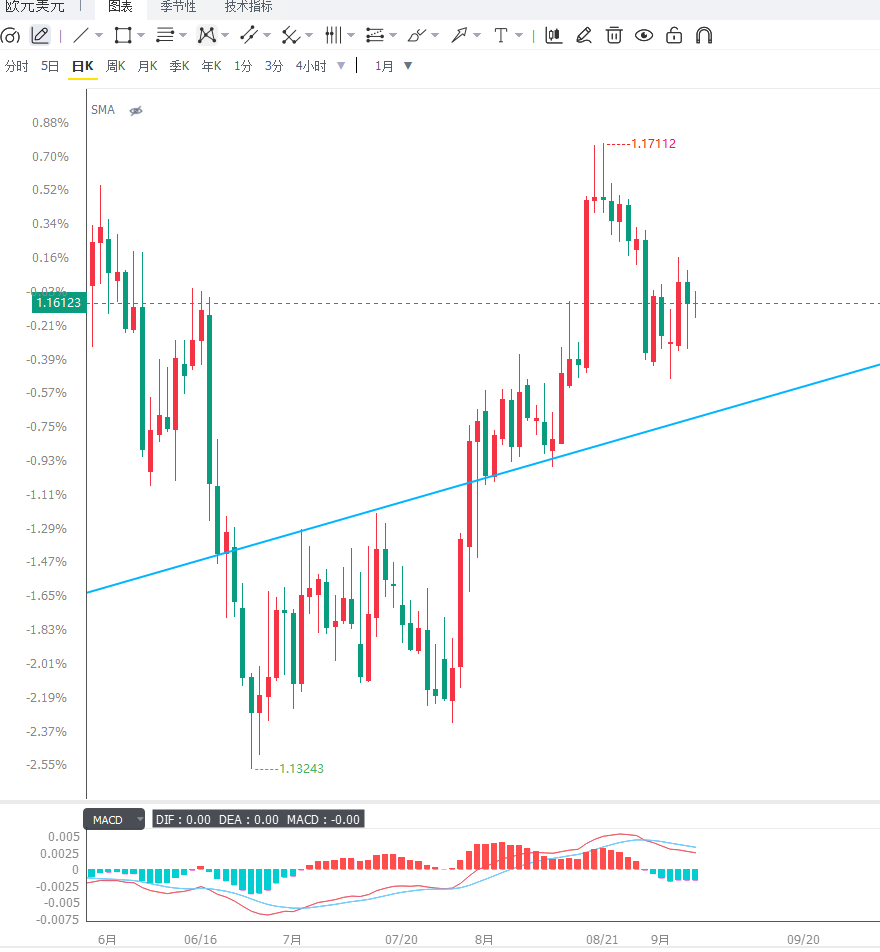 Editor's Summary: Deutsche Bank has revised its forecast for the European Central Bank's (ECB) terminal interest rate from 2.5% to 2.75%, and expects another 25 basis point rate hike in December, reflecting that the duration of the European energy shock has exceeded previous expectations. Currently, Eurozone inflation has risen back above 3%, making energy prices a variable that cannot be ignored on the policy front. However, 2.75% does not necessarily mean that the ECB will begin a sustained and significant tightening cycle. If energy prices fall, geopolitical risks ease, and Eurozone economic growth weakens further, 2.5% may still be the end of this interest rate cycle; only when energy inflation further spreads to wages and core prices will interest rates potentially approach 3% or even higher. For the euro, the focus of the September 10th interest rate decision is not only on the rate hike itself, but also on whether the ECB leaves policy space for another rate hike in December. If a hawkish signal is released, EUR/USD is expected to retest 1.1650 and 1.1710; if the central bank emphasizes growth risks and downplays the effects of double-dip inflation, the euro may come under renewed pressure, and a further decline should be watched for after 1.1600 is breached.
Previously, Deutsche Bank predicted that the European Central Bank's (ECB) deposit facility rate would eventually peak at 2.5%, primarily based on the assumption that energy price shocks were temporary and that Eurozone economic growth remained weak. However, recent energy risks have persisted longer than previously assumed, prompting the bank to reassess its policy path. Currently, the bank considers a final interest rate of 2.75% a more likely scenario , with a 25 basis point rate hike in December becoming the new benchmark. The ECB's September 10th interest rate meeting is a crucial juncture for this policy change. The market widely expects the ECB to raise the deposit facility rate from 2.25% to 2.50%, representing a further rate hike in this tightening cycle. Previously, the ECB kept interest rates unchanged at its July meeting but explicitly stated that the impact of energy prices and the Middle East situation on future inflation remained highly uncertain. Energy factors are a core variable driving changes in ECB policy expectations. Recent sharp increases in crude oil and European natural gas prices have already pushed up overall Eurozone inflation again. Data shows that the Eurozone's inflation rate rose to 3.3% in August, significantly higher than the ECB's medium-term target of 2%, with energy costs being a major driving factor for this resurgence of inflation. For the European Central Bank (ECB), the current policy environment is more complex than simply weak economic growth. On the one hand, rising energy prices may continue to be passed on to end prices through transportation, manufacturing, and service sector costs; on the other hand, the Eurozone labor market has not shown obvious signs of overheating, and wage growth has not shown a sustained acceleration. Therefore, the current rise in inflation is still mainly due to supply-side shocks, rather than overall demand overheating. This is also the key to whether the ECB will continue to raise interest rates in December. Deutsche Bank believes that if the energy shock continues and broader price and wage pressures begin to emerge, the ECB may need to raise interest rates further to prevent inflation expectations from spiraling out of control. However, if energy prices fall rapidly, geopolitical tensions ease, and economic growth slows further, the final interest rate may remain at 2.5%. Current market expectations indicate that the ECB's policy path has clearly deviated from the previous baseline scenario of "ending the tightening cycle after a September rate hike." A previous survey of economists showed that most respondents still expected a 25 basis point rate hike in September followed by a pause, with deposit rates remaining at 2.5%. This means that Deutsche Bank's assessment of another rate hike in December remains a relatively hawkish prediction. However, the market also needs to be wary of the negative impact of rising energy prices on Eurozone economic growth. While high oil and natural gas prices will push up inflation, they will also compress real household income, increase business production costs, and potentially further dampen manufacturing activity. Germany's recent industrial production, significantly weaker than expected, also indicates that core Eurozone economies still face considerable growth pressure. Therefore, the European Central Bank (ECB) faces a classic dual constraint of "inflation and growth." Stopping interest rate hikes too early could allow the energy shock to spread to a wider price range; continuing to raise rates could further suppress already weak economic growth. Whether the ECB will ultimately act again in December will depend heavily on changes in energy prices, core inflation, and wage data in the coming months. Meanwhile, the dollar's performance will also influence the euro. US non-farm payrolls increased by 162,000 in August, significantly exceeding market expectations, raising the probability of a Fed rate hike in September to approximately 57%. However, given the possibility of further tightening policies by the ECB and the Bank of Japan, the dollar's interest rate advantage has not fully translated into sustained upward momentum. If the European Central Bank (ECB) signals a further rate hike in December after its September meeting, while expectations for a Fed policy slow down, the euro could gain a new interest rate advantage. Conversely, if the ECB emphasizes that the energy shock is primarily temporary and continues to highlight risks to economic growth, the euro's upside potential may be limited. Looking at the recent EUR/USD movement, the pair remains in a high-level consolidation structure. The exchange rate is currently trading around 1.1610. Weak German industrial data is putting short-term pressure on the euro, but expectations of an ECB rate hike are still providing some support. In the short term, the first resistance level to watch is around 1.1650. If EUR/USD regains a foothold in this area, it could further test the previous resistance levels around 1.1680 and 1.1710. If the ECB releases a more hawkish policy signal, and US inflation data is lower than expected, a break above 1.1710 could open up further upside potential for the euro. On the downside, the first level to watch is the 1.1600 psychological support level. If the price breaks below this level, the next target is around 1.1560; a further breach could see the pair fall back to the 1.1515-1.1500 area. Overall, EUR/USD is currently in a tug-of-war between fundamentals and technical factors. Strengthened expectations of a European Central Bank rate hike are favorable for the euro, while weak German industrial activity and the dollar's interest rate advantage are limiting its upside potential. In the short term, 1.1600 and 1.1650 will be crucial levels for determining the next direction. Editor's Summary: Deutsche Bank has revised its forecast for the European Central Bank's (ECB) terminal interest rate from 2.5% to 2.75%, and expects another 25 basis point rate hike in December, reflecting that the duration of the European energy shock has exceeded previous expectations. Currently, Eurozone inflation has risen back above 3%, making energy prices a variable that cannot be ignored on the policy front. However, 2.75% does not necessarily mean that the ECB will begin a sustained and significant tightening cycle. If energy prices fall, geopolitical risks ease, and Eurozone economic growth weakens further, 2.5% may still be the end of this interest rate cycle; only when energy inflation further spreads to wages and core prices will interest rates potentially approach 3% or even higher. For the euro, the focus of the September 10th interest rate decision is not only on the rate hike itself, but also on whether the ECB leaves policy space for another rate hike in December. If a hawkish signal is released, EUR/USD is expected to retest 1.1650 and 1.1710; if the central bank emphasizes growth risks and downplays the effects of double-dip inflation, the euro may come under renewed pressure, and a further decline should be watched for after 1.1600 is breached.- Risk Warning and Disclaimer
- The market involves risk, and trading may not be suitable for all investors. This article is for reference only and does not constitute personal investment advice, nor does it take into account certain users’ specific investment objectives, financial situation, or other needs. Any investment decisions made based on this information are at your own risk.