With $130 billion in foreign exchange reserves backing it up, and geopolitical risks undermining oil prices, who will prevail in the tug-of-war between bulls and bears over the rupee?
2026-09-07 15:30:06
On Monday (September 7), the Indian rupee opened stronger during the European session, while the US dollar fell to around 94.45 against the rupee. The Reserve Bank of India attracted far more US dollar inflows than expected through the FCNR(B) foreign deposit window (totaling over $130 billion as of August 31), significantly boosting its foreign exchange reserves and providing support for the rupee. 
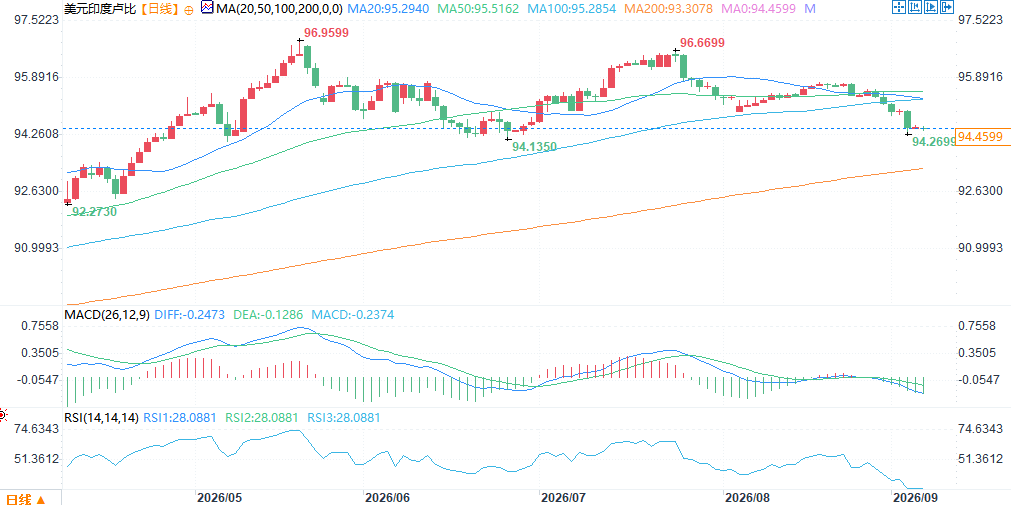 (USD/INR daily chart, source: FX678) At 15:24 Beijing time, the USD/INR exchange rate was 94.45/46.
A flood of foreign exchange has boosted the rupee, but upside potential may be limited.
The Reserve Bank of India (RBI) attracted a much larger-than-expected inflow of US dollars through the FCNR(B) foreign deposit window (totaling over $130 billion as of August 31), significantly boosting its foreign exchange reserves and providing support for the rupee. Mitsubishi UFJ noted that the rupee's significant strengthening was driven by foreign exchange inflows, but cautioned against excessive optimism—the USD/RUB exchange rate is expected to gradually rise in the medium term, but the RBI's measures have provided the authorities with ample "ammunition," ruling out the possibility of a sharp depreciation. The rupee is likely to trade in the 94.00-95.00 range in the short term, with the massive foreign exchange reserves providing solid support. The massive foreign exchange inflows have become the core driver of this round of rupee appreciation. The RBI successfully attracted over $130 billion through the FCNR(B) window, significantly increasing its foreign exchange reserves and enhancing market confidence in the rupee's stability. This move not only directly increased the dollar supply but also sent a clear signal to the market that the authorities have the ability to intervene in the foreign exchange market. Mitsubishi UFJ's analysis emphasizes that although the short-term strengthening is mainly driven by capital inflows, the USD/RUB exchange rate is likely to gradually rise in the medium term, reflecting the impact of structural factors such as the trade deficit and the global dollar cycle. However, ample foreign exchange reserves have significantly reduced the risk of extreme depreciation, giving the central bank more room for policy maneuver. In the short term, the rupee is expected to consolidate within the 94.00-95.00 range, with the huge reserves providing solid support. Investors need to pay attention to the sustainability of subsequent capital inflows and whether the central bank continues to guide foreign exchange flows through window mechanisms to determine whether the appreciation momentum can continue.High oil prices limit rupee gains; US CPI becomes key.
Iran attacked three oil tankers and US military vessels traveling on an "unauthorized route" over the weekend, pushing up oil prices due to geopolitical risk premiums, which may limit further upside for the rupee. The market is now focused on Friday's US August CPI data—Wash has repeatedly warned of upside risks to inflation, but Williams and Waller have described recent data as "encouraging." The escalation of the US-Iran conflict over the weekend further increased geopolitical risk premiums, keeping oil prices high and thus limiting the rupee's upside potential. Meanwhile, market focus has shifted to the upcoming US August CPI data. Divergent statements from Fed officials—Wash emphasizing inflation risks, while Williams and Waller consider recent data encouraging—have increased uncertainty about the policy path. CME tools show that the probability of a September rate hike has risen to 58%. If the CPI reading is overheated, it will strengthen expectations of a rate hike and support the dollar, thus suppressing the rupee; conversely, if the data is moderate, a decline in the probability of a rate hike could alleviate pressure on the dollar, providing additional support for the rupee. In the short term, the currency market will fluctuate under the dual influence of oil prices and US inflation data; investors need to closely monitor the correlation between the two.Summarize
The rupee strengthened to around 94.45, supported by a surge in foreign exchange inflows, but gains were limited by high oil prices. Mitsubishi UFJ warned that the medium-term outlook remains bullish, but the risk of a sharp depreciation has been ruled out. The market is focused on US CPI data; a moderate figure would support the rupee, while a stronger figure would limit gains due to a stronger dollar. The rupee is likely to trade in the 94.00-95.00 range in the short term, with attention focused on the sustainability of foreign exchange inflows, oil price movements, and US inflation data. The Reserve Bank of India's ample "ammunition" provides solid support for the rupee. (USD/INR daily chart, source: FX678) At 15:24 Beijing time, the USD/INR exchange rate was 94.45/46.
- Risk Warning and Disclaimer
- The market involves risk, and trading may not be suitable for all investors. This article is for reference only and does not constitute personal investment advice, nor does it take into account certain users’ specific investment objectives, financial situation, or other needs. Any investment decisions made based on this information are at your own risk.