While relentlessly predicting a downturn, the US and Iran continue to escalate their oil price battle.
2026-09-07 16:11:06
On Monday (September 7th) during the Asian and European sessions, international oil prices generally rebounded after hitting a low on the daily chart, experiencing wide fluctuations. Currently, WTI crude oil futures are trading at $92.07 per ounce. The core theme of the current market is clear: the US is suppressing oil prices through economic sanctions and bearish rhetoric, while Iran is supporting geopolitical premiums through its control of the Strait of Hormuz and military deterrence. Under the pull of this two-way game, oil prices are maintaining a volatile and fluctuating pattern. 
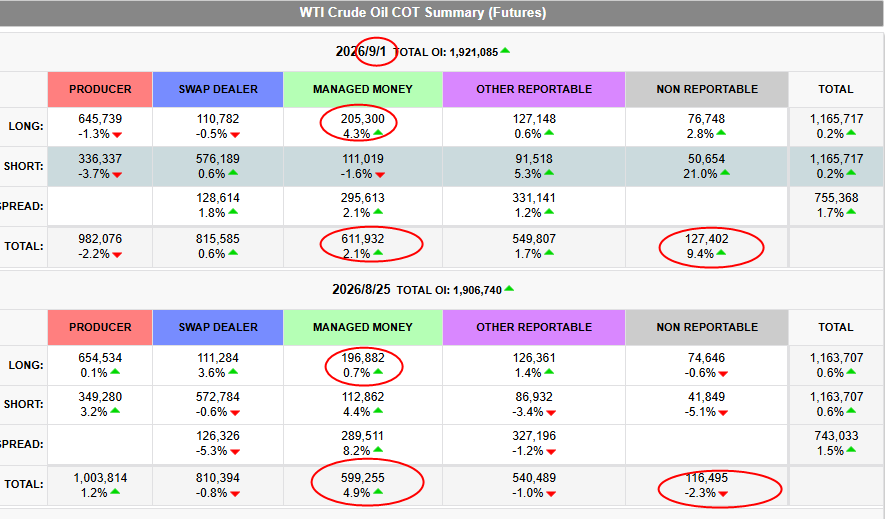 (WTI crude oil COT report, source: CME Group)
 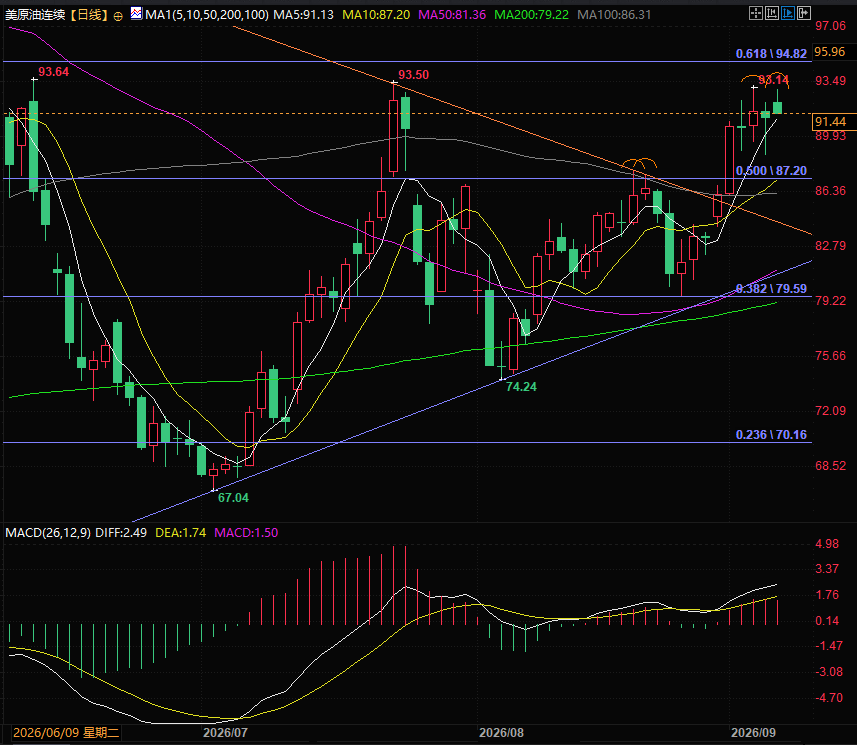 (WTI crude oil daily chart, source: FX678)
The United States has introduced a post-war Middle East strategy, which has exacerbated the risk of regional confrontation.
The Trump administration is drafting a new post-war Middle East strategy aimed at reshaping the region and containing Iran in the long term. Core plans include forming a regional alliance to contain Iran, implementing the Gaza Strip, pushing for the implementation of security agreements between Israel and Syria and Israel and Lebanon, expanding the achievements of the Abraham Accords, and normalizing relations between Saudi Arabia and Israel. This plan is currently in its early drafting stages and will be subject to the Israeli general election in October and the US midterm elections in November. However, this comprehensive containment strategy will continue to exacerbate Iranian tensions, stimulate a backlash from regional resistance forces, significantly increase shipping uncertainty in the Persian Gulf, and create long-term upward risks for oil prices.The US economic strangulation has severely damaged Iran, weakening its deterrent capabilities in the Strait of Hormuz.
The United States, relying on a maritime blockade and the strictest sanctions in history, has imposed comprehensive economic pressure on Iran. Currently, Iran's finances, oil exports, and foreign exchange channels are all restricted. Domestic inflation is high, and there are shortages of essential goods such as fuel and wheat, leading to a sharp increase in pressure on people's livelihoods and posing a risk of social unrest. The US hopes that this economic pressure will force Iran to open the Strait of Hormuz for free navigation. However, the market has gradually adapted to the disruptions in the strait, and global energy alternatives are readily available. Iran's previous strategic goals of "disrupting shipping, triggering a global energy crisis, and forcing the US to compromise" have somewhat failed, and its traditional deterrent power in the strait has weakened. Nevertheless, Iran is extremely resilient. A wartime patriotic consensus supports the public's patience, and the Revolutionary Guard is willing to bear the economic costs and retain the option of military upgrades. It will not compromise in the short term, and the US-Iran reconciliation negotiations remain deadlocked.Iran escalates maritime countermeasures, joining forces with Oman to regain the initiative in the Straits power struggle.
Faced with continued pressure, Iran has unveiled a new countermeasure plan, reconstructing navigation rules in the Strait of Hormuz. Iran will soon designate a new controlled area, covering the waters extending from the US blockade line into the Persian Gulf. Merchant ships entering without authorization will be placed on a sanctions list, affecting their insurance and subsequent passage rights through the Strait. Iran has clearly stated its core conditions for this confrontation: the US must cease its military threats and attacks and fulfill its commitments to the US-Iran peace memorandum before Iran will guarantee normal navigation through the Strait; otherwise, it will continue to restrict shipping. Militarily, Iran has targeted and deliberately avoided directing merchant ships, test-fired anti-ship missiles to deter US aircraft carriers, and targeted multiple US bases while refraining from striking them, preserving ample room for escalation and continuously raising geopolitical risks.Core game theory in crude oil: US public opinion pressures prices, while Iranian geopolitical tensions drive up premiums.
The core logic behind the current oil price volatility is a direct reflection of the two-way narrative game between the US and Iran. The US is employing a combined strategy of "physical blockade + media manipulation": on the physical level, it is continuously depleting Iran's national strength and weakening its geopolitical influence; on the media level, it is continuously releasing pessimistic oil price expectations, with US Treasury Secretary Bessent predicting oil prices to $40/barrel and well-known US investor "Sister Wood" even predicting an extreme drop to $30/barrel. Such rhetoric is essentially a market propaganda war, aimed at suppressing the geopolitical risk premium for crude oil, offsetting domestic inflationary pressures, and suppressing bullish sentiment. Iran, on the other hand, is adopting a "supporting the bottom under pressure, raising prices opportunistically" strategy: instead of completely blocking the Strait of Hormuz and triggering a full-scale war, it is continuously creating shipping uncertainty through measures such as demarcating control zones, sanctioning merchant ships, and military deterrence, pushing up insurance and transportation costs, and raising the geopolitical premium for crude oil, thereby increasing the US's bargaining costs and forcing the US to make concessions.Game boundary and market breakthrough expectations
Both sides in this two-way game have clear weaknesses, making a one-sided trend unlikely. The expectation of ultra-low US oil prices is based on the optimistic assumption of a rapid end to the conflict and the smooth implementation of the US Middle East strategy. However, if US-Iran tensions escalate and Iran retaliates, this bearish logic will be directly disproven. Furthermore, the effectiveness of Iran's verbal threats in driving oil prices is waning; only actual shipping accidents and escalating military conflicts can drive a sustained upward surge in oil prices. Currently, the market has a compromise solution: Iran could relinquish the Straits of Hormuz passage fee but retain the right to collect legitimate service fees for navigation, security, and environmental protection. This would allow both sides to reach a dignified conclusion and is also an acceptable negotiation solution for the US. However, the US and Iran remain in a deep stalemate, and oil prices will continue to fluctuate between US pressure and Iranian geopolitical provocations. Geopolitical risk premiums will be embedded in the oil price system for a long time. Technical Analysis: Following the recent sustained rise in international oil prices, participation from both institutional and retail investors has increased significantly. The overall volatility has widened over the past four trading days, indicating increased divergence among investors. This wide range of fluctuations after the rise may lead to a correction in oil prices. Closely monitor the support level of the 5-day moving average and the double top resistance level at 93.14 on the daily chart. (WTI crude oil COT report, source: CME Group) (WTI crude oil daily chart, source: FX678)
- Risk Warning and Disclaimer
- The market involves risk, and trading may not be suitable for all investors. This article is for reference only and does not constitute personal investment advice, nor does it take into account certain users’ specific investment objectives, financial situation, or other needs. Any investment decisions made based on this information are at your own risk.