One chart: After three consecutive days of gains, the Baltic Dry Index (BDI) has retreated, and freight rates for major vessel types have weakened across the board.
2026-09-08 00:40:05
The latest data shows that the Baltic Dry Index (BDI) was 3575 points on September 7, 2026, a decrease of 1.46% compared to the previous period, marking the largest drop since August 18, 2026. Looking at the short-term charts, the BDI has seen positive growth 9 times, negative growth 2 times, and zero growth in the last 11 BDI readings. Specifically, the Panamax Freight Index (BPI) was 2431 points, down 0.69% from the previous period; the Capesize Freight Index (BCI) was 6286 points, down 2.19%; and the Supramax Freight Index (BSI) was 1682 points, up 0.42%. For detailed charts of the latest 720-day and 10-year trends of the Baltic Dry Index and its three main sub-indices, please refer to the charts specially created by FX678. 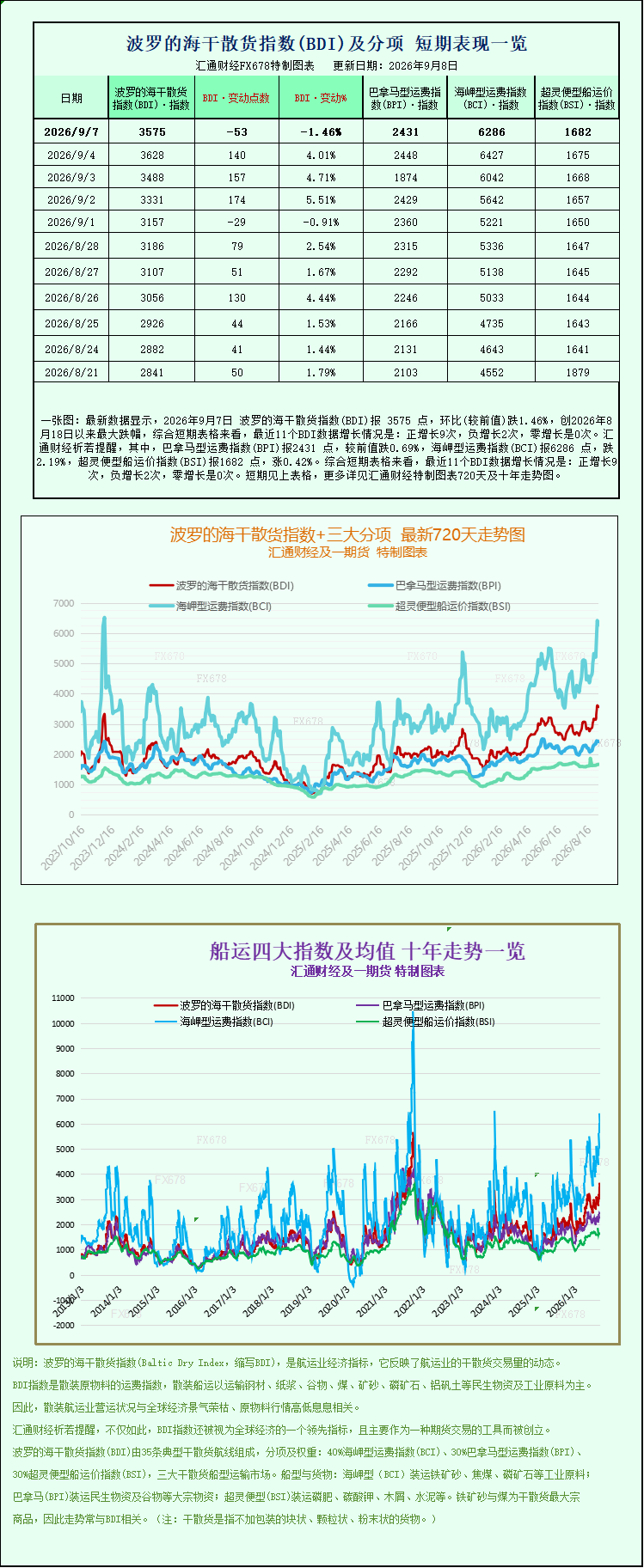 On September 7, 2026, the international dry bulk shipping market reached a short-term turning point. Latest data shows that the Baltic Dry Index (BDI) ended its three-day upward trend, declining slightly on Monday. The main drag was the simultaneous decline in freight rates for the two main vessel types, Capesize and Panamax, with only Supramax freight rates bucking the trend and rising slightly, indicating a clear structural divergence in the market. As a "barometer" of the global dry bulk shipping market, the short-term fluctuations of the Baltic Dry Index directly reflect the phased adjustment in the supply and demand relationship of global bulk commodities such as iron ore, coal, and grain. Specifically, the Baltic Dry Index, which tracks the combined freight rates of the three major dry bulk vessel types (Capesize, Panamax, and Supramax), fell 53 points, or 1.4%, closing at 3575 points, ending the previous three-day recovery and indicating a cooling of overall market activity. Looking at the data for specific ship types, the market exhibits a particularly pronounced divergence in price movements. Large ocean-going bulk carriers faced significant pressure on freight rates, while smaller vessels remained relatively resilient. Capesize vessels, carrying ultra-large industrial raw materials such as iron ore and coal, were the primary drag on the index, experiencing the most significant price correction. Data shows that the Capesize-specific freight rate index plummeted by 141 points in a single day, a drop of 2.2%, to 6286 points. Correspondingly, in terms of market profitability, the average daily revenue on benchmark routes for this vessel type fell sharply by $1283 to $53508 per day. Capesize vessels, with a deadweight tonnage of up to 150,000 tons, primarily serve the iron ore ocean shipping routes from Australia and Brazil to China. They are a core carrier of upstream logistics in the steel industry chain, and their freight rate fluctuations are highly correlated with global steel production and iron ore restocking demand. It is noteworthy that while shipping freight rates declined, the upstream commodity market showed a reverse trend. International iron ore prices continued their strong performance on Monday, rising for the third consecutive trading day and reaching a new high in several weeks. The recent rise in iron ore prices is attributed to two main factors: firstly, increased logistics costs driven by the earlier recovery in shipping freight rates; and secondly, a core driver of market demand expectations. Demand in China, the world's largest iron ore consumer, is expected to rise, with industry insiders widely anticipating that domestic steel companies will begin replenishing their raw material inventories before the National Day holiday. This downstream demand expectation is supporting a steady increase in iron ore prices, creating a short-term market misalignment where "freight rates are falling while cargo prices are rising." Industry analysts point out that this misalignment stems primarily from the shipping market's earlier over-consumption of restocking benefits, with funds and chartering demand released ahead of time, leading to a technical correction after the initial positive impact. Besides Capesize vessels, Panamax vessels, which primarily transport bulk energy and grain over short to medium distances, also saw a slight decline in freight rates, further dragging down the overall index performance. Data shows that the Panamax freight rate index fell 17 points, a decrease of 0.7%, closing at 2431 points. The average daily revenue for this vessel type decreased by $157, ultimately closing at $21,878 per day. Panamax vessels, with a deadweight tonnage concentrated between 60,000 and 70,000 tons, primarily transport bulk commodities such as coal, grain, and fertilizer. Their routes cover major global grain exporting countries, energy-producing regions, and consumer markets, and freight rates directly reflect the strength of global demand for essential goods and industrial supplies. This slight decline was mainly due to a slowdown in global coal stockpiling and weak order fulfillment in some regions, leading to a cooling inquiries in the chartering market and shipowners becoming more flexible in their pricing. Against the backdrop of weakening freight rates for both major vessel types, Supramax vessels became the only positive growth point in the market that day, offsetting some of the downward pressure on the index. Data shows that the Supramax bulk carrier index rose slightly by 7 points, or 0.4%, to 1682 points. This vessel type has a smaller tonnage and greater route flexibility, making it suitable for transporting multiple types of small-batch bulk cargoes. It is less affected by fluctuations in demand for a single type of bulk commodity, exhibiting stronger market resilience. Therefore, it maintained an independent upward trend during the overall market correction, highlighting the core characteristic of the current structural differentiation in the dry bulk market. From a comprehensive market perspective, the recent pullback in the Baltic Dry Index (BDI) is a result of both short-term technical adjustments and changes in supply and demand. The previous three-day rally was primarily driven by rising expectations of pre-holiday restocking by domestic steel mills and a concentrated release of ocean shipping orders, leading to an early recovery in market sentiment. However, after three days of gains, short-term chartering demand materialized, the market fully digested the positive factors, and the relatively ample short-term supply of large vessels caused Capesize and Panamax freight rates to decline simultaneously. Meanwhile, Supramax vessels, leveraging their flexible transport advantages, benefited from global demand for scattered grain and small-volume ore shipments, maintaining a relatively independent and resilient trend. Looking ahead, industry analysts believe the market will continue its differentiated and volatile pattern in the short term. With the National Day holiday approaching, steel mills' restocking demand for iron ore and coal is expected to gradually materialize, potentially stabilizing and rebounding Capesize freight rates. Meanwhile, with supply and demand in the coal and grain markets stabilizing, Panamax freight rates are likely to continue their narrow range-bound fluctuations. In the medium to long term, the pace of global industrial resumption, commodity import and export policies, and the amount of ocean shipping capacity deployed will be the core factors driving the future trend of the Baltic Dry Index.
On September 7, 2026, the international dry bulk shipping market reached a short-term turning point. Latest data shows that the Baltic Dry Index (BDI) ended its three-day upward trend, declining slightly on Monday. The main drag was the simultaneous decline in freight rates for the two main vessel types, Capesize and Panamax, with only Supramax freight rates bucking the trend and rising slightly, indicating a clear structural divergence in the market. As a "barometer" of the global dry bulk shipping market, the short-term fluctuations of the Baltic Dry Index directly reflect the phased adjustment in the supply and demand relationship of global bulk commodities such as iron ore, coal, and grain. Specifically, the Baltic Dry Index, which tracks the combined freight rates of the three major dry bulk vessel types (Capesize, Panamax, and Supramax), fell 53 points, or 1.4%, closing at 3575 points, ending the previous three-day recovery and indicating a cooling of overall market activity. Looking at the data for specific ship types, the market exhibits a particularly pronounced divergence in price movements. Large ocean-going bulk carriers faced significant pressure on freight rates, while smaller vessels remained relatively resilient. Capesize vessels, carrying ultra-large industrial raw materials such as iron ore and coal, were the primary drag on the index, experiencing the most significant price correction. Data shows that the Capesize-specific freight rate index plummeted by 141 points in a single day, a drop of 2.2%, to 6286 points. Correspondingly, in terms of market profitability, the average daily revenue on benchmark routes for this vessel type fell sharply by $1283 to $53508 per day. Capesize vessels, with a deadweight tonnage of up to 150,000 tons, primarily serve the iron ore ocean shipping routes from Australia and Brazil to China. They are a core carrier of upstream logistics in the steel industry chain, and their freight rate fluctuations are highly correlated with global steel production and iron ore restocking demand. It is noteworthy that while shipping freight rates declined, the upstream commodity market showed a reverse trend. International iron ore prices continued their strong performance on Monday, rising for the third consecutive trading day and reaching a new high in several weeks. The recent rise in iron ore prices is attributed to two main factors: firstly, increased logistics costs driven by the earlier recovery in shipping freight rates; and secondly, a core driver of market demand expectations. Demand in China, the world's largest iron ore consumer, is expected to rise, with industry insiders widely anticipating that domestic steel companies will begin replenishing their raw material inventories before the National Day holiday. This downstream demand expectation is supporting a steady increase in iron ore prices, creating a short-term market misalignment where "freight rates are falling while cargo prices are rising." Industry analysts point out that this misalignment stems primarily from the shipping market's earlier over-consumption of restocking benefits, with funds and chartering demand released ahead of time, leading to a technical correction after the initial positive impact. Besides Capesize vessels, Panamax vessels, which primarily transport bulk energy and grain over short to medium distances, also saw a slight decline in freight rates, further dragging down the overall index performance. Data shows that the Panamax freight rate index fell 17 points, a decrease of 0.7%, closing at 2431 points. The average daily revenue for this vessel type decreased by $157, ultimately closing at $21,878 per day. Panamax vessels, with a deadweight tonnage concentrated between 60,000 and 70,000 tons, primarily transport bulk commodities such as coal, grain, and fertilizer. Their routes cover major global grain exporting countries, energy-producing regions, and consumer markets, and freight rates directly reflect the strength of global demand for essential goods and industrial supplies. This slight decline was mainly due to a slowdown in global coal stockpiling and weak order fulfillment in some regions, leading to a cooling inquiries in the chartering market and shipowners becoming more flexible in their pricing. Against the backdrop of weakening freight rates for both major vessel types, Supramax vessels became the only positive growth point in the market that day, offsetting some of the downward pressure on the index. Data shows that the Supramax bulk carrier index rose slightly by 7 points, or 0.4%, to 1682 points. This vessel type has a smaller tonnage and greater route flexibility, making it suitable for transporting multiple types of small-batch bulk cargoes. It is less affected by fluctuations in demand for a single type of bulk commodity, exhibiting stronger market resilience. Therefore, it maintained an independent upward trend during the overall market correction, highlighting the core characteristic of the current structural differentiation in the dry bulk market. From a comprehensive market perspective, the recent pullback in the Baltic Dry Index (BDI) is a result of both short-term technical adjustments and changes in supply and demand. The previous three-day rally was primarily driven by rising expectations of pre-holiday restocking by domestic steel mills and a concentrated release of ocean shipping orders, leading to an early recovery in market sentiment. However, after three days of gains, short-term chartering demand materialized, the market fully digested the positive factors, and the relatively ample short-term supply of large vessels caused Capesize and Panamax freight rates to decline simultaneously. Meanwhile, Supramax vessels, leveraging their flexible transport advantages, benefited from global demand for scattered grain and small-volume ore shipments, maintaining a relatively independent and resilient trend. Looking ahead, industry analysts believe the market will continue its differentiated and volatile pattern in the short term. With the National Day holiday approaching, steel mills' restocking demand for iron ore and coal is expected to gradually materialize, potentially stabilizing and rebounding Capesize freight rates. Meanwhile, with supply and demand in the coal and grain markets stabilizing, Panamax freight rates are likely to continue their narrow range-bound fluctuations. In the medium to long term, the pace of global industrial resumption, commodity import and export policies, and the amount of ocean shipping capacity deployed will be the core factors driving the future trend of the Baltic Dry Index.
- Risk Warning and Disclaimer
- The market involves risk, and trading may not be suitable for all investors. This article is for reference only and does not constitute personal investment advice, nor does it take into account certain users’ specific investment objectives, financial situation, or other needs. Any investment decisions made based on this information are at your own risk.