Silver tested its consolidation range ahead of the Fed's interest rate decision.
2026-09-08 01:38:06
On Monday (September 7), spot silver remained range-bound throughout the day, with the battle between bulls and bears remaining balanced. Prices fluctuated between key moving averages, and market sentiment became cautious, with funds entering a wait-and-see mode in anticipation of the upcoming Federal Reserve interest rate decision. Precious metal prices are facing conflicting structural forces: safe-haven demand and interest rate sensitivity are at odds, leaving the commodity market caught in a tug-of-war between two opposing logics. Beneath silver's current consolidation pattern lies a deeper risk: if interest rates remain high, the bullish logic that has supported the market's long positions over the past few months may crumble. The contradiction between macroeconomic positives and yield-related negatives has created an asymmetrical market pattern, which will only be broken if the Federal Reserve releases a clear signal.  Market Structure and Price Movements Silver is in a consolidation phase, with prices framed by key moving averages. The 50-day exponential moving average (EMA) and the 200-day simple moving average (SMA) are constraining institutional investor positions from above and below. Currently, the price is trading above the long-term trendline (200-day SMA), indicating structural support from trend-following buyers; however, the negative yield factor from high interest rates is dampening market bullish sentiment. The market's inability to choose a clear direction—neither a strong upward breakout nor a test of lower support levels—fully reflects significant market uncertainty: whether the Fed's statements will confirm or disprove the medium-term bullish logic remains to be seen. Technical Support and Resistance Levels Support areas are located at $60 (a psychological level and a historical pivot point) and $65 (a medium-term accumulation zone for institutional funds, where the current 50-day EMA is situated). Resistance is concentrated around $70, a level that has seen repeated selling pressure in the past and is prone to concentrated profit-taking. Analysis of trading volume at the aforementioned key price levels shows that both bulls and bears are relatively restrained: there is neither frenzied buying nor panic selling. Both bulls and bears are primarily holding existing positions without significantly increasing their holdings. The $10 trading range indicates that the market is awaiting the Fed's decision; institutional buyers are holding the lows, while sellers are suppressing upside potential – a typical positioning pattern before a major event. Fed Decision: A Catalyst for Fund Flows Silver's current consolidation coincides with a crucial juncture: over the past three weeks, market expectations for the Fed's interest rate path have shifted dramatically, leading to asymmetrical profit and loss outcomes for positions. If the Fed signals the end of the rate hike cycle or hints at future rate cuts, safe-haven demand combined with changes in real yields will prompt a rapid influx of funds into commodities. Conversely, if the Fed adopts a hawkish stance or discusses "inflation stickiness," it will confirm the current strengthening yields, and silver is likely to continue its range-bound trading, or even decline further. This week's policy announcement is more than just ordinary economic data; it's a crucial turning point: it will determine whether the structural bullish logic supporting silver over the past few months will materialize or completely fail. The Hidden Risks Behind the Consensus on Bullish Sentiment The market's positioning structure exposes a major hidden danger: retail and institutional traders have established a large number of long positions, their core assumption being that even with rising interest rates, geopolitical supply concerns and inflation hedging demand will still support silver prices. However, this consensus ignores an objective fact: if the Federal Reserve maintains high interest rates for a longer period, the real yield on fiat currency assets will rise, and silver, which offers no interest income, will become less attractive as a portfolio hedging tool. Many trend traders have heavily invested based on the logic of a "soft landing"; however, once the Federal Reserve signals continued tightening, this logic will quickly reverse. Therefore, the current consolidation range does not represent a stable market situation, but rather reflects blind optimism. Once prices fall below $60, a large number of long positions will be exposed to risk, triggering a chain reaction of liquidations by most traders who were unprepared for hedging. What would break the current consolidation logic? This consolidation judgment is only valid if silver holds the $60-70 range around the time of the Fed's decision announcement.
 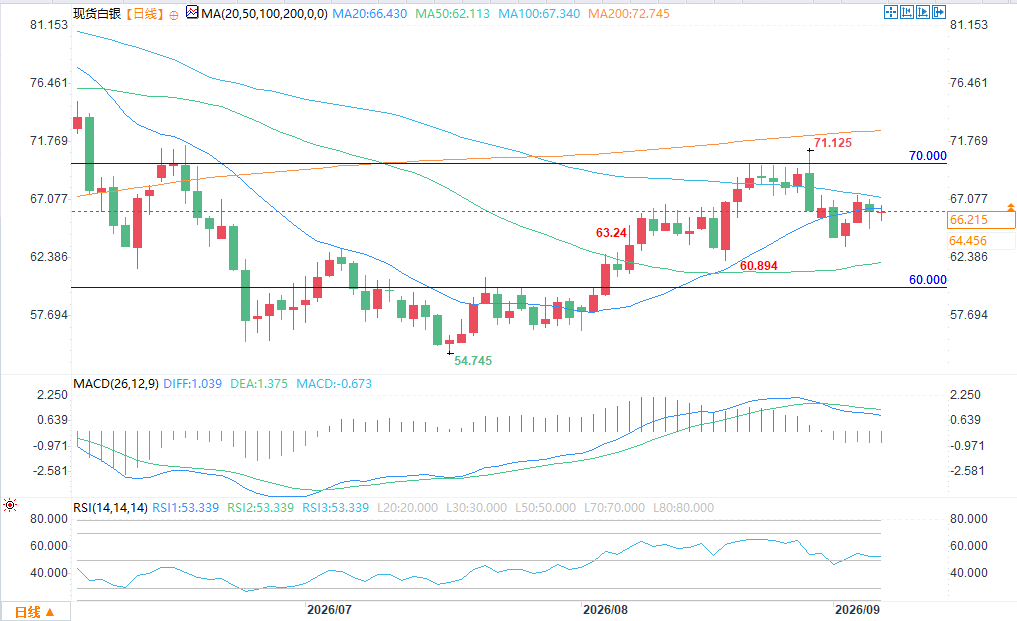 (Spot silver daily chart source: FX678) If the daily closing price effectively holds above $70 on the day of the decision announcement or within 48 hours thereafter, it means the market has digested hawkish expectations, real yields have begun to decline, the logic of yields suppressing prices has failed, and funds will accelerate their inflow into silver. Conversely, if accompanied by increased volume, the price effectively falls below $60, it indicates that the risk of long positions is concentratedly exposed, and it also means the market needs to accept that the duration of interest rate hikes may far exceed market expectations. Judging the market reversal cannot rely solely on price; it must be combined with the Fed's speech: dovish rhetoric coupled with a price break above $70 represents a formal shift in the structural trend; if the speech is hawkish, and the price continues to be pressured below $65, the oscillating pattern will continue. Silver trading in the $60-70 range indicates that the market is waiting for the Fed to provide clear guidance on the interest rate path, rather than the market entering a stable equilibrium state. Once yields continue to rise, the risk of long positions hidden below this range will erupt. Closely monitor silver's performance following the Fed's decision this week: a break above $70 would indicate a repricing of dovish expectations, initiating a structural upward trend; conversely, if prices remain below $65, the downward pressure from interest rates will persist. The next 72 hours are crucial: the consolidation pattern will either continue into next week, or the Fed decision will trigger the directional move traders have been waiting for.
Market Structure and Price Movements Silver is in a consolidation phase, with prices framed by key moving averages. The 50-day exponential moving average (EMA) and the 200-day simple moving average (SMA) are constraining institutional investor positions from above and below. Currently, the price is trading above the long-term trendline (200-day SMA), indicating structural support from trend-following buyers; however, the negative yield factor from high interest rates is dampening market bullish sentiment. The market's inability to choose a clear direction—neither a strong upward breakout nor a test of lower support levels—fully reflects significant market uncertainty: whether the Fed's statements will confirm or disprove the medium-term bullish logic remains to be seen. Technical Support and Resistance Levels Support areas are located at $60 (a psychological level and a historical pivot point) and $65 (a medium-term accumulation zone for institutional funds, where the current 50-day EMA is situated). Resistance is concentrated around $70, a level that has seen repeated selling pressure in the past and is prone to concentrated profit-taking. Analysis of trading volume at the aforementioned key price levels shows that both bulls and bears are relatively restrained: there is neither frenzied buying nor panic selling. Both bulls and bears are primarily holding existing positions without significantly increasing their holdings. The $10 trading range indicates that the market is awaiting the Fed's decision; institutional buyers are holding the lows, while sellers are suppressing upside potential – a typical positioning pattern before a major event. Fed Decision: A Catalyst for Fund Flows Silver's current consolidation coincides with a crucial juncture: over the past three weeks, market expectations for the Fed's interest rate path have shifted dramatically, leading to asymmetrical profit and loss outcomes for positions. If the Fed signals the end of the rate hike cycle or hints at future rate cuts, safe-haven demand combined with changes in real yields will prompt a rapid influx of funds into commodities. Conversely, if the Fed adopts a hawkish stance or discusses "inflation stickiness," it will confirm the current strengthening yields, and silver is likely to continue its range-bound trading, or even decline further. This week's policy announcement is more than just ordinary economic data; it's a crucial turning point: it will determine whether the structural bullish logic supporting silver over the past few months will materialize or completely fail. The Hidden Risks Behind the Consensus on Bullish Sentiment The market's positioning structure exposes a major hidden danger: retail and institutional traders have established a large number of long positions, their core assumption being that even with rising interest rates, geopolitical supply concerns and inflation hedging demand will still support silver prices. However, this consensus ignores an objective fact: if the Federal Reserve maintains high interest rates for a longer period, the real yield on fiat currency assets will rise, and silver, which offers no interest income, will become less attractive as a portfolio hedging tool. Many trend traders have heavily invested based on the logic of a "soft landing"; however, once the Federal Reserve signals continued tightening, this logic will quickly reverse. Therefore, the current consolidation range does not represent a stable market situation, but rather reflects blind optimism. Once prices fall below $60, a large number of long positions will be exposed to risk, triggering a chain reaction of liquidations by most traders who were unprepared for hedging. What would break the current consolidation logic? This consolidation judgment is only valid if silver holds the $60-70 range around the time of the Fed's decision announcement. (Spot silver daily chart source: FX678) If the daily closing price effectively holds above $70 on the day of the decision announcement or within 48 hours thereafter, it means the market has digested hawkish expectations, real yields have begun to decline, the logic of yields suppressing prices has failed, and funds will accelerate their inflow into silver. Conversely, if accompanied by increased volume, the price effectively falls below $60, it indicates that the risk of long positions is concentratedly exposed, and it also means the market needs to accept that the duration of interest rate hikes may far exceed market expectations. Judging the market reversal cannot rely solely on price; it must be combined with the Fed's speech: dovish rhetoric coupled with a price break above $70 represents a formal shift in the structural trend; if the speech is hawkish, and the price continues to be pressured below $65, the oscillating pattern will continue. Silver trading in the $60-70 range indicates that the market is waiting for the Fed to provide clear guidance on the interest rate path, rather than the market entering a stable equilibrium state. Once yields continue to rise, the risk of long positions hidden below this range will erupt. Closely monitor silver's performance following the Fed's decision this week: a break above $70 would indicate a repricing of dovish expectations, initiating a structural upward trend; conversely, if prices remain below $65, the downward pressure from interest rates will persist. The next 72 hours are crucial: the consolidation pattern will either continue into next week, or the Fed decision will trigger the directional move traders have been waiting for.
- Risk Warning and Disclaimer
- The market involves risk, and trading may not be suitable for all investors. This article is for reference only and does not constitute personal investment advice, nor does it take into account certain users’ specific investment objectives, financial situation, or other needs. Any investment decisions made based on this information are at your own risk.