Crude Oil Trading Alert: Middle East supply risks continue to escalate, with WTI crude oil rising above $92, nearing its recent high. Transportation risks from the Hormuz region have become a key market variable.
2026-09-08 09:39:05
International oil prices continued to fluctuate at high levels on Tuesday, with WTI crude oil last trading around $92.36 per barrel and Brent crude oil rising to around $97.34 per barrel , the market moving closer to the $100 mark. Over the past week, with the renewed deterioration of the situation in the Middle East and attacks on ships near the Strait of Hormuz, concerns about oil supply disruptions have intensified significantly, with WTI rising nearly 10% and Brent rising about 8% for the week.  The core reason for this oil price surge is not a sudden improvement in demand, but rather the rapid expansion of supply-side risk premiums. The recent renewed conflict between the US and Iran has impacted maritime transport, with multiple ships attacked in and around the Strait of Hormuz. The market is concerned that further escalation could affect crude oil exports and refined product shipments from the Gulf region. Iran has warned of further risks to energy infrastructure in the Gulf region, forcing traders to reassess the stability of global crude oil supply in the coming weeks. New attacks on Saudi Arabian energy facilities have further reinforced these concerns. Saudi Aramco's refinery in Jizan was attacked again on Monday, and the damage is still being assessed. The facility has a refining capacity of approximately 400,000 barrels per day . While previous similar incidents have not caused long-term production disruptions, market concerns about continued attacks on regional energy facilities have clearly increased. Meanwhile, shipping conditions in the Strait of Hormuz are becoming crucial in determining whether oil prices can rise further. While the strait has not completely ceased shipping, recent vessel traffic has significantly decreased. Market data shows that an average of only about 10 commodity ships have passed through the Strait of Hormuz per day over the past 10 days, the lowest level since May. In other words, the current market is not facing a complete supply disruption, but rather a "hidden supply contraction" caused by decreased transportation efficiency, increased shipping risks, and rising insurance and freight costs. From a global supply perspective, the importance of the Strait of Hormuz means that any transportation risks will quickly transmit to crude oil prices. Currently, approximately 7 million barrels per day of crude oil and refined products still pass through this sea route, so as long as transportation safety does not return to normal levels, it will be difficult for the market to completely eliminate supply concerns. For traders, the real concern is no longer whether a particular facility has suffered short-term damage, but whether Gulf energy exports can remain continuous and stable. US domestic inventories also provide additional support for oil prices. Recent declines in US crude oil inventories, while gasoline and distillate fuel inventories are significantly lower than the same period last year and the five-year seasonal average, indicating that the buffer space in the US energy market is narrowing. Data released on September 2 showed that US crude oil inventories fell by approximately 4.5 million barrels in a single week, further strengthening market attention to the resilience of the US supply side. Changes in inventory structure are particularly noteworthy. Typically, when international supply risks rise, US inventories can buffer market shocks by increasing exports or releasing some commercial stocks. However, if gasoline and distillate fuel inventories are already relatively low, the additional supply pressure that refineries and the refined product market can withstand will be limited. Therefore, even if there isn't a large-scale supply gap in crude oil, the market may still assign a higher risk premium due to a declining safety margin in inventories. Meanwhile, rising oil prices are transmitting to global inflation expectations. With WTI crude regaining $90, US gasoline and diesel prices face further upward pressure, while European and Asian economies may bear higher energy expenditures through import costs. For global central banks, the renewed rise in oil prices means that the process of declining inflation may encounter new resistance, especially if energy price increases continue for several weeks and further transmit to transportation, manufacturing, and service costs, potentially altering monetary policy expectations. This also constrains the crude oil market itself. While rising oil prices imply increased supply risks, if prices remain high for an extended period and begin to compress consumer fuel demand, while simultaneously increasing the incentive for US shale oil companies to increase production, then high oil prices may ultimately create a counter-cyclical adjustment through decreased demand and increased supply. Therefore, the market's real focus right now is on how long the supply risk can last, rather than whether oil prices can break through a certain psychological level in the short term based solely on geopolitical risks. From a market sentiment perspective, oil bulls still hold the upper hand. Last week, WTI rose nearly 10% and Brent rose about 8%, with prices returning to the high levels seen since late July. On Monday, WTI briefly rose to around $93 before retreating somewhat, but the latest price remains above $92, indicating that the market has not yet significantly reduced its risk premium. However, after the rapid rise in oil prices, technical correction pressure has begun to accumulate. Two forces are currently at play: on the one hand, Middle East supply risks are driving funds to continue chasing higher prices; on the other hand, after the continuous rise in WTI and Brent, some short-term bulls may choose to take profits. Therefore, if the situation does not deteriorate further, it is not unexpected for oil prices to fluctuate at high levels or even undergo a technical correction. From a daily chart perspective, WTI has re-established a clear bullish trend, with prices breaking through previous important resistance areas. Currently, the area around $92 has become a crucial battleground between bulls and bears in the short term. The first resistance level to watch is the $93.50-$95 area. If supply risks escalate and push WTI to a decisive break above $95, the market may further test the psychological level of $97 or even $100. On the downside, the first support level to watch is around $89 , which corresponds to a previous important pullback low and is a key support level that bulls need to hold. A break below $89 could see oil prices retreat further to around $86. Looking at the 4-hour chart, WTI is still in an uptrend in the short term, but after a rapid and continuous rise, momentum is clearly at a high level. As long as the price remains above $89, the short-term structure remains bullish, and pullbacks are more likely to be seen as a technical digestion of previous gains. If it breaks through $93.50 and further stabilizes above $95, new upside potential may be opened; however, if the price continues to encounter resistance in the $93-$95 area, and the shipping risks in the Strait of Hormuz ease, short-term profit-taking could push oil prices to retest the $90 or even $89 support level. It is worth noting that the market has already begun to repric the long-term supply disruption. Some institutions believe that if supply constraints in the Middle East persist for an extended period, high oil prices may continue until the end of this year or even longer; meanwhile, other institutions have raised their future oil price forecasts. The latest market analysis indicates significant uncertainty regarding the speed of supply recovery, thus the price fluctuation range may widen further. The most crucial factor to observe going forward is not a single attack, but rather three interconnected variables: first, whether shipping traffic in the Strait of Hormuz can resume; second, whether there will be continuous damage to Gulf energy facilities; and third, whether US crude oil and refined product inventories can re-establish a safety margin. If all three variables worsen simultaneously, market pressure for WTI to break through $95 and test $100 will further increase; if transportation resumes, inventories improve, and the situation de-escalates, the previously rapidly accumulated risk premium may be quickly reversed.
 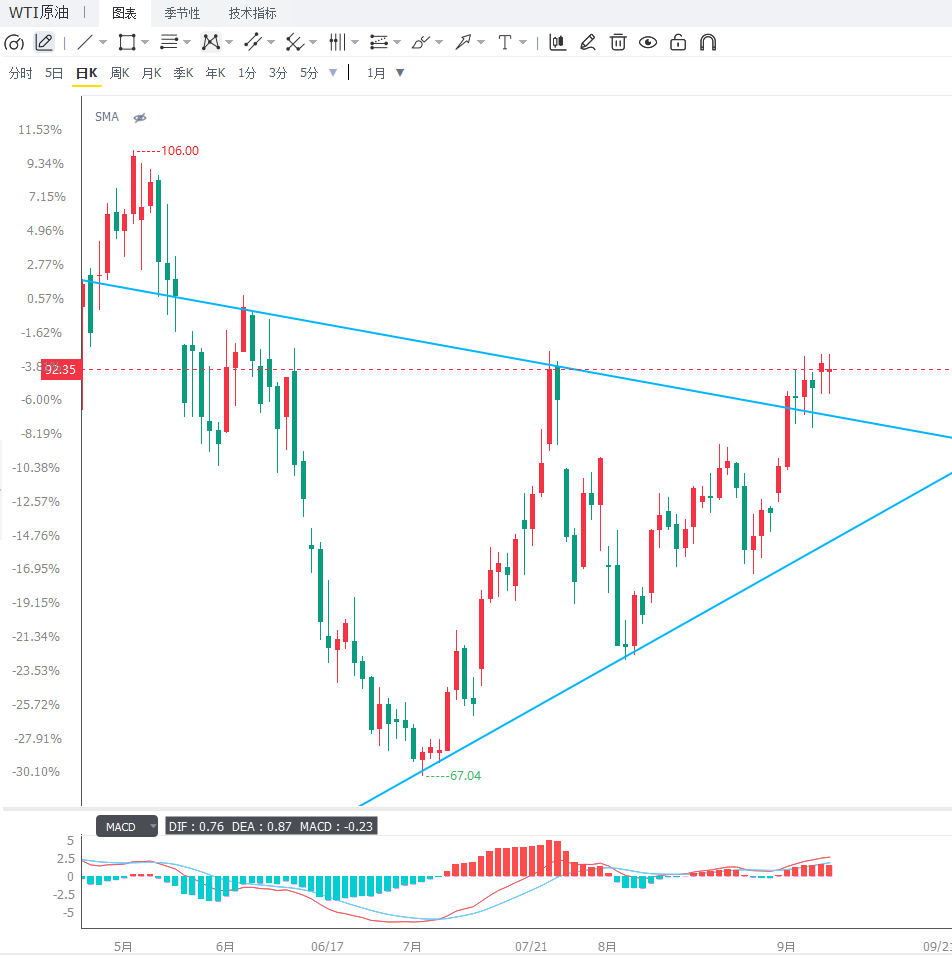 Editor's Summary: The core contradiction in the current crude oil market has shifted from the traditional supply-demand balance to the combined effect of "geopolitical risks + transportation bottlenecks + tight inventory." WTI's return to $92 and Brent's near $97 indicate that the market has already priced in a significant supply risk premium. In the short term, as long as transportation restrictions in the Strait of Hormuz and the risk of attacks on regional energy facilities persist, oil prices still have room to challenge the $95 and even $100 levels. However, if transportation gradually resumes and conflict risks subside, the currently rapidly accumulating risk premium may see a substantial pullback. Therefore, the key to future oil price direction is not simply the number of military events, but rather observing actual crude oil flow, inventory changes, and whether there are sustained disruptions to maritime transportation.
The core reason for this oil price surge is not a sudden improvement in demand, but rather the rapid expansion of supply-side risk premiums. The recent renewed conflict between the US and Iran has impacted maritime transport, with multiple ships attacked in and around the Strait of Hormuz. The market is concerned that further escalation could affect crude oil exports and refined product shipments from the Gulf region. Iran has warned of further risks to energy infrastructure in the Gulf region, forcing traders to reassess the stability of global crude oil supply in the coming weeks. New attacks on Saudi Arabian energy facilities have further reinforced these concerns. Saudi Aramco's refinery in Jizan was attacked again on Monday, and the damage is still being assessed. The facility has a refining capacity of approximately 400,000 barrels per day . While previous similar incidents have not caused long-term production disruptions, market concerns about continued attacks on regional energy facilities have clearly increased. Meanwhile, shipping conditions in the Strait of Hormuz are becoming crucial in determining whether oil prices can rise further. While the strait has not completely ceased shipping, recent vessel traffic has significantly decreased. Market data shows that an average of only about 10 commodity ships have passed through the Strait of Hormuz per day over the past 10 days, the lowest level since May. In other words, the current market is not facing a complete supply disruption, but rather a "hidden supply contraction" caused by decreased transportation efficiency, increased shipping risks, and rising insurance and freight costs. From a global supply perspective, the importance of the Strait of Hormuz means that any transportation risks will quickly transmit to crude oil prices. Currently, approximately 7 million barrels per day of crude oil and refined products still pass through this sea route, so as long as transportation safety does not return to normal levels, it will be difficult for the market to completely eliminate supply concerns. For traders, the real concern is no longer whether a particular facility has suffered short-term damage, but whether Gulf energy exports can remain continuous and stable. US domestic inventories also provide additional support for oil prices. Recent declines in US crude oil inventories, while gasoline and distillate fuel inventories are significantly lower than the same period last year and the five-year seasonal average, indicating that the buffer space in the US energy market is narrowing. Data released on September 2 showed that US crude oil inventories fell by approximately 4.5 million barrels in a single week, further strengthening market attention to the resilience of the US supply side. Changes in inventory structure are particularly noteworthy. Typically, when international supply risks rise, US inventories can buffer market shocks by increasing exports or releasing some commercial stocks. However, if gasoline and distillate fuel inventories are already relatively low, the additional supply pressure that refineries and the refined product market can withstand will be limited. Therefore, even if there isn't a large-scale supply gap in crude oil, the market may still assign a higher risk premium due to a declining safety margin in inventories. Meanwhile, rising oil prices are transmitting to global inflation expectations. With WTI crude regaining $90, US gasoline and diesel prices face further upward pressure, while European and Asian economies may bear higher energy expenditures through import costs. For global central banks, the renewed rise in oil prices means that the process of declining inflation may encounter new resistance, especially if energy price increases continue for several weeks and further transmit to transportation, manufacturing, and service costs, potentially altering monetary policy expectations. This also constrains the crude oil market itself. While rising oil prices imply increased supply risks, if prices remain high for an extended period and begin to compress consumer fuel demand, while simultaneously increasing the incentive for US shale oil companies to increase production, then high oil prices may ultimately create a counter-cyclical adjustment through decreased demand and increased supply. Therefore, the market's real focus right now is on how long the supply risk can last, rather than whether oil prices can break through a certain psychological level in the short term based solely on geopolitical risks. From a market sentiment perspective, oil bulls still hold the upper hand. Last week, WTI rose nearly 10% and Brent rose about 8%, with prices returning to the high levels seen since late July. On Monday, WTI briefly rose to around $93 before retreating somewhat, but the latest price remains above $92, indicating that the market has not yet significantly reduced its risk premium. However, after the rapid rise in oil prices, technical correction pressure has begun to accumulate. Two forces are currently at play: on the one hand, Middle East supply risks are driving funds to continue chasing higher prices; on the other hand, after the continuous rise in WTI and Brent, some short-term bulls may choose to take profits. Therefore, if the situation does not deteriorate further, it is not unexpected for oil prices to fluctuate at high levels or even undergo a technical correction. From a daily chart perspective, WTI has re-established a clear bullish trend, with prices breaking through previous important resistance areas. Currently, the area around $92 has become a crucial battleground between bulls and bears in the short term. The first resistance level to watch is the $93.50-$95 area. If supply risks escalate and push WTI to a decisive break above $95, the market may further test the psychological level of $97 or even $100. On the downside, the first support level to watch is around $89 , which corresponds to a previous important pullback low and is a key support level that bulls need to hold. A break below $89 could see oil prices retreat further to around $86. Looking at the 4-hour chart, WTI is still in an uptrend in the short term, but after a rapid and continuous rise, momentum is clearly at a high level. As long as the price remains above $89, the short-term structure remains bullish, and pullbacks are more likely to be seen as a technical digestion of previous gains. If it breaks through $93.50 and further stabilizes above $95, new upside potential may be opened; however, if the price continues to encounter resistance in the $93-$95 area, and the shipping risks in the Strait of Hormuz ease, short-term profit-taking could push oil prices to retest the $90 or even $89 support level. It is worth noting that the market has already begun to repric the long-term supply disruption. Some institutions believe that if supply constraints in the Middle East persist for an extended period, high oil prices may continue until the end of this year or even longer; meanwhile, other institutions have raised their future oil price forecasts. The latest market analysis indicates significant uncertainty regarding the speed of supply recovery, thus the price fluctuation range may widen further. The most crucial factor to observe going forward is not a single attack, but rather three interconnected variables: first, whether shipping traffic in the Strait of Hormuz can resume; second, whether there will be continuous damage to Gulf energy facilities; and third, whether US crude oil and refined product inventories can re-establish a safety margin. If all three variables worsen simultaneously, market pressure for WTI to break through $95 and test $100 will further increase; if transportation resumes, inventories improve, and the situation de-escalates, the previously rapidly accumulated risk premium may be quickly reversed. Editor's Summary: The core contradiction in the current crude oil market has shifted from the traditional supply-demand balance to the combined effect of "geopolitical risks + transportation bottlenecks + tight inventory." WTI's return to $92 and Brent's near $97 indicate that the market has already priced in a significant supply risk premium. In the short term, as long as transportation restrictions in the Strait of Hormuz and the risk of attacks on regional energy facilities persist, oil prices still have room to challenge the $95 and even $100 levels. However, if transportation gradually resumes and conflict risks subside, the currently rapidly accumulating risk premium may see a substantial pullback. Therefore, the key to future oil price direction is not simply the number of military events, but rather observing actual crude oil flow, inventory changes, and whether there are sustained disruptions to maritime transportation.
- Risk Warning and Disclaimer
- The market involves risk, and trading may not be suitable for all investors. This article is for reference only and does not constitute personal investment advice, nor does it take into account certain users’ specific investment objectives, financial situation, or other needs. Any investment decisions made based on this information are at your own risk.