The yen fell below 154, hitting a new low since February 19! Upward revision of GDP and soaring wages cleared the way for interest rate hikes.
2026-09-08 10:08:05
On Tuesday (September 8) during Asian trading hours, the USD/JPY pair continued its decline, falling to 153.16 as of 10:05, a new low since February 19. The yen received a significant boost, mainly driven by Japanese economic data and monetary policy expectations. Japan's Q2 GDP annualized quarterly rate, released on Tuesday, was revised upward from the initial 1.1% to 1.4%, but still below the median economist forecast of 1.6%-1.8%. The swap market is pricing in a 98% probability of a rate hike to 1.25% next week, and a further rate hike to 1.5% in January is already fully priced in. The upward revision of GDP and wage data cleared the final data hurdle for the Bank of Japan's rate hike, providing support for the yen, but having a mixed impact on the Nikkei index. 
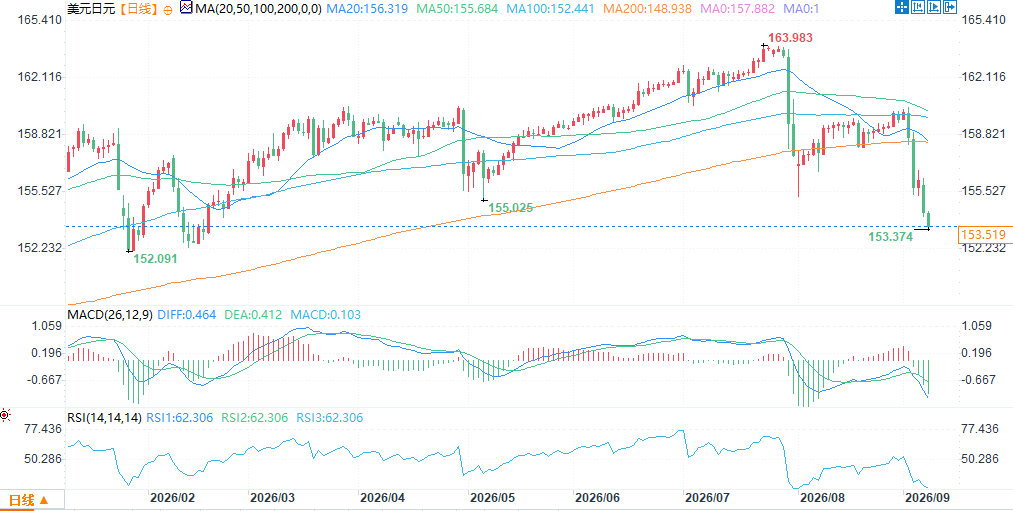 (USD/JPY daily chart, source: EasyForex) At 10:05 Beijing time, USD/JPY was trading at 153.16/17.
Upward revision of GDP clears the way for interest rate hikes, while wage data reinforces sustainability.
Japan's second-quarter real GDP annualized quarterly growth rate was revised upward to 1.4%, higher than the initial estimate of 1.1%, but slightly lower than the median forecast of 1.6% to 1.8%. Economists at Daiwa Securities noted that maintaining this level of growth in a quarter when the situation in the Middle East could exert downward pressure on the economy is "remarkable," emphasizing that the data "offers no reason to worry about growth," thus paving the way for the Bank of Japan to continue raising interest rates. Meanwhile, real wages rose sharply by 2.4% year-on-year in July, the largest increase since May 2021, marking the seventh consecutive month of positive growth. This strong performance further demonstrates that the wage-driven recovery is sufficiently sustainable to withstand the pressure from monetary policy tightening. The continued improvement in real wages not only enhances household purchasing power but also provides a solid foundation for robust expansion of domestic demand. Combined with the upward revision of GDP and wage data, the Japanese economic fundamentals show resilience, significantly reducing the central bank's concerns that interest rate hikes might stifle the recovery momentum, creating favorable conditions for releasing a clearer tightening signal at next week's policy meeting.The market has fully priced in the interest rate hike, which supports the yen but has a mixed impact on the Nikkei.
The swap market has already priced in a 98% probability of the Bank of Japan (BOJ) raising interest rates to 1.25% next week, while a further rate hike to 1.5% in January has also been fully priced in, indicating that the rate hike itself is almost a foregone conclusion. Market focus has therefore shifted to how the central bank will frame the risks of the Middle East conflict and the potential impact of tightening policies on the economy. The expectation of a rate hike provides clear support for the yen, helping to alleviate previous depreciation pressures. However, the impact on the Nikkei index is two-sided: strong growth and wage narratives are beneficial to improved domestic demand and corporate profit prospects, especially for export-oriented companies; but if Japanese government bond yields rise further, it will suppress the valuation performance of interest rate-sensitive sectors such as banking and real estate. If the BOJ confirms a hawkish stance and hints at further room for rate hikes, the yen is expected to strengthen further; conversely, if the statement is dovish or emphasizes caution, the exchange rate may rebound. Investors will closely watch the actual decision of next week's central bank meeting, the wording of the policy statement, and the details of the governor's press conference; these signals will directly determine the next stage of the yen and stock market direction.USD/JPY: A 98% probability of an interest rate hike is already priced in; the real variable lies in the "next step."
The upward revision of Japan's Q2 GDP and wage data directly supported the USD/JPY exchange rate. The swap market has already priced in a 98% probability of a rate hike to 1.25% next week, and a further rate hike to 1.5% in January, meaning the market has fully priced in the Bank of Japan's tightening path. USD/JPY is currently trading below 154, a significant drop from above 160 last week, as the market digests the dual impact of rate hike expectations and the narrowing USD/JPY interest rate differential. Economists at Daiwa Securities pointed out that the upward revision of GDP "cleared the way for a rate hike"—the data shows that the Japanese economy is capable of withstanding policy tightening, reducing the risk that the central bank might postpone action due to concerns about growth. Real wages in July saw the largest increase since May 2021, further strengthening the sustainability of the wage-inflation positive cycle. For USD/JPY, this means the rationale for a rate hike is shifting from "data allows" to "data supports," marginally strengthening the yen's interest rate differential support. However, the downside potential for USD/JPY remains fundamentally constrained by the USD/JPY interest rate differential – even if the Bank of Japan raises its rate to 1.25%, it will still be more than 200 basis points behind the Federal Reserve's policy rate of 3.5%-3.75%. In the short term, the exchange rate may fluctuate between 153 and 157. If the Bank of Japan releases clearer signals regarding future rate hikes (such as a quarterly pace of rate hikes or higher terminal interest rate guidance), the yen may move towards 153 or even 152; if the stance is dovish, the exchange rate may rebound to the 155-157 area. The actual outcome and forward guidance of next week's Bank of Japan meeting will be the key variables in breaking the current range-bound trading.Summarize
Upward revisions to Japanese GDP and positive wage data have cleared the way for a central bank rate hike. The swap market is pricing in a 98% probability of a rate hike next week, and a further rate increase to 1.5% in January is already fully priced in. Investors should pay close attention to the Bank of Japan's meeting results and subsequent policy signals. A hawkish stance could lead to further yen strength; a dovish stance could result in a rebound. Market focus is shifting to how the central bank frames its future path, which is more important for the yen and the Nikkei than the rate hike itself. (USD/JPY daily chart, source: EasyForex) At 10:05 Beijing time, USD/JPY was trading at 153.16/17.
- Risk Warning and Disclaimer
- The market involves risk, and trading may not be suitable for all investors. This article is for reference only and does not constitute personal investment advice, nor does it take into account certain users’ specific investment objectives, financial situation, or other needs. Any investment decisions made based on this information are at your own risk.