Expectations of a Bank of Japan interest rate hike are rising, causing the dollar to fall sharply against the yen, hitting a six-month low.
2026-09-08 10:34:05
The dollar continued its decline against the yen in Asian trading on Tuesday, briefly touching around 153.00 , its lowest level since February 18. This marks the second consecutive day of losses for the pair and the fourth decline in the past five trading days. The yen's recent significant strengthening has been primarily driven by improved Japanese economic data and a more hawkish shift in expectations for the Bank of Japan's policy, while the dollar's own weakness has further amplified the downward pressure on USD/JPY.  The latest data released by Japan has significantly boosted market confidence in the economic fundamentals. Real wages in Japan rose 2.4% year-on-year in July, marking the seventh consecutive month of growth and the largest increase since May 2021. Simultaneously, the inflation indicator used to calculate real wages rose above 2% for the first time this year. The relationship between wage growth and inflation is a crucial reference for the Bank of Japan in assessing residents' real purchasing power and the sustainability of potential inflation. The significant rebound in real wages indicates that Japanese residents' income and consumption capacity are improving, and it has also increased market expectations for the Bank of Japan to continue its exit from easing policies. Economic growth data also provided support for the yen. Revised data released by the Cabinet Office showed that Japan's real GDP grew at an annualized rate of 1.4% in the second quarter of this year, higher than the initial estimate of 1.1%. The upward revision of economic growth, coupled with relatively rapid wage growth, suggests that the Japanese economy currently has the capacity to withstand a higher interest rate environment. Against this backdrop, market expectations for further interest rate hikes by the Bank of Japan have rapidly increased. The market has now largely priced in the possibility of a 25 basis point rate hike at the Bank of Japan's meeting on September 17-18. If the Bank of Japan (BOJ) further signals its intention to tighten monetary policy in its meeting statement, the yen could gain further upward momentum. Some market participants are even discussing the possibility of a larger interest rate hike, primarily based on the BOJ's need to stabilize inflation expectations through clearer policy actions while preventing a rapid rise in long-term government bond yields. However, whether the BOJ truly needs to take more aggressive policy actions remains highly uncertain. While the Japanese economy has received an upward revision, the external environment remains complex, particularly with rising energy prices potentially pushing up import costs and overall inflation. If energy prices remain high, the BOJ will face both inflationary pressures and economic growth risks, requiring policymakers to strike a balance between controlling prices and avoiding excessive contractionary shocks to the economy. Another important driver of the yen's strength is the market's renewed focus on potential exchange rate stabilization measures by the Japanese authorities. The USD/JPY exchange rate had been at high levels for an extended period, and the continued depreciation of the yen had increased policy attention. As the exchange rate falls back towards 153, the market is reassessing whether the Japanese authorities might strengthen verbal intervention or even take concrete action during periods of rapid yen volatility. While no specific measures are yet confirmed, the policy risk itself will limit some investors from re-establishing long positions in USD/JPY. The situation is also unfavorable for USD/JPY. US non-farm payrolls increased by 162,000 in August, significantly higher than market expectations, and the unemployment rate remained at 4.1%, raising market expectations for further tightening by the Federal Reserve in September. However, the dollar did not continue to strengthen after the employment data release, indicating that the market has begun to focus on this week's US inflation data. The US Producer Price Index (PPI) and Consumer Price Index (CPI) will be important indicators for the market to judge the policy path in September. If PPI and CPI are significantly higher than expected, expectations of a Fed rate hike may further intensify, and there is room for a rebound in US Treasury yields and the dollar, which will provide some support for USD/JPY. Conversely, if inflation data is lower than expected, the market may reduce its bets on US policy tightening again, and further weakening of the dollar will put greater downward pressure on USD/JPY. Therefore, USD/JPY is currently facing a clear two-way policy-driven situation: improved Japanese economic data is fueling expectations of further tightening by the Bank of Japan, while strong US employment data has not yet fully translated into sustained dollar appreciation. As long as Japanese wages and inflation remain resilient, and the Bank of Japan continues to signal policy normalization, the expectation of a narrowing interest rate differential between Japan and the US is likely to continue supporting the yen. From a capital flow perspective, the recent yen's rise also reflects a shift in market risk appetite. Persistently high oil prices and rising energy supply risks are increasing global inflationary pressures and may also strengthen safe-haven allocations. However, compared to the dollar, the yen currently receives more direct support from policy expectations. If expectations of a Bank of Japan rate hike further intensify, some previously established short yen positions may continue to be closed, amplifying the yen's appreciation. From a daily chart perspective, USD/JPY has broken below the important support level of 155.30, further confirming the recent downward trend from its highs. The current price is around 153.00; if the bears continue to dominate, the first support level to watch is the psychological level of 152.00 . If a technical rebound occurs, the 155.20-155.30 area, previously a support level, has now become a significant resistance level. Only by regaining and stabilizing above this area can the short-term downward pressure be significantly alleviated. Looking at the 4-hour chart, USD/JPY is in a clear short-term downtrend, with the price consistently trading below major short-term moving averages, indicating relatively limited rebound strength. The current exchange rate has entered a relatively low range after its rapid decline, so further shorting should be approached with caution due to the possibility of a technical correction. If significant buying pressure appears around 153.00, the exchange rate may rebound towards 154.00 or even 155.20; however, if the rebound fails to break through the 154.50-155.30 area, the downtrend remains intact. Once 153.00 is effectively broken, the market may further seek support around $152. Currently, the biggest variable in the market remains the shift in policy expectations between the Bank of Japan and the Federal Reserve. Continued improvement in Japanese data means the yen has both fundamental and policy support, while the US needs to wait for inflation data to further confirm the interest rate path. Against this backdrop, the short-term trend for USD/JPY is clearly bearish, but given the continuous decline in the exchange rate, the risk of a technical rebound is increasing. Future market movements may gradually shift from a simple downward trend to a more volatile pattern of "decline – rebound – re-selection of direction."
 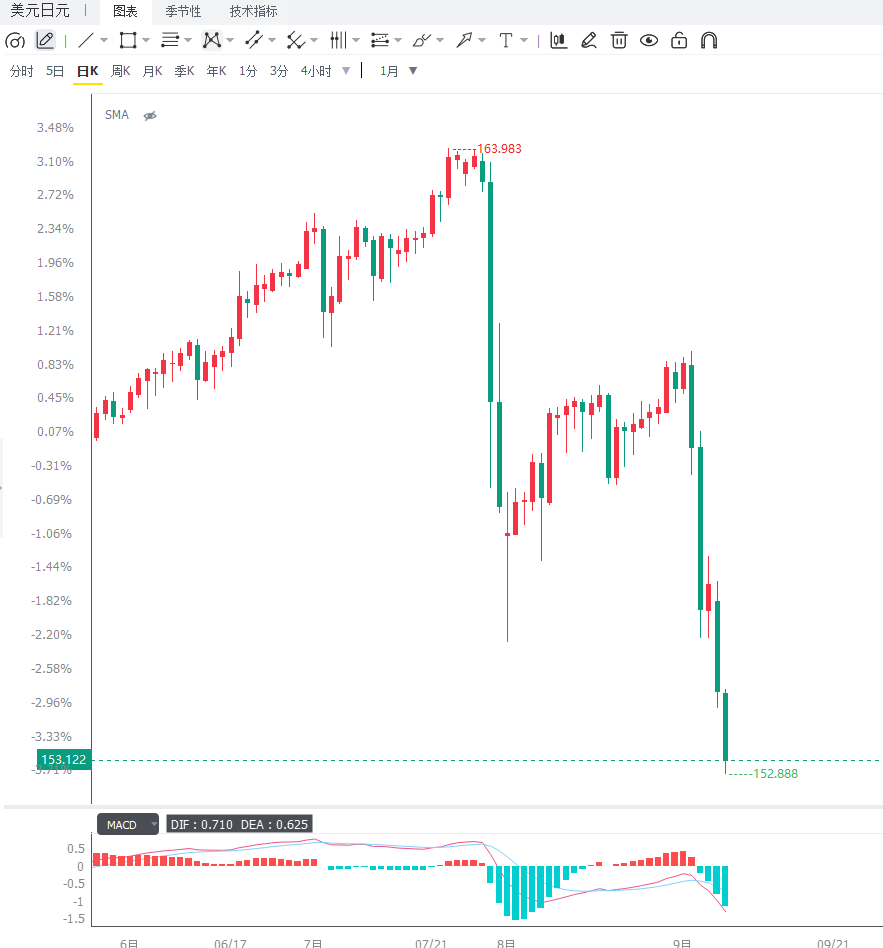 Editor's Summary: Japan's real wage growth of 2.4% and the upward revision of second-quarter economic growth to 1.4% are reinforcing market expectations of further interest rate hikes by the Bank of Japan, becoming the main driver of the recent yen's strength. Meanwhile, while strong US employment data has increased expectations of a tighter Federal Reserve policy, the dollar has not yet formed a sustained upward trend, putting more significant downward pressure on USD/JPY. In the short term, 153.00 is a crucial level that bears need to break through, while 155.20-155.30 is a key area to determine whether the downward structure has changed. Subsequent policy signals from the Bank of Japan and US PPI and CPI will determine whether the expected interest rate differential between Japan and the US will continue to tilt towards the yen. If expectations of a normalization of Japanese policy further intensify, USD/JPY still has room to adjust towards around 152 USD; however, if US inflation rebounds, a dollar rebound may also bring a phase of recovery.
The latest data released by Japan has significantly boosted market confidence in the economic fundamentals. Real wages in Japan rose 2.4% year-on-year in July, marking the seventh consecutive month of growth and the largest increase since May 2021. Simultaneously, the inflation indicator used to calculate real wages rose above 2% for the first time this year. The relationship between wage growth and inflation is a crucial reference for the Bank of Japan in assessing residents' real purchasing power and the sustainability of potential inflation. The significant rebound in real wages indicates that Japanese residents' income and consumption capacity are improving, and it has also increased market expectations for the Bank of Japan to continue its exit from easing policies. Economic growth data also provided support for the yen. Revised data released by the Cabinet Office showed that Japan's real GDP grew at an annualized rate of 1.4% in the second quarter of this year, higher than the initial estimate of 1.1%. The upward revision of economic growth, coupled with relatively rapid wage growth, suggests that the Japanese economy currently has the capacity to withstand a higher interest rate environment. Against this backdrop, market expectations for further interest rate hikes by the Bank of Japan have rapidly increased. The market has now largely priced in the possibility of a 25 basis point rate hike at the Bank of Japan's meeting on September 17-18. If the Bank of Japan (BOJ) further signals its intention to tighten monetary policy in its meeting statement, the yen could gain further upward momentum. Some market participants are even discussing the possibility of a larger interest rate hike, primarily based on the BOJ's need to stabilize inflation expectations through clearer policy actions while preventing a rapid rise in long-term government bond yields. However, whether the BOJ truly needs to take more aggressive policy actions remains highly uncertain. While the Japanese economy has received an upward revision, the external environment remains complex, particularly with rising energy prices potentially pushing up import costs and overall inflation. If energy prices remain high, the BOJ will face both inflationary pressures and economic growth risks, requiring policymakers to strike a balance between controlling prices and avoiding excessive contractionary shocks to the economy. Another important driver of the yen's strength is the market's renewed focus on potential exchange rate stabilization measures by the Japanese authorities. The USD/JPY exchange rate had been at high levels for an extended period, and the continued depreciation of the yen had increased policy attention. As the exchange rate falls back towards 153, the market is reassessing whether the Japanese authorities might strengthen verbal intervention or even take concrete action during periods of rapid yen volatility. While no specific measures are yet confirmed, the policy risk itself will limit some investors from re-establishing long positions in USD/JPY. The situation is also unfavorable for USD/JPY. US non-farm payrolls increased by 162,000 in August, significantly higher than market expectations, and the unemployment rate remained at 4.1%, raising market expectations for further tightening by the Federal Reserve in September. However, the dollar did not continue to strengthen after the employment data release, indicating that the market has begun to focus on this week's US inflation data. The US Producer Price Index (PPI) and Consumer Price Index (CPI) will be important indicators for the market to judge the policy path in September. If PPI and CPI are significantly higher than expected, expectations of a Fed rate hike may further intensify, and there is room for a rebound in US Treasury yields and the dollar, which will provide some support for USD/JPY. Conversely, if inflation data is lower than expected, the market may reduce its bets on US policy tightening again, and further weakening of the dollar will put greater downward pressure on USD/JPY. Therefore, USD/JPY is currently facing a clear two-way policy-driven situation: improved Japanese economic data is fueling expectations of further tightening by the Bank of Japan, while strong US employment data has not yet fully translated into sustained dollar appreciation. As long as Japanese wages and inflation remain resilient, and the Bank of Japan continues to signal policy normalization, the expectation of a narrowing interest rate differential between Japan and the US is likely to continue supporting the yen. From a capital flow perspective, the recent yen's rise also reflects a shift in market risk appetite. Persistently high oil prices and rising energy supply risks are increasing global inflationary pressures and may also strengthen safe-haven allocations. However, compared to the dollar, the yen currently receives more direct support from policy expectations. If expectations of a Bank of Japan rate hike further intensify, some previously established short yen positions may continue to be closed, amplifying the yen's appreciation. From a daily chart perspective, USD/JPY has broken below the important support level of 155.30, further confirming the recent downward trend from its highs. The current price is around 153.00; if the bears continue to dominate, the first support level to watch is the psychological level of 152.00 . If a technical rebound occurs, the 155.20-155.30 area, previously a support level, has now become a significant resistance level. Only by regaining and stabilizing above this area can the short-term downward pressure be significantly alleviated. Looking at the 4-hour chart, USD/JPY is in a clear short-term downtrend, with the price consistently trading below major short-term moving averages, indicating relatively limited rebound strength. The current exchange rate has entered a relatively low range after its rapid decline, so further shorting should be approached with caution due to the possibility of a technical correction. If significant buying pressure appears around 153.00, the exchange rate may rebound towards 154.00 or even 155.20; however, if the rebound fails to break through the 154.50-155.30 area, the downtrend remains intact. Once 153.00 is effectively broken, the market may further seek support around $152. Currently, the biggest variable in the market remains the shift in policy expectations between the Bank of Japan and the Federal Reserve. Continued improvement in Japanese data means the yen has both fundamental and policy support, while the US needs to wait for inflation data to further confirm the interest rate path. Against this backdrop, the short-term trend for USD/JPY is clearly bearish, but given the continuous decline in the exchange rate, the risk of a technical rebound is increasing. Future market movements may gradually shift from a simple downward trend to a more volatile pattern of "decline – rebound – re-selection of direction." Editor's Summary: Japan's real wage growth of 2.4% and the upward revision of second-quarter economic growth to 1.4% are reinforcing market expectations of further interest rate hikes by the Bank of Japan, becoming the main driver of the recent yen's strength. Meanwhile, while strong US employment data has increased expectations of a tighter Federal Reserve policy, the dollar has not yet formed a sustained upward trend, putting more significant downward pressure on USD/JPY. In the short term, 153.00 is a crucial level that bears need to break through, while 155.20-155.30 is a key area to determine whether the downward structure has changed. Subsequent policy signals from the Bank of Japan and US PPI and CPI will determine whether the expected interest rate differential between Japan and the US will continue to tilt towards the yen. If expectations of a normalization of Japanese policy further intensify, USD/JPY still has room to adjust towards around 152 USD; however, if US inflation rebounds, a dollar rebound may also bring a phase of recovery.
- Risk Warning and Disclaimer
- The market involves risk, and trading may not be suitable for all investors. This article is for reference only and does not constitute personal investment advice, nor does it take into account certain users’ specific investment objectives, financial situation, or other needs. Any investment decisions made based on this information are at your own risk.