Behind record high copper prices: Global inventory redistribution is changing the landscape of the metals market.
2026-09-08 22:00:07
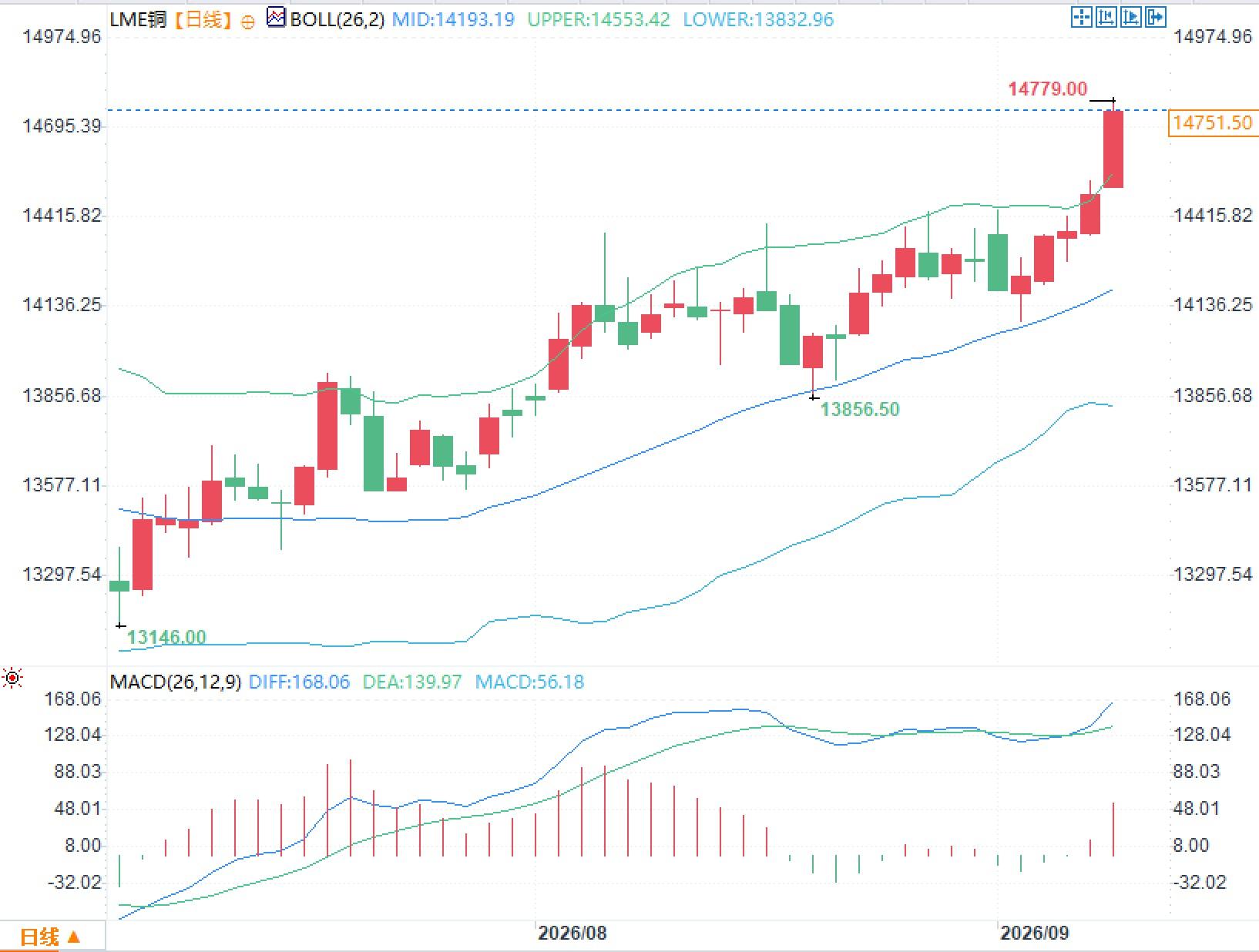
On Tuesday, September 8th, three-month copper futures on the London Metal Exchange traded above $14,700 per tonne, currently hovering near the intraday record high. However, the core factor driving short-term pricing is not the depletion of global refined copper reserves, but rather the reshaping of deliverable inventory distribution by tariff expectations: record-breaking stockpiles at the New York Mercantile Exchange and tight supply in the London warehouse receipt system. The U.S. Department of Commerce was originally scheduled to submit its refined copper market review to the White House by June 30th, but the deadline has passed without a public conclusion, and the flow of goods and term structure continue to be anchored by this policy vacuum. 
The total ledger and the deliverable map do not overlap.
Several research institutions still project a global refined copper surplus for 2026. Consulting firm CRU previously estimated a surplus of approximately 639,000 tons for the year. The problem is that if surplus metal is locked into a particular tariff jurisdiction, it no longer automatically constitutes immediate supply to other markets. CRU's chief copper analyst points out that if copper in US warehouses is no longer considered a source of returnable goods, tariff expectations will rewrite the original surplus year as a "at most balanced" year; if imports maintain the intensity of the first half of the year, markets outside the US will exhibit shortage characteristics at the trading level. As of early September, New York Mercantile Exchange inventories recorded 766,795 short tons, equivalent to approximately 695,600 tons, a record high. Including off-exchange warehouses, the market generally estimates that US stockpiles have exceeded 1 million tons, a level approaching the annual output of the Escondida copper mine in Chile. The United States imported approximately 885,000 tons of refined copper cathodes in the first half of the year, about 3% higher than the same period in 2025, and roughly double that of the first half of 2024; total imports in 2025 reached 1.64 million tons. The metal hasn't disappeared; it has simply moved from the London pricing system to the North American delivery system.How will tariff expectations reshape cross-market spreads?
Since 2025, the market has repeatedly traded along the same policy path: the U.S. Department of Commerce had proposed imposing a 15% tariff on refined copper starting in 2027, rising to 30% in 2028. The White House subsequently postponed imposing tariffs on refined cathodes, instead imposing a 50% tariff on semi-finished products and derivatives such as pipes and wires, while requiring the Department of Commerce to submit a further report by the end of June 2026 on whether it was still necessary to impose tariffs on refined copper. With the review deadline passed and no announcement made, the premium window between New York and London remained open, and traders continued to ship cathodes to U.S. ports. Societe Generale summarized this structure as "policy trading": arbitrage between New York and London has transformed from a technical basis into a pricing tool for the Section 232 tariff path. The team estimated, after breaking down freight, warehouse receipts, and financing costs, that the market implicitly carries a 14.6% probability of a 15% tariff being implemented in January 2027 and a 37% probability of a 30% tariff being implemented in January 2028. Benchmark Minerals Intelligence analysis emphasizes that while the outcome of tariffs is difficult to predict, the longer the uncertainty persists, the longer metal flows to the US and the longer off-balance-sheet available inventory remains under pressure. Stoneex calls the overdue Section 232 review the current "single biggest catalyst" for the copper market. A positive tariff would stimulate another round of rush shipments before it takes effect; if the plan is shelved, there is pressure to repatriate positions accumulated over the past 18 months. Even if the tariffs ultimately fail to materialize, some traders still believe the US will use inventory as a buffer for manufacturing. The "Treasury Plan," launched in February 2026, will establish a critical mineral reserve of approximately $12 billion through public-private partnerships. The funding structure consists of approximately $10 billion in loans from the Export-Import Bank of the United States plus approximately $2 billion in private capital, covering 60 critical minerals designated by the government. Copper is included in the list, but the official breakdown of how many tons will be fixed as long-term strategic reserves has not yet been provided.London spot premium and warehouse receipt structure
The contradictions in London are more concrete. In mid-August, the cash premium over the three-month contract once exceeded $500/ton, the widest since the squeeze in 2021. Subsequently, traders concentrated on delivering to London warehouses, and the cash premium narrowed rapidly; at the end of August, there were large-scale cancellations and delivery orders, and the inventory available for immediate delivery was once again close to the tight range. As of September 7, copper inventory on the London Metal Exchange was 236,475 tons, with cancelled warrants accounting for about 51%, corresponding to more than 121,000 tons of metal marked as awaiting release. The cash premium over the three-month contract fell back to about $92/ton, but the term structure still showed a cash premium, indicating that the pricing power of near-month supplies has not yet returned to a relaxed state.Mining constraints and demand base coexist
Looking at the bigger picture, the inventory mismatch is compounded by a supply chain with very low supply elasticity. Chile, as the largest mineral producer, has repeatedly lowered its production guidance this year, with declining ore grades forcing the processing of more raw ore to obtain the equivalent amount of metal. Maintenance at smelting facilities in Indonesia and other regions further disrupts the matching of concentrate and anodes. S&P Global research indicates that large copper mines take an average of about 17 years from discovery to production, and in recent years, grassroots exploration's share of base metal budgets has fallen to a historical low, with most discovered deposits still stuck before feasibility studies. Existing mine expansions and new mine construction simultaneously face environmental reviews, community negotiations, and increased capital expenditures, lengthening the supply-price response lag. The demand-side narrative hasn't disappeared. Photovoltaics, wind power, grid upgrades, electric vehicles, and data center power infrastructure all use copper as a conductor and heat transfer material. High prices may prompt some downstream users to seek alternatives or postpone purchases, but so far, demand-side constraints have not reversed the supply-driven premium structure. Weak concentrate processing fees and tight raw material supplies at some smelters have led to a temporary increase in demand for refined copper. It's important to distinguish between two timelines: one based on quarterly shipment flows determined by tariffs and warehouse receipts, and the other on a ten-year supply gap determined by mines and the power grid. To conflate these two factors into a single "shortage" or "bubble" would deviate from the true constraints of the current market.Frequently Asked Questions
Question 1: Does the record high in LME copper mean there is a global copper shortage? Answer: No. CRU still projects a surplus of approximately 639,000 tons in 2026. The high prices are largely due to the relocation of deliverable inventory: New York Mercantile Exchange inventory reached a record high of approximately 695,600 tons, while London inventory was 236,500 tons with approximately 51% of warrants cancelled. The metal exists on the books, but it has temporarily exited the London pricing system. Question 2: Why are goods still being shipped to the US when the refined copper tariff has not yet been announced? Answer: The US Department of Commerce has suggested a phased tariff rate of 15% in 2027 and 30% in 2028. The June 30th review deadline has passed without a conclusion. As long as the premium window covers freight and insurance costs, traders have an incentive to continue shipping. Societe Generale estimates that the market implies a 15% tariff rate with a probability of implementation of approximately 14.6%, indicating that pricing is based on probability, not a finalized tariff. Question 3: Where will the millions of tons of US inventory ultimately go? A: If the additional tariffs are implemented, there may be another rush to ship goods before they take effect; if the plan is cancelled, there will be pressure for arbitrage positions to flow back. The Treasury plan is approximately $12 billion and covers 60 types of minerals; the exact percentage for copper has not yet been determined. Whether the inventory is a strategic reserve or a return to the London Metal Exchange depends on the policy text, not just slogans.- Risk Warning and Disclaimer
- The market involves risk, and trading may not be suitable for all investors. This article is for reference only and does not constitute personal investment advice, nor does it take into account certain users’ specific investment objectives, financial situation, or other needs. Any investment decisions made based on this information are at your own risk.