A chart shows the Baltic Dry Index rising slightly, with Capesize bulk carrier freight rates leading the market.
2026-09-09 00:22:05
The latest data shows that the Baltic Dry Index (BDI) was 3584 points on September 8, 2026, up 0.25% from the previous week, marking the largest increase since September 4, 2026. Looking at the short-term charts, the BDI has seen positive growth 9 times, negative growth 2 times, and zero growth in the last 11 BDI readings. Specifically, the Panamax Freight Index (BPI) was 2414 points, down 0.70% from the previous week; the Capesize Freight Index (BCI) was 6313 points, up 0.43%; and the Supramax Freight Index (BSI) was 1693 points, up 0.65%. For detailed charts of the Baltic Dry Index and its three main sub-indices, including the latest 720-day and 10-year trends, please refer to the charts specially created by FX678. 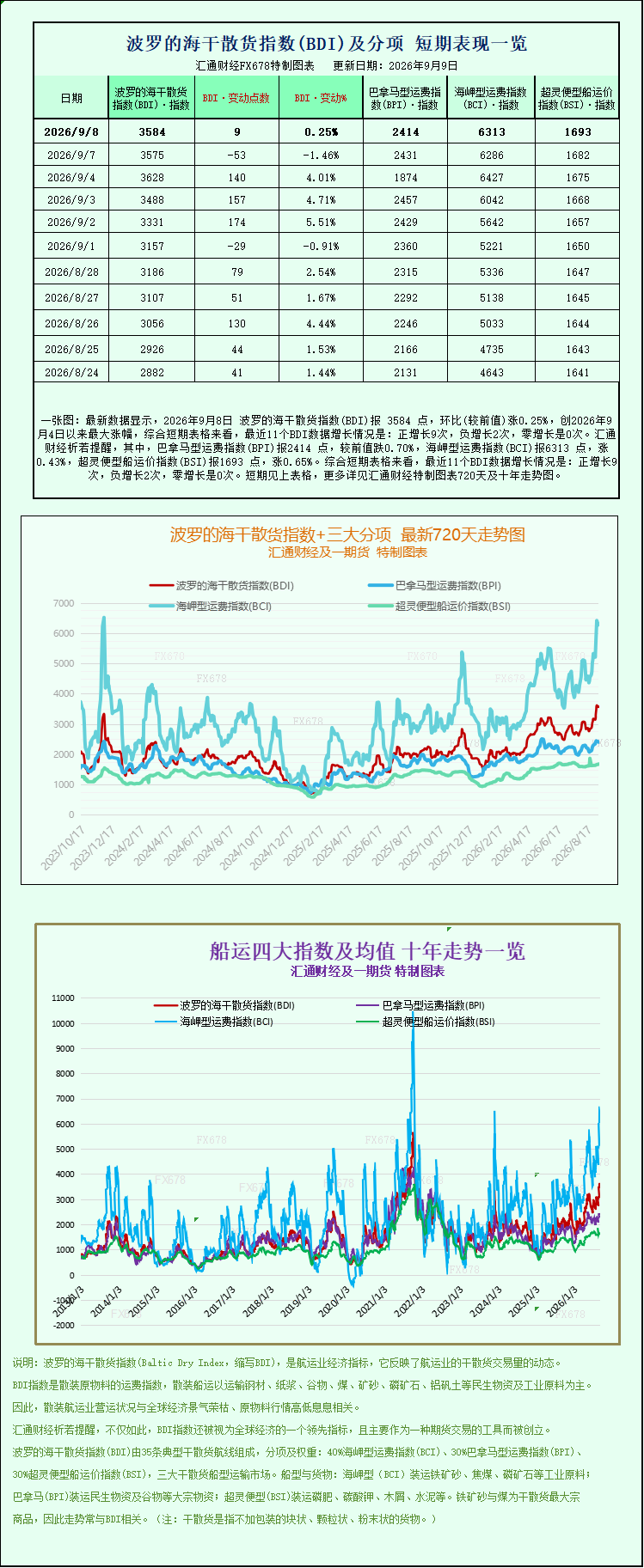 The international dry bulk shipping market experienced structural differentiation, with the Baltic Dry Index (BDI) rising slightly, ending the previous trading day's decline. Capesize (Good Hope) freight rates performed particularly well, becoming the core driver of the index's rise, while Panamax rates declined slightly, and Supramax rates steadily increased, showing a clear divergence between vessel types in the overall market. As a core indicator of the global dry bulk shipping market, the Baltic Dry Index (BDI) directly reflects the global demand for seaborne commodities such as iron ore, coal, and grain, as well as the supply and demand of shipping capacity, providing important reference for global trade, commodity prices, and shipping industry trends. Data shows that on September 8th, the Baltic Dry Index rose 9 points, or 0.3%, closing at 3584 points, with overall freight rates remaining at a high level. Looking at the sub-ship type indices, the market differentiation is very significant, with Capesize vessels, the largest in size and primarily transporting industrial raw materials, showing independent strength. The Capesize vessel index (.BACI) rose 27 points, or 0.4%, to close at 6313 points, continuing to lead all bulk carrier categories. In terms of core profitability, Capesize vessels, mainly engaged in 150,000-ton heavy-haul transportation and primarily carrying iron ore and thermal coal, saw their average daily earnings increase by $242 compared to the previous period, with daily revenue climbing to $53,570. Their profitability remains strong, demonstrating the recovery momentum in demand for industrial raw materials by sea. This round of strong Capesize freight rates is primarily driven by the phased recovery in the iron ore market. It is understood that international iron ore prices have risen for four consecutive trading days, and market bullish sentiment continues to rise. From the demand side, as the world's largest iron ore consumer, the Chinese market is experiencing its traditional seasonal demand recovery cycle. Downstream steel industry operating rates are gradually recovering, releasing restocking demand and driving an increase in iron ore import sea freight orders. Meanwhile, shipments from major global iron ore producing countries have slowed temporarily, leading to a temporary shortage of ocean shipping capacity and further supporting higher Capesize freight rates. However, the upward momentum remains constrained. Domestic iron ore port inventories are currently high, coupled with low profit margins in the steel industry, resulting in cautious purchasing by downstream steel mills. This has slightly limited the upside potential for iron ore prices and ocean freight rates, leading to a "steady recovery and slight increase" in the current market trend, without a significant surge. In stark contrast to the strong performance of Capesize vessels, Panamax freight rates, primarily used for short- and medium-haul coal and grain transport, have slightly declined. Data shows that the Panamax index fell 17 points, or 0.7%, to 2414 points; the average daily revenue for the corresponding .BPWT vessel type decreased by $154 to $21,724. This vessel type mainly carries 60,000 to 70,000 tons of bulk commodities such as coal and grain, primarily serving regional trade and short-haul food and energy transport. The decline in freight rates was mainly due to a recent temporary drop in global seaborne grain shipments, coupled with insufficient growth in regional coal trade orders, resulting in a temporary easing of the market supply and demand balance. This offset some of the positive demand from the peak season, leading to a weaker performance in the sector. The small and medium-sized bulk carrier market, however, continued its steady upward trend. The Supramax bulk carrier index rose 11 points, or 0.7%, to close at 1693 points, a relatively significant increase among the three major vessel types. Supramax vessels offer greater flexibility and are adaptable to a wider range of routes, primarily handling small-batch transport of industrial raw materials, building materials, and grain. Supported by the steady recovery in global fragmented trade demand, freight rates continued to rise slightly, demonstrating the resilience of the small and medium-sized commodity seaborne market. Overall, the global dry bulk shipping market has entered a phase of structural adjustment, no longer characterized by widespread increases or decreases. The recovery in demand for industrial raw materials is supporting the performance of large Capesize vessels, while weak grain and regional energy trade is dragging down the performance of Panamax vessels. Small and medium-sized vessels are maintaining a steady trend due to their flexibility and adaptability. Industry analysts point out that future market trends will continue to be anchored to the strength of China's industrial demand recovery, the global commodity inventory cycle, and the pace of ocean-going vessel capacity deployment. With the gradual arrival of the peak season for traditional infrastructure and manufacturing in China, the demand for imported industrial raw materials such as iron ore and thermal coal is expected to continue to be released, providing support for Capesize freight rates. Meanwhile, demand for grain shipping needs to wait for the full commencement of the global autumn harvest and shipping peak season, and the Panamax market is expected to see a recovery. Currently, the Baltic Dry Index remains above 3500 points, indicating that the overall shipping market is still at a relatively high level for the year, with the industry's fundamental profitability generally positive. Going forward, key factors to watch include the progress of the domestic steel market recovery, the reduction of iron ore port inventories, and changes in global ocean-going capacity. These factors will directly determine the sustainability and upward potential of the dry bulk shipping market's rise in the fourth quarter.
The international dry bulk shipping market experienced structural differentiation, with the Baltic Dry Index (BDI) rising slightly, ending the previous trading day's decline. Capesize (Good Hope) freight rates performed particularly well, becoming the core driver of the index's rise, while Panamax rates declined slightly, and Supramax rates steadily increased, showing a clear divergence between vessel types in the overall market. As a core indicator of the global dry bulk shipping market, the Baltic Dry Index (BDI) directly reflects the global demand for seaborne commodities such as iron ore, coal, and grain, as well as the supply and demand of shipping capacity, providing important reference for global trade, commodity prices, and shipping industry trends. Data shows that on September 8th, the Baltic Dry Index rose 9 points, or 0.3%, closing at 3584 points, with overall freight rates remaining at a high level. Looking at the sub-ship type indices, the market differentiation is very significant, with Capesize vessels, the largest in size and primarily transporting industrial raw materials, showing independent strength. The Capesize vessel index (.BACI) rose 27 points, or 0.4%, to close at 6313 points, continuing to lead all bulk carrier categories. In terms of core profitability, Capesize vessels, mainly engaged in 150,000-ton heavy-haul transportation and primarily carrying iron ore and thermal coal, saw their average daily earnings increase by $242 compared to the previous period, with daily revenue climbing to $53,570. Their profitability remains strong, demonstrating the recovery momentum in demand for industrial raw materials by sea. This round of strong Capesize freight rates is primarily driven by the phased recovery in the iron ore market. It is understood that international iron ore prices have risen for four consecutive trading days, and market bullish sentiment continues to rise. From the demand side, as the world's largest iron ore consumer, the Chinese market is experiencing its traditional seasonal demand recovery cycle. Downstream steel industry operating rates are gradually recovering, releasing restocking demand and driving an increase in iron ore import sea freight orders. Meanwhile, shipments from major global iron ore producing countries have slowed temporarily, leading to a temporary shortage of ocean shipping capacity and further supporting higher Capesize freight rates. However, the upward momentum remains constrained. Domestic iron ore port inventories are currently high, coupled with low profit margins in the steel industry, resulting in cautious purchasing by downstream steel mills. This has slightly limited the upside potential for iron ore prices and ocean freight rates, leading to a "steady recovery and slight increase" in the current market trend, without a significant surge. In stark contrast to the strong performance of Capesize vessels, Panamax freight rates, primarily used for short- and medium-haul coal and grain transport, have slightly declined. Data shows that the Panamax index fell 17 points, or 0.7%, to 2414 points; the average daily revenue for the corresponding .BPWT vessel type decreased by $154 to $21,724. This vessel type mainly carries 60,000 to 70,000 tons of bulk commodities such as coal and grain, primarily serving regional trade and short-haul food and energy transport. The decline in freight rates was mainly due to a recent temporary drop in global seaborne grain shipments, coupled with insufficient growth in regional coal trade orders, resulting in a temporary easing of the market supply and demand balance. This offset some of the positive demand from the peak season, leading to a weaker performance in the sector. The small and medium-sized bulk carrier market, however, continued its steady upward trend. The Supramax bulk carrier index rose 11 points, or 0.7%, to close at 1693 points, a relatively significant increase among the three major vessel types. Supramax vessels offer greater flexibility and are adaptable to a wider range of routes, primarily handling small-batch transport of industrial raw materials, building materials, and grain. Supported by the steady recovery in global fragmented trade demand, freight rates continued to rise slightly, demonstrating the resilience of the small and medium-sized commodity seaborne market. Overall, the global dry bulk shipping market has entered a phase of structural adjustment, no longer characterized by widespread increases or decreases. The recovery in demand for industrial raw materials is supporting the performance of large Capesize vessels, while weak grain and regional energy trade is dragging down the performance of Panamax vessels. Small and medium-sized vessels are maintaining a steady trend due to their flexibility and adaptability. Industry analysts point out that future market trends will continue to be anchored to the strength of China's industrial demand recovery, the global commodity inventory cycle, and the pace of ocean-going vessel capacity deployment. With the gradual arrival of the peak season for traditional infrastructure and manufacturing in China, the demand for imported industrial raw materials such as iron ore and thermal coal is expected to continue to be released, providing support for Capesize freight rates. Meanwhile, demand for grain shipping needs to wait for the full commencement of the global autumn harvest and shipping peak season, and the Panamax market is expected to see a recovery. Currently, the Baltic Dry Index remains above 3500 points, indicating that the overall shipping market is still at a relatively high level for the year, with the industry's fundamental profitability generally positive. Going forward, key factors to watch include the progress of the domestic steel market recovery, the reduction of iron ore port inventories, and changes in global ocean-going capacity. These factors will directly determine the sustainability and upward potential of the dry bulk shipping market's rise in the fourth quarter.
- Risk Warning and Disclaimer
- The market involves risk, and trading may not be suitable for all investors. This article is for reference only and does not constitute personal investment advice, nor does it take into account certain users’ specific investment objectives, financial situation, or other needs. Any investment decisions made based on this information are at your own risk.