Will oil prices surge again?
2026-09-09 01:00:05
At the height of oil price panic this year, I refuted various doomsday predictions about oil prices. I judged at the time that oil prices wouldn't spiral out of control. Since the lockdown measures were reinstated on July 14th, the Iranian rial has been on a depreciation spiral, a clear indication of the severe impact on the country's economy. The lockdown is costly for Iran and may force the Iranian regime to return to the negotiating table in good faith.  Although the conflict shows no signs of ending in the short term, those who loudly proclaimed in March and April that oil prices would soar to $200 have now disappeared. However, the fact that a previous oil price surge did not materialize does not mean it is impossible now. This article will explain that the likelihood of another surge in oil prices has been steadily decreasing over time; meanwhile, Brent crude oil remaining in the $90-$100 range has already fully priced in the ongoing supply disruption risks from the Strait of Hormuz.
 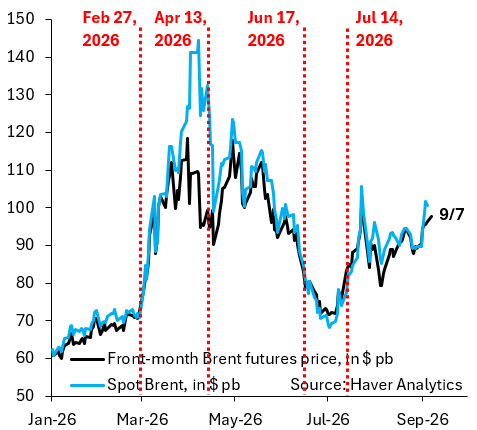 The black line in the chart above represents the near-month Brent crude oil futures price, while the blue line represents the spot price, which is the price at which crude oil is delivered immediately. The two usually move in tandem, but this was not the case during the peak of the oil price panic in March and April of this year. At that time, the market rushed to buy crude oil, pushing the spot price significantly higher than the near-month futures price. The vertical red line in the chart marks several key points: the outbreak of fighting on the night of February 27; the first implementation of the blockade on April 13; the signing of a memorandum of understanding on June 17, with the blockade lifted the following day; and finally, the re-implementation of the blockade on July 14. As time goes on, the probability of oil prices returning to the highs of earlier this year has decreased significantly, mainly for three reasons: 1. Market psychology: All the doomsday oil price predictions earlier this year were severely inaccurate, making the market skeptical of any talk of "oil prices rising." Currently, the market generally regards such claims as false hype. 2. A shift in the narrative surrounding Iran: More and more people realize that the US blockade is severely impacting Iran and may push the Iranian regime to return to the negotiating table in good faith. Compared to the beginning of the year, market expectations have shifted significantly, a factor that will suppress oil prices as it implies an increased likelihood of a long-term peace agreement. 3. Supply chains adapt to shocks through trial and error: The longer the shock lasts, the more the market learns to withstand various shocks and find alternative trade routes. As I mentioned before, during the most severe phase of this shock, South Korea shifted to large-scale imports of Canadian crude oil. Similar adjustments are occurring in various regions, and market participants are observing and learning from the responses of other players; the scale of such alternative trade will continue to expand.
 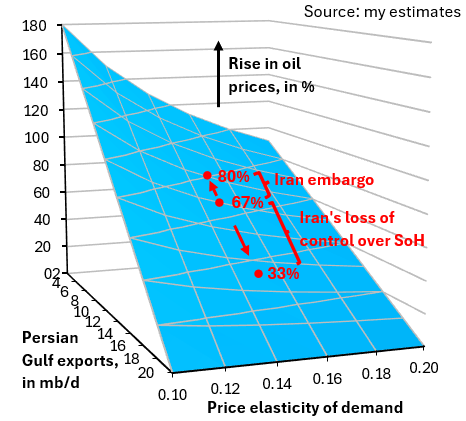 The core reason why Brent crude oil prices won't surge is that Iran's control over the Strait of Hormuz is weakening, and with the support of the US Navy, more and more crude oil is being shipped out of the Persian Gulf. The chart above continues my analysis from March. The horizontal axis, facing the reader, represents the price elasticity of demand for crude oil, with a median estimate of 0.15 from academic literature; the vertical axis represents the volume of crude oil exports from the Persian Gulf. When the strait is unobstructed, crude oil exports are 20 million barrels per day. My hypothetical scenario in March was 10 million barrels per day, corresponding to a 67% increase in Brent crude oil prices; if a blockade of Iran is added, the increase could reach 80%. My current optimal estimate for Persian Gulf crude oil exports is 15 million barrels per day. Compared to the pre-war benchmark oil price of $70, this only supports a 33% increase, meaning that Brent crude oil around $95 is a reasonable price, reflecting Iran's gradually weakening control over the strait. The peak of $125 that I previously predicted (corresponding to an 80% increase) will not reappear; that phase has passed.
Although the conflict shows no signs of ending in the short term, those who loudly proclaimed in March and April that oil prices would soar to $200 have now disappeared. However, the fact that a previous oil price surge did not materialize does not mean it is impossible now. This article will explain that the likelihood of another surge in oil prices has been steadily decreasing over time; meanwhile, Brent crude oil remaining in the $90-$100 range has already fully priced in the ongoing supply disruption risks from the Strait of Hormuz. The black line in the chart above represents the near-month Brent crude oil futures price, while the blue line represents the spot price, which is the price at which crude oil is delivered immediately. The two usually move in tandem, but this was not the case during the peak of the oil price panic in March and April of this year. At that time, the market rushed to buy crude oil, pushing the spot price significantly higher than the near-month futures price. The vertical red line in the chart marks several key points: the outbreak of fighting on the night of February 27; the first implementation of the blockade on April 13; the signing of a memorandum of understanding on June 17, with the blockade lifted the following day; and finally, the re-implementation of the blockade on July 14. As time goes on, the probability of oil prices returning to the highs of earlier this year has decreased significantly, mainly for three reasons: 1. Market psychology: All the doomsday oil price predictions earlier this year were severely inaccurate, making the market skeptical of any talk of "oil prices rising." Currently, the market generally regards such claims as false hype. 2. A shift in the narrative surrounding Iran: More and more people realize that the US blockade is severely impacting Iran and may push the Iranian regime to return to the negotiating table in good faith. Compared to the beginning of the year, market expectations have shifted significantly, a factor that will suppress oil prices as it implies an increased likelihood of a long-term peace agreement. 3. Supply chains adapt to shocks through trial and error: The longer the shock lasts, the more the market learns to withstand various shocks and find alternative trade routes. As I mentioned before, during the most severe phase of this shock, South Korea shifted to large-scale imports of Canadian crude oil. Similar adjustments are occurring in various regions, and market participants are observing and learning from the responses of other players; the scale of such alternative trade will continue to expand. The core reason why Brent crude oil prices won't surge is that Iran's control over the Strait of Hormuz is weakening, and with the support of the US Navy, more and more crude oil is being shipped out of the Persian Gulf. The chart above continues my analysis from March. The horizontal axis, facing the reader, represents the price elasticity of demand for crude oil, with a median estimate of 0.15 from academic literature; the vertical axis represents the volume of crude oil exports from the Persian Gulf. When the strait is unobstructed, crude oil exports are 20 million barrels per day. My hypothetical scenario in March was 10 million barrels per day, corresponding to a 67% increase in Brent crude oil prices; if a blockade of Iran is added, the increase could reach 80%. My current optimal estimate for Persian Gulf crude oil exports is 15 million barrels per day. Compared to the pre-war benchmark oil price of $70, this only supports a 33% increase, meaning that Brent crude oil around $95 is a reasonable price, reflecting Iran's gradually weakening control over the strait. The peak of $125 that I previously predicted (corresponding to an 80% increase) will not reappear; that phase has passed.
- Risk Warning and Disclaimer
- The market involves risk, and trading may not be suitable for all investors. This article is for reference only and does not constitute personal investment advice, nor does it take into account certain users’ specific investment objectives, financial situation, or other needs. Any investment decisions made based on this information are at your own risk.