Crude oil trading alert: Middle East supply risks continue to escalate; WTI crude oil prices have risen for three consecutive days, breaking through $94. Be wary of accelerated upward movement.
2026-09-09 09:42:05
International oil prices continued to strengthen on Wednesday, with WTI crude rising for the third consecutive trading day, briefly climbing above $94 in early Asian trading. As of the latest market quotes, WTI was around $94.33 per barrel, and Brent crude was around $99.40 per barrel. WTI has risen nearly 10% since the beginning of September. The rapid approach to the $100 mark reflects the market's continued pricing in the risk premium of further disruptions to Middle Eastern supply chains.  The direct catalyst for this round of price increases remains supply-side risks. The US has struck several oil tankers linked to Iran, one of which was located near Hag Island in the Strait of Hormuz. Hag Island is a crucial Iranian crude oil export hub, and these actions have raised market concerns about further impacts on crude oil transportation, loading, and subsequent export capabilities. Simultaneously, Iran has issued warnings regarding shipping in the Persian Gulf, significantly increasing market concerns about the safety of tanker passage. Supply risks are not limited to Iran. The Iranian-backed Houthi rebels recently launched attacks on several cities and energy facilities in southern Saudi Arabia. Saudi Arabia has confirmed that some energy facilities have been affected, including the Jizan refinery with a daily capacity of approximately 400,000 barrels . Attacks on energy facilities mean that the market needs to consider not only crude oil exports but also reassess the refining capacity and the stability of refined product supply in the Middle East. This is changing the logic behind rising oil prices. Previously, the market primarily traded on the potential disruption risk in the Strait of Hormuz, but now the focus has gradually expanded to the entire supply chain: crude oil production—export—shipping—refining . If the conflict continues to escalate, even if major oil-producing countries can maintain some production, the obstruction of tanker passage could lead to regional supply mismatches, further widening the premium in the spot market. The Strait of Hormuz is particularly noteworthy. The number of commodity ships passing through this waterway has decreased significantly recently; market data shows that only seven commodity ships passed through this strategic waterway on Monday, compared to eight the previous day. This decline in shipping activity indicates that market participants are increasing their risk aversion. Meanwhile, some Gulf oil-producing countries are using the Red Sea, Egypt, and other alternative routes to maintain exports, so a full-blown global crude oil supply disruption has not yet occurred. This is why, despite the rapid rise in oil prices, Brent crude has not yet stabilized above $100. The market is not completely without supply; rather, it is buffering the impact through alternative shipping routes, increased production from other oil-producing countries, and inventory adjustments. Recent market analysis shows that there is still a certain amount of crude oil transportation activity in the Strait of Hormuz, and Gulf oil-producing countries are actively seeking alternative export channels. Therefore, current prices reflect more the risk of future supply disruptions than a complete supply loss . New changes are also emerging on the demand side. Due to increased uncertainty surrounding Middle Eastern crude oil supplies, Asian refineries are seeking more crude oil from non-Middle Eastern sources, with increased attention focused on oil from Africa, Canada, and Latin America. Changes in the purchasing demand of major Asian countries are also beginning to impact the global spot market, widening price spreads between crude oils from different regions. Meanwhile, the large inventories previously accumulated by major Asian countries provide a buffer for the market, but if Middle Eastern supplies are constrained for an extended period, inventory depletion could accelerate. From a global supply and demand perspective, the market currently still has some buffer space. Increased supply from non-OPEC oil-producing countries such as the United States, Canada, and Guyana helps offset some of the losses from Middle Eastern exports; at the same time, major Asian countries possess substantial crude oil reserves, which can reduce their dependence on the spot market in the short term. Therefore, whether oil prices can truly stabilize above $100 depends not only on whether the conflict continues, but also on whether the actual traffic volume in the Strait of Hormuz can continue to decline, and whether the reduction in Middle Eastern exports can exceed the global capacity for alternative supplies . However, the refined oil market has already released more tense signals. Following attacks on Middle Eastern energy facilities, the supply risks of refined oil products such as diesel have increased, and spot market premiums have widened significantly. Compared to the simple rise in crude oil futures, the abnormal performance of refined product prices is more noteworthy, as it indicates that supply shortages are gradually transmitting from the financial markets to the real market. If this trend continues, energy costs could further push up global inflation and force major central banks to reassess their interest rate cuts or hikes. Currently, there is a clear divergence in the market regarding the future of oil prices. On the one hand, the longer the conflict lasts, the higher the shipping insurance, detour costs, and inventory depletion will be, making it more difficult for the geopolitical risk premium in oil prices to dissipate quickly. On the other hand, high oil prices will also stimulate increased supply in regions such as the United States, Canada, and Guyana, gradually weakening the upward momentum by suppressing demand. Therefore, WTI remains bullish in the short term, but the $95-$100 area will become an important psychological and technical battleground for both bulls and bears . From the daily chart, WTI has broken through several previous highs and is now above $93, maintaining a clear bullish overall trend. The first support level is currently in the $92.00-$92.30 area, which is both a recent breakout point and a zone that short-term bulls need to hold. Further downside support is the $90 psychological level; if oil prices fall back to this area and find support, the medium-term uptrend structure remains intact. On the upside, the first resistance level is $95 ; a decisive break above this level would lead to a test of the $97.50-$98 area, followed by a challenge of the $100 psychological level. If oil prices can effectively hold above $100, it could open up space towards $105 or even higher. Looking at the 4-hour chart, WTI is currently in a clear upward trend with consolidation, prices moving along short-term moving averages with relatively limited pullbacks, indicating that buyers still hold the short-term initiative. However, with the continuous price increase, short-term profit-taking has begun to accumulate. If WTI crude oil breaks through $95 and holds above that level, the short-term trend will strengthen further, with $97.50-$98 potentially becoming the next target. Conversely, if the upward momentum fails and the price falls below $92, it indicates weakening short-term momentum, and the price may retrace to around $90. Given the current market's high dependence on geopolitical events, any news regarding shipping in the Strait of Hormuz, energy facilities, or ceasefire negotiations could lead to a rapid breakout or reversal on the 4-hour chart.
 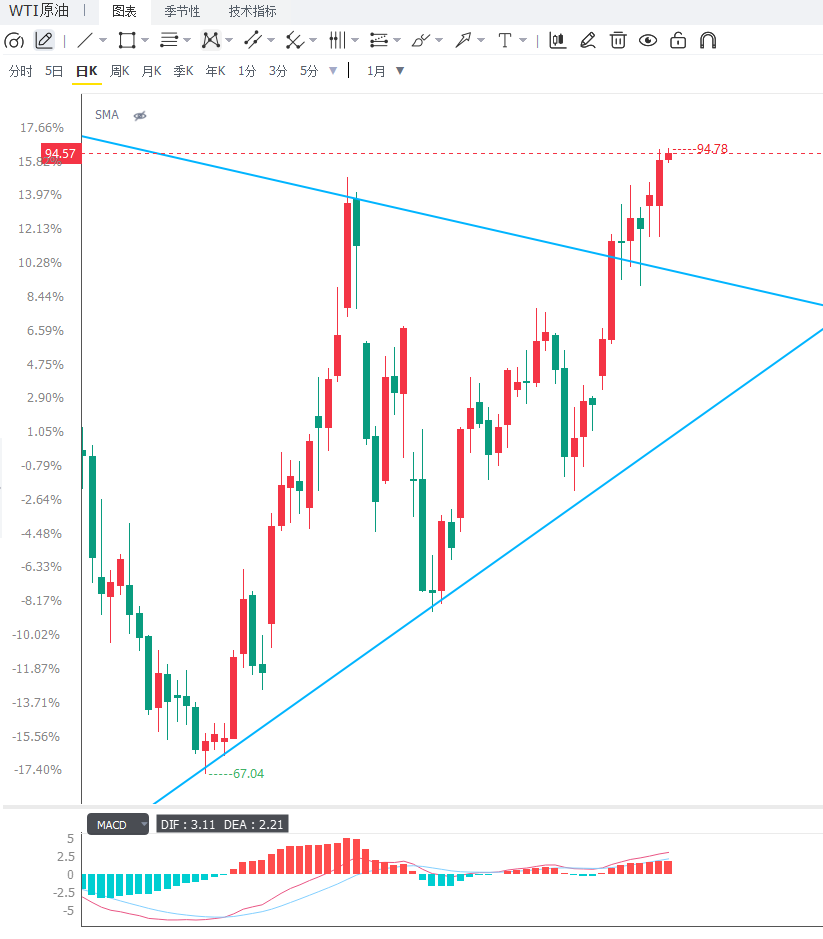 Editor's Summary: The current WTI price surge has evolved from a simple geopolitical risk trade to a reassessment of global supply chain risks. Tanker attacks, damage to energy facilities, and a decline in shipping activity in the Strait of Hormuz have collectively driven the continued expansion of the crude oil risk premium. In the short term, $95 is a crucial level for WTI to further challenge $100, while $92 is a key support level for determining the continuation of the bullish structure. If Gulf shipping continues to be disrupted, oil prices may break through $100; however, if shipping gradually recovers, alternative supplies increase, or the market shows signs of easing, the current accumulated risk premium may be quickly reversed. Investors should focus on monitoring actual traffic volume in the Strait of Hormuz, changes in Middle Eastern exports, refined product inventories, and supply growth from non-Middle Eastern oil-producing countries.
The direct catalyst for this round of price increases remains supply-side risks. The US has struck several oil tankers linked to Iran, one of which was located near Hag Island in the Strait of Hormuz. Hag Island is a crucial Iranian crude oil export hub, and these actions have raised market concerns about further impacts on crude oil transportation, loading, and subsequent export capabilities. Simultaneously, Iran has issued warnings regarding shipping in the Persian Gulf, significantly increasing market concerns about the safety of tanker passage. Supply risks are not limited to Iran. The Iranian-backed Houthi rebels recently launched attacks on several cities and energy facilities in southern Saudi Arabia. Saudi Arabia has confirmed that some energy facilities have been affected, including the Jizan refinery with a daily capacity of approximately 400,000 barrels . Attacks on energy facilities mean that the market needs to consider not only crude oil exports but also reassess the refining capacity and the stability of refined product supply in the Middle East. This is changing the logic behind rising oil prices. Previously, the market primarily traded on the potential disruption risk in the Strait of Hormuz, but now the focus has gradually expanded to the entire supply chain: crude oil production—export—shipping—refining . If the conflict continues to escalate, even if major oil-producing countries can maintain some production, the obstruction of tanker passage could lead to regional supply mismatches, further widening the premium in the spot market. The Strait of Hormuz is particularly noteworthy. The number of commodity ships passing through this waterway has decreased significantly recently; market data shows that only seven commodity ships passed through this strategic waterway on Monday, compared to eight the previous day. This decline in shipping activity indicates that market participants are increasing their risk aversion. Meanwhile, some Gulf oil-producing countries are using the Red Sea, Egypt, and other alternative routes to maintain exports, so a full-blown global crude oil supply disruption has not yet occurred. This is why, despite the rapid rise in oil prices, Brent crude has not yet stabilized above $100. The market is not completely without supply; rather, it is buffering the impact through alternative shipping routes, increased production from other oil-producing countries, and inventory adjustments. Recent market analysis shows that there is still a certain amount of crude oil transportation activity in the Strait of Hormuz, and Gulf oil-producing countries are actively seeking alternative export channels. Therefore, current prices reflect more the risk of future supply disruptions than a complete supply loss . New changes are also emerging on the demand side. Due to increased uncertainty surrounding Middle Eastern crude oil supplies, Asian refineries are seeking more crude oil from non-Middle Eastern sources, with increased attention focused on oil from Africa, Canada, and Latin America. Changes in the purchasing demand of major Asian countries are also beginning to impact the global spot market, widening price spreads between crude oils from different regions. Meanwhile, the large inventories previously accumulated by major Asian countries provide a buffer for the market, but if Middle Eastern supplies are constrained for an extended period, inventory depletion could accelerate. From a global supply and demand perspective, the market currently still has some buffer space. Increased supply from non-OPEC oil-producing countries such as the United States, Canada, and Guyana helps offset some of the losses from Middle Eastern exports; at the same time, major Asian countries possess substantial crude oil reserves, which can reduce their dependence on the spot market in the short term. Therefore, whether oil prices can truly stabilize above $100 depends not only on whether the conflict continues, but also on whether the actual traffic volume in the Strait of Hormuz can continue to decline, and whether the reduction in Middle Eastern exports can exceed the global capacity for alternative supplies . However, the refined oil market has already released more tense signals. Following attacks on Middle Eastern energy facilities, the supply risks of refined oil products such as diesel have increased, and spot market premiums have widened significantly. Compared to the simple rise in crude oil futures, the abnormal performance of refined product prices is more noteworthy, as it indicates that supply shortages are gradually transmitting from the financial markets to the real market. If this trend continues, energy costs could further push up global inflation and force major central banks to reassess their interest rate cuts or hikes. Currently, there is a clear divergence in the market regarding the future of oil prices. On the one hand, the longer the conflict lasts, the higher the shipping insurance, detour costs, and inventory depletion will be, making it more difficult for the geopolitical risk premium in oil prices to dissipate quickly. On the other hand, high oil prices will also stimulate increased supply in regions such as the United States, Canada, and Guyana, gradually weakening the upward momentum by suppressing demand. Therefore, WTI remains bullish in the short term, but the $95-$100 area will become an important psychological and technical battleground for both bulls and bears . From the daily chart, WTI has broken through several previous highs and is now above $93, maintaining a clear bullish overall trend. The first support level is currently in the $92.00-$92.30 area, which is both a recent breakout point and a zone that short-term bulls need to hold. Further downside support is the $90 psychological level; if oil prices fall back to this area and find support, the medium-term uptrend structure remains intact. On the upside, the first resistance level is $95 ; a decisive break above this level would lead to a test of the $97.50-$98 area, followed by a challenge of the $100 psychological level. If oil prices can effectively hold above $100, it could open up space towards $105 or even higher. Looking at the 4-hour chart, WTI is currently in a clear upward trend with consolidation, prices moving along short-term moving averages with relatively limited pullbacks, indicating that buyers still hold the short-term initiative. However, with the continuous price increase, short-term profit-taking has begun to accumulate. If WTI crude oil breaks through $95 and holds above that level, the short-term trend will strengthen further, with $97.50-$98 potentially becoming the next target. Conversely, if the upward momentum fails and the price falls below $92, it indicates weakening short-term momentum, and the price may retrace to around $90. Given the current market's high dependence on geopolitical events, any news regarding shipping in the Strait of Hormuz, energy facilities, or ceasefire negotiations could lead to a rapid breakout or reversal on the 4-hour chart. Editor's Summary: The current WTI price surge has evolved from a simple geopolitical risk trade to a reassessment of global supply chain risks. Tanker attacks, damage to energy facilities, and a decline in shipping activity in the Strait of Hormuz have collectively driven the continued expansion of the crude oil risk premium. In the short term, $95 is a crucial level for WTI to further challenge $100, while $92 is a key support level for determining the continuation of the bullish structure. If Gulf shipping continues to be disrupted, oil prices may break through $100; however, if shipping gradually recovers, alternative supplies increase, or the market shows signs of easing, the current accumulated risk premium may be quickly reversed. Investors should focus on monitoring actual traffic volume in the Strait of Hormuz, changes in Middle Eastern exports, refined product inventories, and supply growth from non-Middle Eastern oil-producing countries.
- Risk Warning and Disclaimer
- The market involves risk, and trading may not be suitable for all investors. This article is for reference only and does not constitute personal investment advice, nor does it take into account certain users’ specific investment objectives, financial situation, or other needs. Any investment decisions made based on this information are at your own risk.