Energy inflation is forcing the European Central Bank to raise interest rates to 2.5%, but will the "buy the rumor, sell the fact" scenario repeat itself?
2026-09-09 10:18:08
On Wednesday (September 9) during Asian trading hours, the euro fluctuated slightly higher against the US dollar, currently trading around 1.1630, continuing its narrow upward trend since the beginning of the week. Market expectations of a 25 basis point rate hike by the European Central Bank on Thursday provided a bottom support for the euro, but upward momentum remains constrained by cautious sentiment ahead of the release of key US inflation data on Friday. 
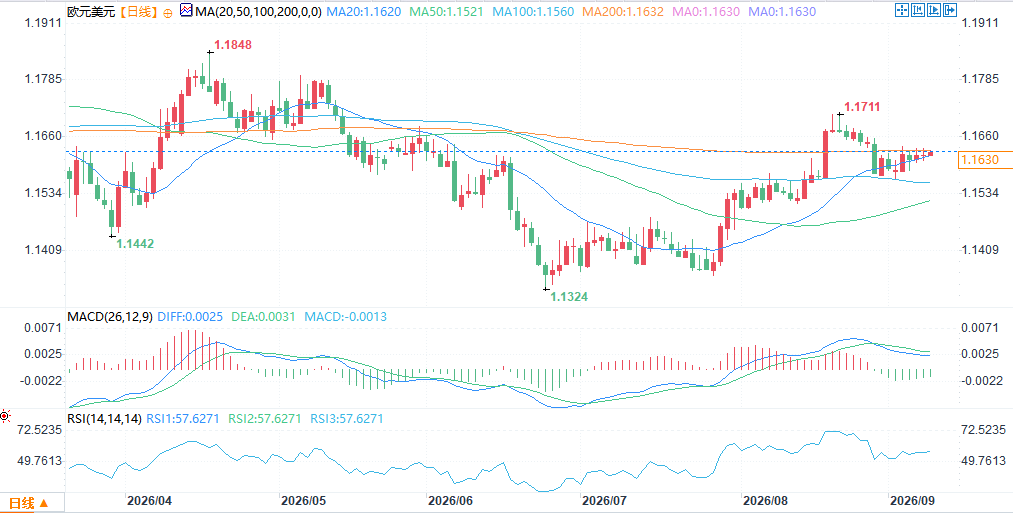 (Euro/USD daily chart, source: FX678) At 10:17 Beijing time, the euro was trading at 1.1629/30 against the US dollar.
The market has fully priced in the ECB's rate hike expectations; now it is focused on signals of a "hawkish rate cut."
The European Central Bank's (ECB) September policy meeting on Thursday is widely seen by the market as a "sure thing" window for an interest rate hike. Driven by the ongoing US-Iran conflict pushing up energy prices, the Eurozone's inflation rate rebounded to over 3% in August, providing data support for the central bank to continue tightening monetary policy. The swap market has fully priced in a 25 basis point rate hike, at which point the deposit rate will rise to 2.5%. A prominent global macro head noted, "We expect the ECB to raise rates by 25 basis points—this is an insurance rate hike, or to put it more bluntly: a dovish rate hike." This assessment accurately summarizes the current market consensus on ECB policy—the rate hike itself has been fully priced in; the real variable affecting the market lies in how ECB President Lagarde describes the future policy path. If the central bank hints that this is the last rate hike in this tightening cycle, the euro may face downward pressure due to "buy the rumor, sell the fact"; conversely, if it signals that inflation remains sticky and there is still room for further rate hikes, the euro is expected to gain further upward momentum.US inflation data is the biggest variable this week, and the dollar's trajectory awaits direction.
In stark contrast to the European Central Bank's almost certain interest rate hike path, the outlook for the Federal Reserve's September 14-15 policy meeting remains fraught with uncertainty. The market currently lacks consensus on whether the Fed will continue tightening, maintain the status quo, or signal easing. Therefore, the US Producer Price Index (PPI) and Consumer Price Index (CPI) inflation data to be released later this week will be crucial for reassessing the policy path. If the inflation data is higher than expected, it will strengthen market bets on the Fed maintaining a tight stance or even raising rates again, potentially providing significant support for the dollar and further pressuring the euro against the dollar. Conversely, if the inflation data shows a moderate decline and a cooling trend, it may solidify market expectations that the Fed will stop raising rates this year or even reverse course, thus opening up further upside potential for the euro. Traders generally believe that the timing of these two data releases, precisely before the policy meeting, could cause rapid fluctuations in the dollar index and major currency pairs, regardless of whether they exceed or fall short of expectations. In the short term, the dollar's performance will be highly dependent on data results. Market focus has shifted from simple interest rate expectations to the correlation between inflation stickiness and employment data. Any figure that deviates from the consensus may change the pricing logic of the September meeting.Institutional Views
In its latest monthly foreign exchange outlook, MUFG projected the euro/dollar exchange rate to reach 1.1500 by the end of Q3 2026, 1.1800 by the end of Q4 2026, and then 1.2000 in both Q1 and Q2 2027. The bank believes the dollar may remain relatively strong in the short term due to pricing in Federal Reserve policy, but over time, narrowing interest rate differentials and improved European economic growth will drive the euro to gradually strengthen. Regarding the European Central Bank (ECB), the market has almost fully priced in a September rate hike and has about an 80% probability of another hike this year. MUFG's baseline forecast is one rate hike, while seeing an increased risk of further action. Political uncertainty (including German state elections and the 2027 French presidential election) will remain a significant variable for Europe. Scotiabank strategists noted that the euro/dollar exchange rate has stabilized near a low of 1.16, with market focus on the ECB's policy meeting this Thursday. The market widely expects the ECB to raise rates by 25 basis points and maintain a relatively hawkish stance to address the inflationary risks and potential contagion pressures from rising energy prices. The outlook for central bank policy remains supportive of the euro, with the fair value of the 2-year German-American interest rate differential estimated at around 1.1650.Summarize
The euro is currently trending higher against the dollar around 1.1630, with expectations of a European Central Bank (ECB) rate hike providing support, but uncertainty surrounding US inflation data and post-ECB guidance is limiting upside. The market is in a "quiet period before policy confirmation," and Thursday's ECB decision will provide short-term direction for the euro—a dovish rate hike could lead to a pullback, while a hawkish signal could push the euro out of its current range. It is recommended to monitor the upper and lower limits of the 1.1585-1.1670 range for potential breakouts to determine the next trend direction. (Euro/USD daily chart, source: FX678) At 10:17 Beijing time, the euro was trading at 1.1629/30 against the US dollar.
- Risk Warning and Disclaimer
- The market involves risk, and trading may not be suitable for all investors. This article is for reference only and does not constitute personal investment advice, nor does it take into account certain users’ specific investment objectives, financial situation, or other needs. Any investment decisions made based on this information are at your own risk.