Institutions: Gold prices are just taking a breather; they predict a potential move to $4,900 this year.
2026-09-09 10:58:06
Since February of this year, the pace of gold's rise has slowed significantly, leading many market investors to worry whether the current bull market in precious metals has come to an end. Anthony Kim, Global Head of Metals Trading at Goldman Sachs, offers a completely different perspective, believing that the current weakness in gold prices is merely a temporary pause in the bull market, not the end of the rally, and that gold prices still have the potential to reach new historical highs in the medium term . Meanwhile, Goldman Sachs' research team also released a report predicting a gold price target of $4,900 per ounce for the year, while also highlighting the volatility risks associated with gold derivatives. Market attention is focused on the August US CPI data, which will be the most important inflation reference indicator before the September Federal Reserve interest rate meeting and will be released at 20:30 Beijing time on Friday, September 11th.
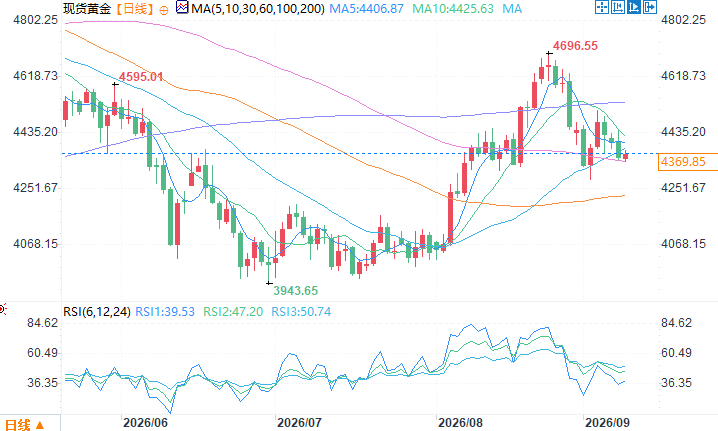 Spot gold daily chart source: EasyTrade. At 10:57 AM Beijing time on September 9th, spot gold was trading at $4382.69 per ounce.
Gold prices have been consolidating for seven months, with two major variables suppressing upward movement.
When asked whether the near-record high of $5,600 per ounce at the end of January this year signified the peak of the current gold cycle, Anthony King stated that from Goldman Sachs' perspective, this is not the end of the bull market, but merely a prolonged period of consolidation. He attributed this consolidation, lasting over seven months, to two core factors. The first was the nomination and eventual confirmation of Kevin Warsh as the new Federal Reserve Chairman. King explained that the market is constantly testing the new Fed Chairman's policy response framework and inclinations, coupled with the continued repercussions of statements from the Trump administration, requiring time for the market to digest potential policy changes. The second factor is the conflict in Iran, which has disrupted the energy market and altered the circulation path of global central bank reserve funds. King explained that previously, some reserve funds flowed into the precious metals market, but this flow has now been significantly disrupted, with Goldman Sachs' business channels observing a substantial contraction in large trading positions. However, he added that the flow of funds from central banks continuously increasing their gold holdings remains stable, which is the core foundation supporting gold prices. In summary, the current situation is merely a period of consolidation, and the bull market trend will eventually resume, with gold prices expected to reach new highs.The logic behind US Treasury yields is changing, and fiscal issues are reshaping the gold pricing framework.
The market continues to discuss opportunity cost, with many investors worried that high US Treasury yields will continue to suppress gold price increases. Jin stated that the continuous depreciation of fiat currencies relative to gold has been a long-term trend for several years. If fiscal sustainability becomes the core driver of gold asset allocation, the traditional correlation between US Treasury yields and gold will be broken. In other words, while the market worries about fiscal issues pushing up long-term US Treasury yields, funds will instead choose to allocate to gold as a safe haven. In the short term, the correlation between interest rates and gold still holds, but the long-term pricing logic is changing. Recent US government policy interventions are a major driving force behind this narrative shift. Jin cited examples such as the USD/JPY exchange rate intervention and the US Treasury's increased repurchase of long-term US Treasury bonds, both of which alter the bond market's operating pattern. Whenever the government intervenes in the market, funds often choose to buy gold for hedging. Entering the summer, following the July FOMC meeting, a series of policy interventions, and the Jackson Hole symposium, Goldman Sachs clients remain highly active in trading. Many clients are deploying convexity hedging strategies and dynamically adjusting their positions based on economic data. Jin emphasized that the key focus going forward is on the August CPI data, which will directly determine the direction of the Fed's interest rate decision in September. The way the market interprets the inflation data will determine the short-term direction of gold prices.Goldman Sachs sets year-end target price; central bank gold purchases provide a floor; derivatives amplify volatility.
A report released on September 2nd by Goldman Sachs research team Lina Thomas and Daan Struyven predicts that gold prices will continue to rise in the second half of 2026, potentially reaching $4,900 per ounce by the end of the year. Diversified central bank gold purchases are a key support, and the market's downward revision of expectations for a Fed rate hike in 2026 will also reduce headwinds for gold prices. The report shows that central bank gold purchases have been a long-standing trend, used to hedge against geopolitical and financial risks. Goldman Sachs estimates that global central banks will buy an average of 50 tons of gold per month in 2026, far exceeding the 17 tons per month level before 2022. After seasonal adjustment, central bank gold purchases will increase to 100 tons per month in June 2026, with major Asian central banks being the largest confirmed buyers that month. Meanwhile, demand for gold call options continues to rise, with investors using derivatives to hedge policy risks, which will amplify the two-way volatility of gold prices. As gold prices rise and approach the option strike price, traders who have sold call options need to buy gold to hedge their short positions, further pushing up prices. Conversely, if prices fall, traders sell their gold holdings, exacerbating the decline. The target price of $4,900 does not yet factor in the upside potential from this type of hedging, meaning there is still room for further upside, but price volatility will be significantly amplified.Conclusion
Goldman Sachs believes that the current gold price movement is a mid-bull market consolidation rather than a trend reversal. Policy expectations surrounding the new Fed Chair and disruptions to capital flows due to the Iranian conflict are key factors suppressing gold prices in the short term, while continued global central bank gold purchases and fiscal pressures on various countries provide medium- to long-term support. Goldman Sachs is bullish on gold prices reaching $4,900 by the end of the year, with the $4,000 level considered a strong support level, making it suitable for gradually building long positions during market fluctuations. Investors should be aware that gold options and derivatives amplify market volatility, and the risks associated with both long and short positions should not be ignored when trading in this market. Spot gold daily chart source: EasyTrade. At 10:57 AM Beijing time on September 9th, spot gold was trading at $4382.69 per ounce.
- Risk Warning and Disclaimer
- The market involves risk, and trading may not be suitable for all investors. This article is for reference only and does not constitute personal investment advice, nor does it take into account certain users’ specific investment objectives, financial situation, or other needs. Any investment decisions made based on this information are at your own risk.