With unresolved internal problems in the US, gold may well be a winner regardless of interest rate hikes or not.
2026-09-09 17:46:06
On Wednesday (September 9th) during the Asian and European sessions, international oil prices rose again due to geopolitical issues, while gold prices unusually rebounded earlier than expected, currently trading around 4401, up 1%. The recent escalation of the US-Iran geopolitical conflict has fueled rising oil prices and inflation expectations, which in turn has fueled concerns about a potential Fed rate hike, continuously suppressing gold prices. With the Fed's interest rate meeting approaching on September 16, 2026, significant policy divergence exists in the market. The US-Iran geopolitical conflict, pushing up oil prices and inflation, coupled with strong US non-farm payrolls, provides support for a rate hike; however, pressure from the White House to cut rates, concerns about bond market risks, and divergent institutional opinions significantly limit the Fed's room for further rate hikes. This decision represents a multi-faceted interplay of economic fundamentals, geopolitical inflation, administrative intervention, and financial stability. 
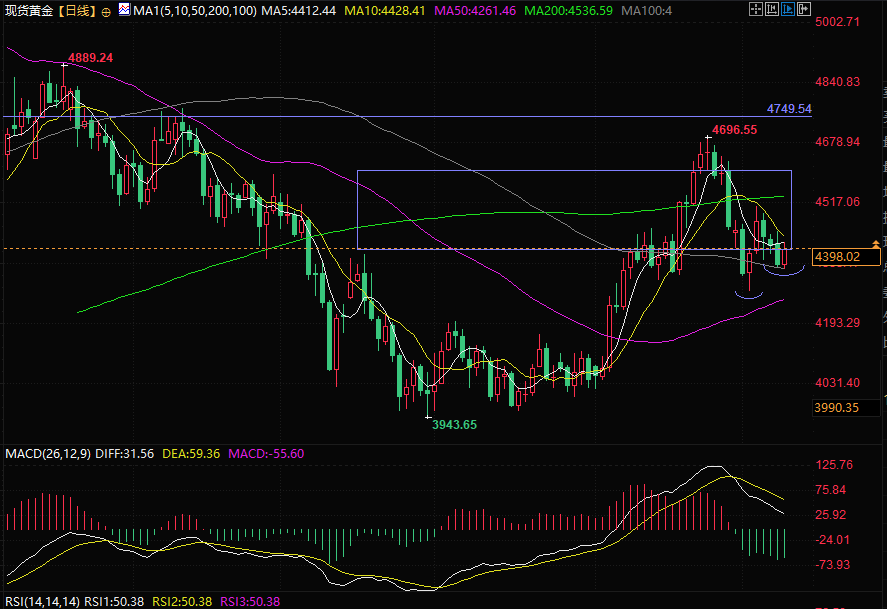 (Spot gold daily chart, source: FX678) At 17:42 Beijing time, spot gold is currently trading at $4395.7 per ounce.
Key support for interest rate hikes: Strong employment coupled with rising geopolitical inflation.
The most crucial and recent catalyst for this round of interest rate hikes stems from the escalating geopolitical conflict between the US and Iran, coupled with high oil price inflation—significant real-time variables that have been brewing recently. On September 8, the US military proactively destroyed five Iranian oil tankers, and on September 9, Iran launched a large-scale retaliation, severely damaging US warships, US-related oil tankers, and several vessels that had crossed the Strait of Hormuz, significantly expanding the high-risk shipping zone in the Gulf. The ongoing maritime confrontation has caused the geopolitical premium for oil to surge, with Brent crude approaching $100, a recent high, directly pushing up imported inflation in the US and creating short-term inflation rigidity. This is the most critical immediate risk variable for this interest rate meeting. Oil prices are currently strongly supported by geopolitical conflict, but are suppressed by global demand and high interest rates, exhibiting an overall pattern of high-level fluctuations and limited upward potential. From a fundamental perspective, the exceptionally strong US non-farm payrolls provide underlying support for the interest rate hike. August's non-farm payrolls increased by 162,000, with July's data revised upwards by 21,000, significantly exceeding the long-term average, while the unemployment rate remained stable at 4.1%. Strong employment data demonstrates the resilience of the US economy and its ability to withstand the impact of interest rate hikes, providing a fundamental safety net for the Federal Reserve to tighten its policies.Key constraints to postponing interest rate hikes: administrative pressure, bond market risks, and institutional disagreements.
First, senior Trump administration officials collectively pressured the Federal Reserve to halt interest rate hikes or even cut rates in September. Treasury Secretary Bessant clarified that the current inflation is due to rising oil prices caused by geopolitical conflicts, constituting a supply shock. Following past Fed practices, he suggested a temporary halt to rate hikes to observe the secondary transmission effect of inflation. Second, there are clear risk warnings in the bond market. "Bond King" Jeffrey Gundlach recently warned that if the Fed holds rates steady next week, contrary to market expectations, it will push US long-term Treasury yields further up, exacerbating a historic sell-off in the bond market. Therefore, he is currently avoiding long-term US Treasuries, favoring short-duration fixed-income assets, local currency-denominated emerging market bonds, and real assets. Furthermore, market institutions hold significantly divergent views. Morgan Stanley argues that current PCE inflation shows no signs of sustained overheating, and supply-side inflation is not sustainable, so there is no need to rush into rate hikes. Fed Governor Waller also lowered the probability of a September rate hike to 50/50, indicating a more cautious policy stance and further suppressing the possibility of short-term rate hikes.Decision benchmark prediction: The Fed's final choice may not be that important.
In summary, whether the Federal Reserve will raise interest rates still depends on Friday's CPI data, meaning the outcome remains uncertain until the very last moment. However, whether or not interest rates are raised is merely an outcome; the problems facing the US remain the same: imported inflation due to high oil prices, high financing costs for the government and businesses due to the sell-off of US Treasury bonds, the excessive spending on AI drawing funds away from other industries, and the need to prevent a stock market crash before the election. Therefore, we believe that even if interest rates are raised, it will not be the opening of a new rate hike window but rather a preventative measure, and ultimately will not cause significant shocks to dollar-denominated commodities such as US stocks and precious metals.Summary and Technical Analysis:
For gold, a rate hike would maintain the Fed's independence and thus benefit the 10-year Treasury yield in the medium to long term, potentially leading to a short-term dip in gold prices, creating a "golden pit" pattern. Conversely, if interest rates remain unchanged, gold prices would rebound. The Fed's independence has disappointed many, and the market continues to trade on the logic of a declining dollar. Gold's future movement will then depend on oil prices, the Fed's explanations, and subsequent data. Technically, gold prices have been consolidating near the lower edge of their trading range, forming a double bottom pattern on the daily chart. We should observe whether this can be supported by fundamental factors to trigger a rebound. Support is around today's low of 4341, while resistance is around 4450. (Spot gold daily chart, source: FX678) At 17:42 Beijing time, spot gold is currently trading at $4395.7 per ounce.
- Risk Warning and Disclaimer
- The market involves risk, and trading may not be suitable for all investors. This article is for reference only and does not constitute personal investment advice, nor does it take into account certain users’ specific investment objectives, financial situation, or other needs. Any investment decisions made based on this information are at your own risk.