Bessant publicly challenges short sellers: Asymmetric information is rewriting the yen's pricing power.
2026-09-09 19:00:07
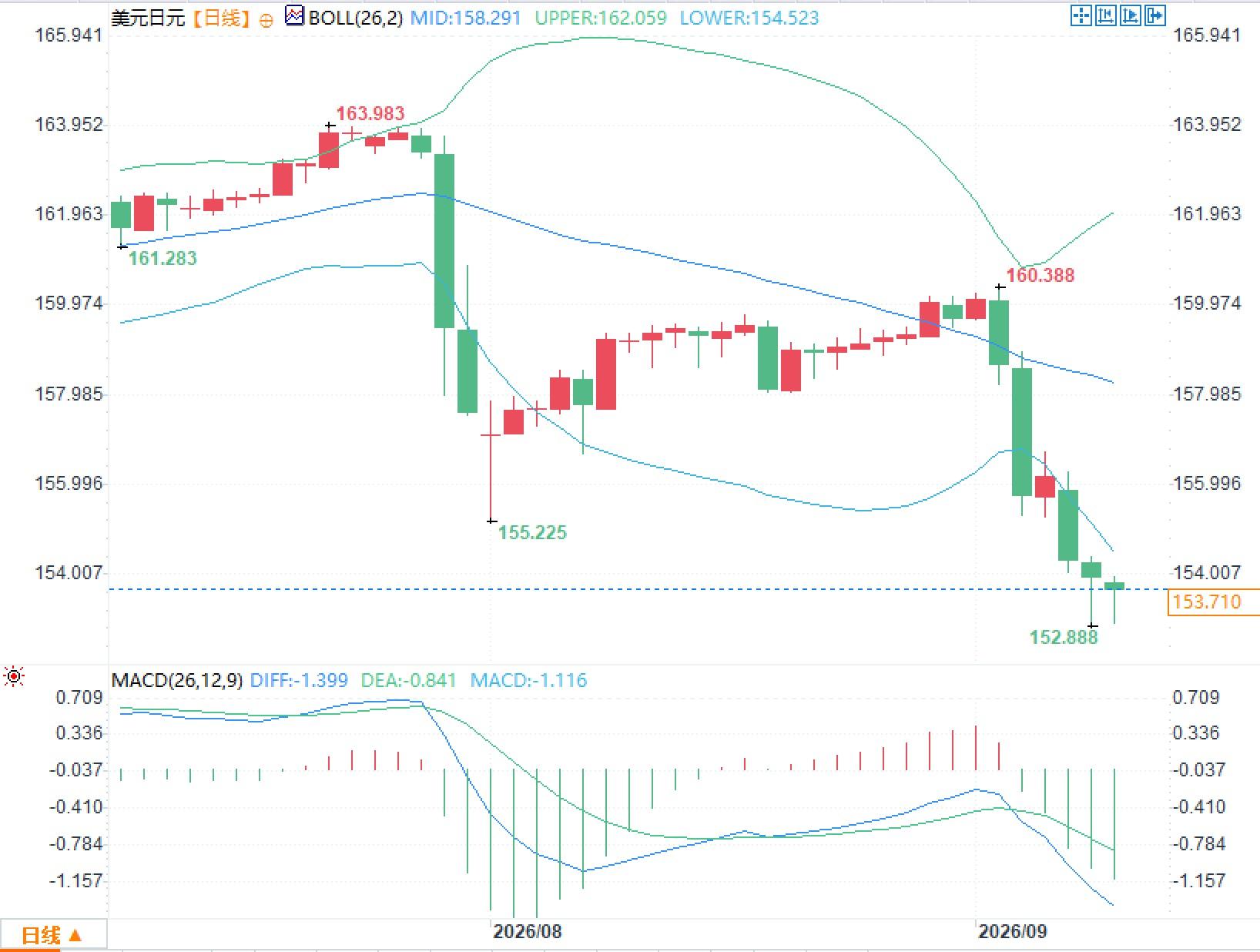
On Wednesday, September 9th, the USD/JPY pair was fluctuating around 153.5, with the yen in a relatively strong range for the past seven months. Following a joint US-Japan purchase of yen on July 31st, the exchange rate has retreated from its highs, and the yen has appreciated by approximately 4% against the dollar since September. 
 Whether public pension funds are repatriating overseas assets is another frequently traded but officially unconfirmed clue. This repatriation would alter the foreign exchange supply and the demand structure for Japanese ultra-long-term government bonds. Without formal guidance, it remains a scenario, not a policy.
Bessant's "bookmaker theory" elevates intervention from tactics to information structure.
U.S. Treasury Secretary Scott Bessant said at an event at Southern Methodist University in Texas on the 8th, local time: "When we intervened in the yen, I had a fairly clear understanding of what the Bank of Japan and Japanese policymakers would do next. I had asymmetric information. Now I'm the house. Go ahead and mess with me." He directly referred to the Treasury Secretary's informational advantage as market structure, which is uncommon in public speeches by finance officials of major economies in recent years. Bessant also explained his motivation: "Whenever someone says the Treasury Secretary is taking risks, that's actually my ideal situation; I have asymmetric information." There are two layers of meaning in his words. The first is the operational level: On July 31, the U.S. Treasury bought yen for the first time in 30 years and used euro assets in the exchange rate stabilization fund to buy yen, without fully informing the European Central Bank beforehand. The second is the coordination level: He implied that the intervention was not a one-off impulse, but was tied to the rhythm of Japanese domestic policy. Lee Hardman, senior foreign exchange analyst at Mitsubishi UFJ Bank, assessed that such statements would strengthen market expectations that Japan would adjust its domestic policy to provide follow-up support for coordinated intervention. This statement needs to be transformed from a slogan into a constraint. The premise for a market maker's advantage is that the opposing side interprets the yen's weakness primarily as speculative short selling, rather than as a result of interest rate differentials, energy costs, and cross-border capital allocation. If fundamentals don't keep pace with verbal threats, asymmetric information will quickly become obsolete. At the G20 finance ministers' meeting in late August, Bessant stated that he believed the Japanese government and the Bank of Japan would take actions conducive to a stronger yen, and that the market was already pricing in a Bank of Japan interest rate hike. Verbal intervention, coordinated buying, and policy expectations are linked together; the market needs to identify which link in the chain is most likely to loosen, rather than treating a single slogan as a pricing formula.The real constraints of joint intervention: reserve allocation and US Treasury holdings
The key to the July 31st action lay not in slogans, but in the balance sheet. The US Treasury used its existing foreign exchange assets from the Currency Stabilization Fund to buy yen, preventing Japan from massively selling US Treasury bonds to prop up its currency. In a subsequent letter responding to congressional inquiries, Bessant stated that Japan was a major holder of US Treasury bonds, and disorderly yen fluctuations could trigger forced liquidation of positions, thereby disrupting global markets and pushing up financing costs for US businesses and households. This framed the currency operation as risk management in the US Treasury market, rather than a simple bilateral monetary arrangement. Japanese authorities used a considerable amount of reserves to buy yen during the late July-August window. Intervention can alter short-term liquidity and position distribution, but it cannot rewrite interest rate differentials and inflation expectations. The joint action also included a overlooked detail: the US sold euros to buy yen, which was interpreted by the European side as resource reallocation. Bessant later stated that the euro was closer to equilibrium, intending to reduce cross-market misinterpretations. This means that if another multilateral reserve shift occurs, the impact may simultaneously appear on the euro, yen, and US Treasury bond balance sheets, rather than just on the dollar/yen axis. The post-intervention path is not linear. The initial appreciation of the yen after July 31st was reversed, only strengthening again in September. This suggests that verbal and actual buying can reduce short-selling pressure, but its sustainability depends on the path of Japanese domestic interest rates, whether public pension funds will flow back into the country, and whether US long-term interest rates continue to absorb global duration. Describing a one-off intervention as a trend reversal is inconsistent with the price path that has already occurred.Interest Rate Spreads and the Bank of Japan: Policy is still assessing the cumulative effect.
The Bank of Japan raised its policy rate to around 1.0% in June, a level not seen in about 31 years. The next monetary policy meeting is scheduled for September 17-18. Governor Kazuo Ueda stated on September 1, after the G20 finance ministers and central bank governors meeting, "We hope to continue raising interest rates because financial conditions remain relatively loose. On the other hand, we have already raised rates five times, and we need to carefully assess the cumulative impact on the economy. At the same time, policymakers will focus on upside risks to inflation." He added that with potential inflation approaching 2%, upside risks need to be given more attention than before, and the next meeting will fully discuss whether the economy and prices are moving in the baseline scenario. The yield on 10-year Japanese government bonds was around 2.89% on September 9. The yield on 10-year US Treasury bonds was around 4.81% at the same time. The interest rate differential remains, although it has narrowed somewhat from the weakest point of the yen in July. Energy prices have risen again due to the Middle East conflict and have also entered Ueda's list of price risks. The market may interpret the September meeting as a policy test, but it is not reasonable to consider a rate hike a foregone conclusion before the meeting results are announced. The recent rebound in the yen is due to both short covering and pricing in increased policy discussions; the weight of these two factors will be redistributed based on the wording of the meeting statements and press conferences. Whether public pension funds are repatriating overseas assets is another frequently traded but officially unconfirmed clue. This repatriation would alter the foreign exchange supply and the demand structure for Japanese ultra-long-term government bonds. Without formal guidance, it remains a scenario, not a policy.Treasury bond repurchase agreements apply the same logic to the US Treasury yield curve.
Bessant applied his strong stance on foreign exchange to the Treasury market. On August 19, the U.S. Treasury announced that from September 9 to November 4, the single repurchase limit for 10- to 20-year and 20- to 30-year nominal bonds would be increased from at least $2 billion to $4 billion, citing liquidity support based on a continuous stream of high-quality offers from dealers in long-term operations. Bessant further stated on the 8th that expanding repurchases was intended to cool the "fever" in the bond market, aiming to push prices back to near equilibrium, and did not believe he could rewrite the equilibrium itself. The 10-year Treasury yield is currently around 4.81%, in a relatively high range since 2023. The scale of the expanded repurchases is still limited relative to the existing Treasury bond supply, primarily altering the short-term distribution of marginal liquidity and duration supply. The most scathing criticism of this approach comes from Stanley Druckenmiller, who previously mentored Bessant. He wrote, "Governments that use funds to fight fundamentals will ultimately lose; the only difference is how much they spend before admitting defeat. This isn't liquidity management, it's price management." He added that if 30-year bonds must be cleared at higher yields, it's not a crisis, it's a bill. Both fronts share the same logic: fiscal authorities believe the market is disorderly or overheated and are prepared to use their information advantage and balance sheet to correct it. The difference lies in that foreign exchange intervention can directly change the money supply, while government bond repurchases simultaneously rewrite duration and short-term financing structures. What the market needs to observe is whether the scale of operations remains at the published lower limit, and how the source of repurchase funds affects bill issuance.- Risk Warning and Disclaimer
- The market involves risk, and trading may not be suitable for all investors. This article is for reference only and does not constitute personal investment advice, nor does it take into account certain users’ specific investment objectives, financial situation, or other needs. Any investment decisions made based on this information are at your own risk.